
Alocasia ‚Sabrina‘ Aurea Variegata - Care
Location & Light
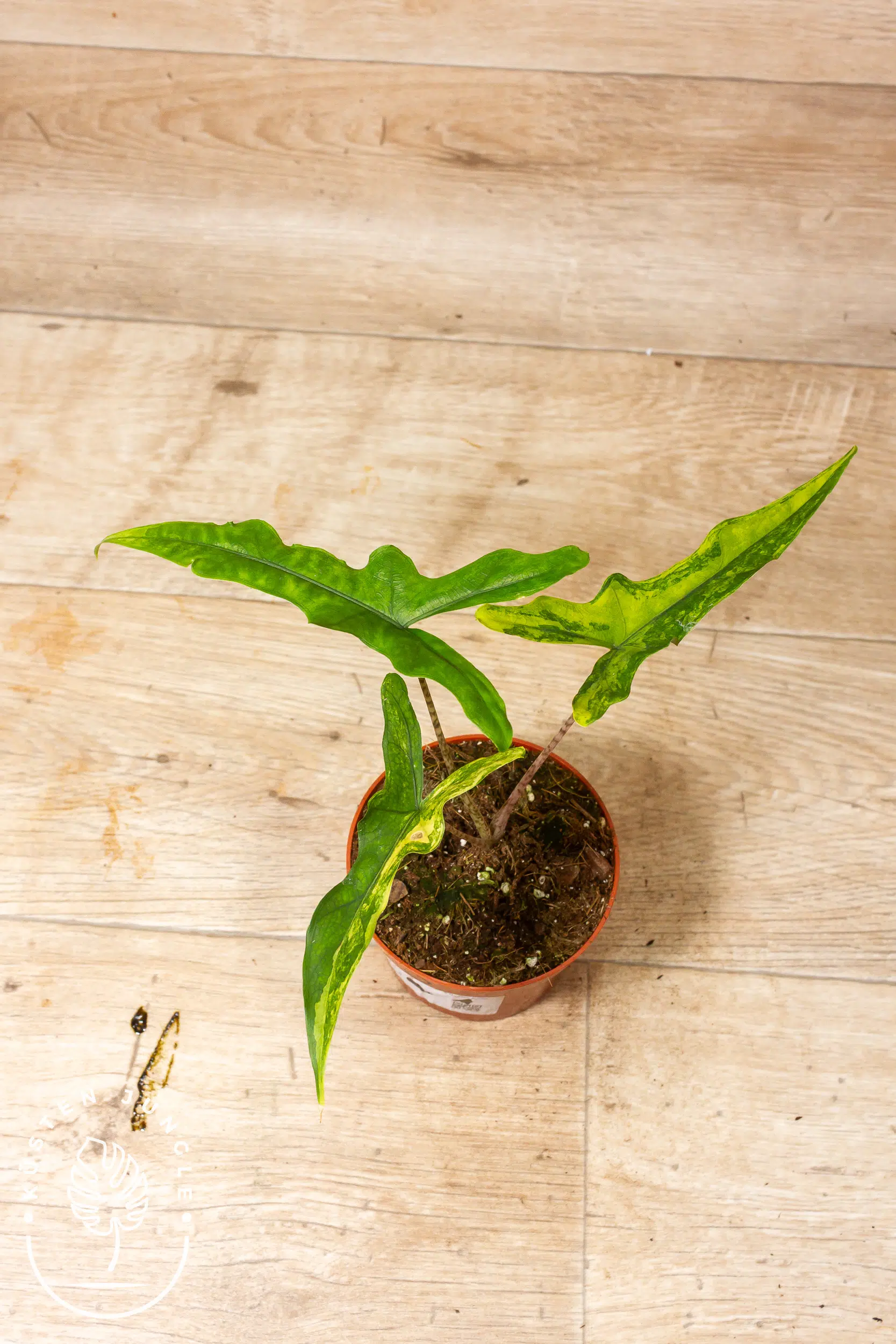
Because of its yellow variegation, Sabrina Aurea is more light-hungry than completely green alocasias, but still cannot tolerate direct midday sun on its leaves. A bright location with plenty of indirect light, for example near an east or west window without direct exposure, is ideal. If it lacks brightness, the variegated leaf areas quickly lose their luminescence and the plant forms thin, unstable stems – a clear sign to choose a brighter location.
Pour
It is best to water as soon as the top half of the substrate feels dry – the root ball should never dry out completely, not even for an extended period. At the same time, waterlogging is the biggest enemy: if the Sabrina Aurea stands in water permanently, root and rhizome rot threaten; stress often first shows in the variegated, chlorophyll-poor leaf areas through limp, dull spots. Room-temperature, low-limescale water is best tolerated. As soon as the plant enters its resting phase in autumn, significantly less water is needed than in summer.
Fertilize
Since the variegated leaf parts contain no chlorophyll and therefore perform less photosynthesis, the Sabrina Aurea grows more slowly overall than its unvariegated relatives. Nevertheless, like most Alocasias, it is a heavy feeder: during the growing season, it can tolerate fertilization with every or every second watering, but only heavily diluted (a quarter to a maximum of half the recommended amount) – due to the reduced green leaf surface, it's better to stay at the lower end of the dosage. As a rough approximation, Alocasias generally require a pH of about 5.5 to 6.5 and a rather low conductivity of 1.0 to 1.5 mS/cm, as the genus is considered salt-sensitive. For precise dosage, follow the manufacturer's instructions on the respective packaging; the plant does not tolerate over-fertilization well. Contrary to popular belief, an Alocasia does not automatically enter true dormancy at normal room temperature – this only occurs at genuinely cooler temperatures. If the Sabrina Aurea is only placed by the window in autumn and winter, the light becomes weaker and fertilization is accordingly reduced or paused; however, if it grows year-round under a sufficiently strong plant lamp, the usual rhythm can be maintained without additional shortening.
We consciously alternate between different fertilizers for our own plants – currently including COMPO COMPLETE, Foliage Focus, Liquid Gold Leaf, and Hesi TNT-Complex, supplemented with Hesi Root Complex, Hesi PowerZyme, and CalMag as needed.
Substrate
The substrate should be loose, airy, and very well-draining. A high-quality aroid mix of potting soil, pine bark, and perlite has proven effective, as it provides sufficient oxygen to the roots and prevents waterlogging. Those who wish can also cultivate Sabrina Aurea entirely in a mineral substrate like Pon, but they must pay closer attention to nutrient supply, as watering behavior differs noticeably from soil.
Humidity & Temperature
The humidity should be at least 60 %; the Sabrina Aurea thrives best at 70 to 80 %. Dry, heated air in winter—often only 30 to 45 %—is not sufficient for it in the long run; a greenhouse, display case, or plant cabinet with a humidifier are the most reliable solutions here. You should avoid regular misting, as moisture left on the leaves promotes fungal and bacterial growth; a humidifier or a tray of pebbles is the better choice. As for temperature, the ideal range is between 18 and 27 °C; it should not be exposed to temperatures consistently below 15 °C or to drafts.
Growth & Dormancy
The Sabrina Aurea grows from a tuber and usually has only a few leaves at a time – it's normal for an older leaf to die off as soon as a new one appears. Only when several leaves show problems simultaneously is a more thorough search for the cause worthwhile. In autumn and winter, the plant noticeably reduces its growth and sometimes sheds several leaves; as long as the substrate is kept sufficiently moist but not wet, this is a normal process from which it will sprout anew in the spring.
Good to know
Like all Alocasias, Sabrina Aurea also contains calcium oxalate crystals and is irritating to pets and children if ingested – best to place it out of reach.
Botanically, Sabrina originates from the forests of North Sulawesi and is closely related to Alocasia ‚Jacklyn‘, from which it differs by having narrower, more elongated leaves with a wavy margin structure; the Aurea variant additionally exhibits yellow instead of white variegation. Due to the reduced leaf surface area with chlorophyll, it grows slower than unvariegated Alocasias and is correspondingly more sensitive to cultivation errors.
Due to the high humidity it needs to thrive, like many velvety-delicate Alocasia varieties, it is prone to thrips and spider mites – regular checking of the undersides of the leaves is worthwhile.