
Alocasia ‚Dragon Scale‘ Mint – Care
Location & Light
The Dragon Scale Mint likes it bright, but without direct midday sun, as this burns the light, mint-colored leaf areas particularly quickly. A spot with plenty of indirect light, such as near an east or west window or behind a curtain, works well. If it's too dark, the new leaves will appear paler with less contrast, and the plant will grow noticeably slower.
Pour
Water as soon as the top layer of soil feels dry – the root ball should then be evenly moist, but never waterlogged. The Dragon Scale Mint is sensitive to both extremes: waterlogging can lead to root and rhizome rot, while soil that is too dry will cause the thick, leathery leaves to droop. Room-temperature, low-lime water is best tolerated. In autumn and winter, when growth noticeably slows down, water significantly less than in summer.
Fertilize
Unlike many other Alocasias, the Dragon Scale Mint grows rather slowly and usually only holds a few leaves at a time. Consequently, fertilizing can also be more restrained, perhaps every 3 to 4 weeks during the growing season with a highly diluted liquid fertilizer (a quarter to a maximum of half the recommended amount). As a rough guideline for Alocasias in general, a pH value of about 5.5 to 6.5 and rather low 1.0 to 1.5 mS/cm are considered appropriate, as the genus is considered salt-sensitive. Stick to the manufacturer's instructions on the respective packaging for precise dosing; the plant does not tolerate over-fertilization well. If the Dragon Scale Mint is placed only by the window in autumn and winter, the light will be weaker and fertilization should be reduced accordingly or paused. If, on the other hand, it grows year-round under a sufficiently strong plant lamp, the usual, already restrained rhythm can be maintained without further reduction.
We consciously alternate between different fertilizers for our own plants – currently including COMPO COMPLETE, Foliage Focus, Liquid Gold Leaf, and Hesi TNT-Complex, supplemented with Hesi Root Complex, Hesi PowerZyme, and CalMag as needed.
Substrate
The substrate should be loose, airy, and very well-draining – a high-quality aroid mix of potting soil, pine bark, and perlite has proven effective, supplemented with some pumice for additional drainage if needed. Some keepers cultivate the Dragon Scale Mint entirely in mineral substrate like Pon, which further reduces the risk of waterlogging, especially with this variety, but is less intuitive to water than soil.
Humidity & Temperature
The humidity should be at least 60 %, preferably 70 to 80 %—the Dragon Scale Mint is one of the more demanding Alocasias in this regard. Normal indoor air in winter, often only 30 to 45 %, isn’t enough for it in the long run; a greenhouse, a display case, or a plant cabinet with a humidifier are the most reliable solutions here. You should avoid regularly misting the leaves, as standing moisture promotes fungal and bacterial growth—a humidifier or a tray of pebbles is the better choice. As for temperature, the ideal range is between 19 and 26 °C; it should not be kept below 15 °C for extended periods or exposed to drafts.
Growth & Dormancy
The Dragon Scale Mint grows from a tuber and usually only holds a limited number of leaves at a time – the plant prefers to invest its energy in a few, thick leaves rather than a lot of leaf mass. It's normal for an older leaf to die off as soon as a new one appears. In autumn and winter, it noticeably reduces its growth and sometimes holds even fewer leaves than usual; as long as the substrate is kept sufficiently moist, but not wet, this is a normal process from which it sprouts anew in spring.
Good to know
Like all Alocasias, the Dragon Scale Mint also contains calcium oxalate crystals and is irritating to pets and children if ingested – best to place it out of reach.
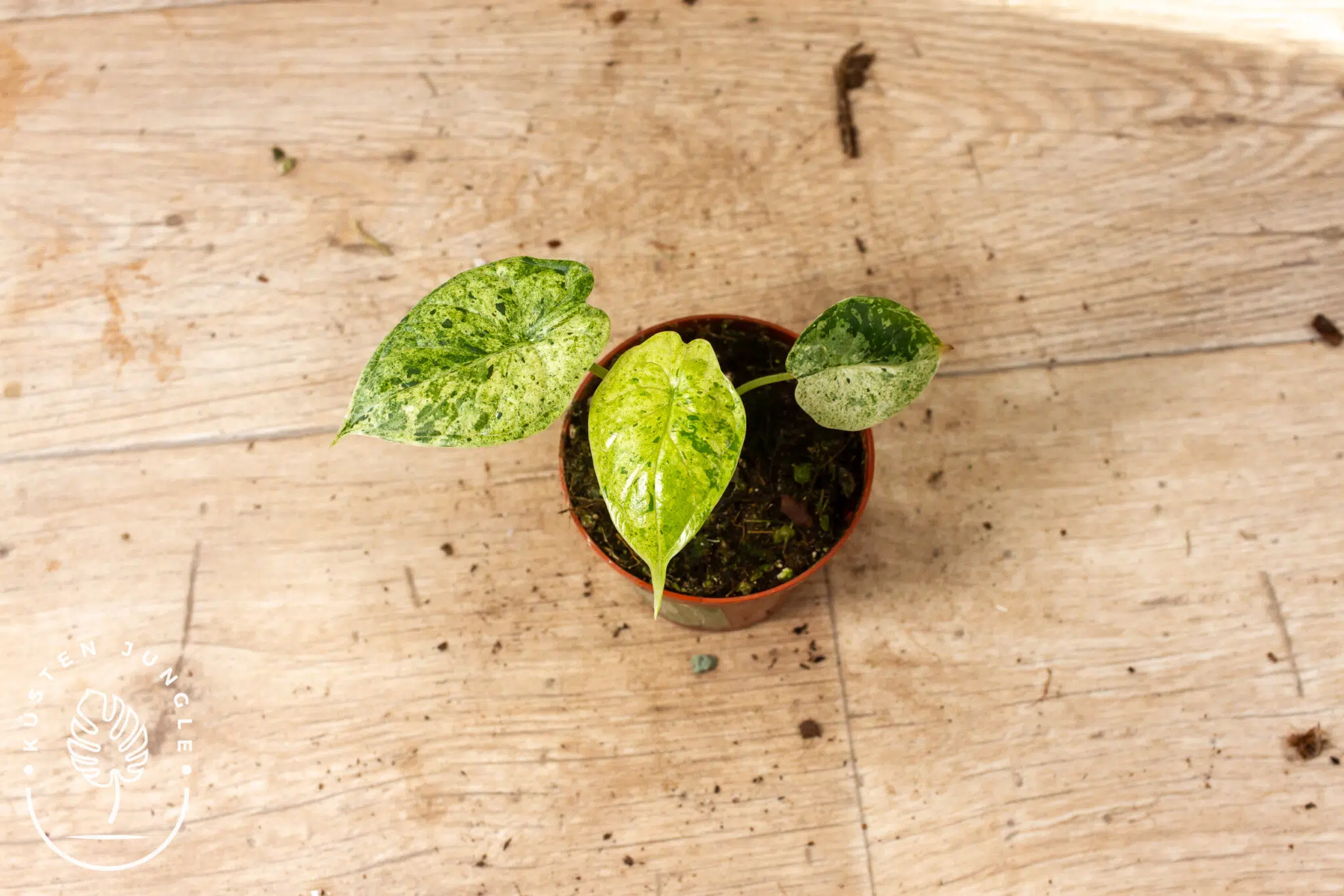
Botanically, the Dragon Scale Mint is a mint green variegated cultivar of Alocasia baginda ‚Dragon Scale‘, known for its thick, embossed leaf structure with pronounced veining, originating from the forests of Borneo. The Mint variant displays lighter, cooler green tones compared to the classic, darker Dragon Scale.
Due to its thick, leathery leaf surface and the high humidity it requires, it is more prone to thrips and spider mites than hardier houseplants – regular inspection of the undersides of the leaves is worthwhile.