
Alocasia sanderiana ‚Nobilis‘ - Care
Location & Light
The Nobilis prefers a semi-shady spot, such as a west or east-facing window, or a bit away from a south-facing window. In its natural habitat, it grows in the dappled undergrowth of the rainforest and is therefore adapted to filtered light, not direct sun. It should not be exposed to direct sun for prolonged periods, especially in summer, as the leaves can otherwise burn. Some early morning or late evening sun is usually tolerated. If there is insufficient light, the characteristic leaf pattern loses its contrast and growth slows down.
Pour
The top layer of soil should dry out to about 2 cm deep before the next watering. After that, the root ball should remain evenly slightly moist, but never waterlogged. Since the Nobilis grows in nature with roots creeping very shallowly under a thin layer of leaves and detritus, it is more sensitive to excessive moisture deep in heavy substrate than to short dry periods on the surface. Room-temperature, low-lime water is best tolerated, and always pour off excess water from saucers or cachepots. Watering is noticeably reduced in autumn and winter.
Fertilize
Like most alocasias, the Nobilis is a heavy feeder and should be regularly supplied with nutrients during its growth phase – approximately every 1 to 2 weeks with a highly diluted liquid fertilizer (one quarter to a maximum of half the recommended amount), as the genus is considered sensitive to salt. In its natural habitat, however, it grows in very nutrient-poor soil, which is why it's better to fertilize too little rather than too much. A rough guideline for alocasias in general is a pH value of about 5.5 to 6.5 and rather low values of 1.0 to 1.5 mS/cm. Follow the manufacturer's instructions on the respective packaging for precise dosage. If the Nobilis is only placed by the window in autumn and winter, the light becomes weaker, and fertilization is reduced or paused accordingly; if, on the other hand, it grows year-round under a gently adjusted plant lamp, the usual rhythm can be maintained without further reduction.
We consciously alternate between different fertilizers for our own plants – currently including COMPO COMPLETE, Foliage Focus, Liquid Gold Leaf, and Hesi TNT-Complex, supplemented with Hesi Root Complex, Hesi PowerZyme, and CalMag as needed.
Substrate
The substrate for a Nobilis should be coarse to very coarse and airy, yet remain consistently moist – an aroid mix of potting soil, coarse bark, and perlite works well. The pot doesn't need to be particularly large: a pot that is too big can quickly lead to the substrate appearing dry on top while still being wet at the bottom, which easily encourages overwatering. Repotting immediately after the plant arrives in its new home is usually not necessary and can add further stress to the plant.
Humidity & Temperature
A noticeably higher humidity level of at least 60 % promotes the most vigorous growth in Nobilis; it can even tolerate significantly higher levels above 90 % quite well. While it can generally cope with normal indoor air humidity in the range of 40 to 50 %, it tends to develop dry, brown leaf edges under these conditions. A humidifier or a display case offers the most reliable way to maintain consistently higher humidity levels. As for temperature, it should be warm year-round, ideally between 20 and 30 °C—including within the substrate itself, which is usually slightly cooler than the measured room temperature due to evaporation. Temperatures consistently below 15 °C and cold drafts quickly lead to growth problems.
Growth & Dormancy
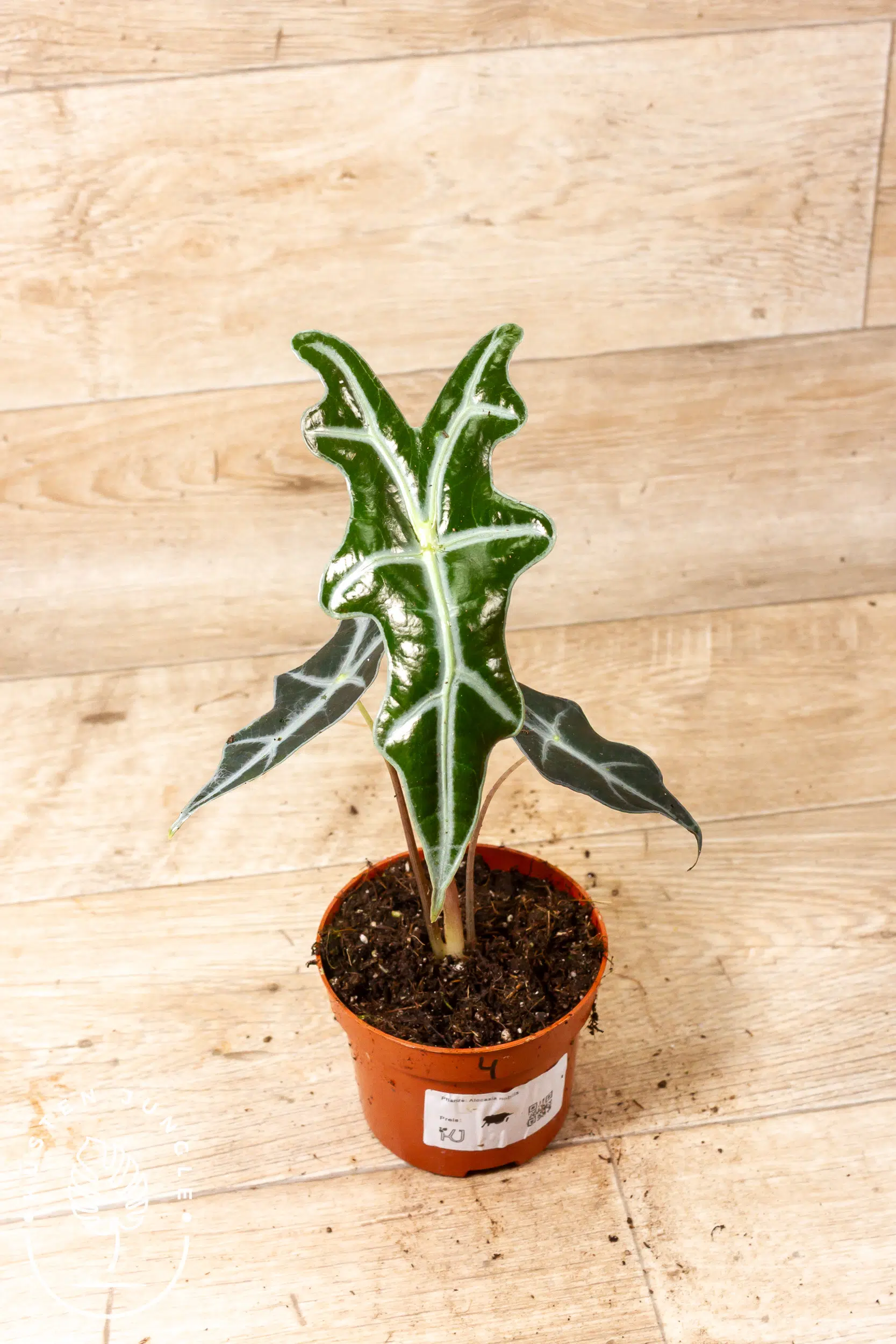
The Nobilis, with a height of mostly 40 to 80 cm, remains a rather small Alocasia and, for a sanderiana form, carries an unusually large number of leaves simultaneously, often 4 to 5 instead of the usual 1 to 2. As a Philippine species, it tends more strongly than many other Alocasias towards a true dormancy period after flowering, which in indoor cultivation usually falls in winter. During this time, it can lose its leaves completely and overwinter as a leafless rhizome before resprouting in early summer; this is normal for this species. Additionally, the light availability also plays a role: if it is only placed by a window in autumn and winter, the weaker light further reinforces the growth pause. In contrast, if it grows year-round under a sufficiently bright plant lamp with stable warmth, the retreat is usually milder.
Good to know
Like all Alocasias, the Nobilis also contains calcium oxalate crystals and is irritating if ingested by pets and children – best to place it out of reach.
„Nobilis“ sounds scientific, but it is not a separate botanical subspecies. It is merely a trade name, in use since 1893, for a form of Alocasia sanderiana characterized by particularly deeply incised, sinuately pinnately lobed leaves and conspicuously light veins. The original species originates from the Philippine island of Mindanao, where it grows in the shady undergrowth of nutrient-poor soils near moist ravines. Due to its distinctive, dagger-like leaf shape, it is occasionally referred to as the „Kris Plant“ in English-speaking regions.
Regularly checking the undersides of leaves is worthwhile, as spider mites and thrips can appear, especially in dry indoor air during winter.