
Begonia sp. U485 „Taconite“ - Care
Location & Light
A bright spot without direct sun best enhances the metallic shimmering pattern of this begonia—filtered light in a terrarium or slightly away from a window is ideal. Direct sunlight should be consistently avoided, as the thin leaves on it will quickly burn. With too little light, the plant grows noticeably slower, and the iridescent, bluish effect on the leaves is hardly visible anymore.
Pour
The substrate should be kept consistently lightly moist, without ever becoming waterlogged – water again as soon as the top 2 to 3 cm have dried out. Unlike hardier houseplants, this begonia tolerates neither prolonged dry periods nor waterlogged conditions particularly well; both quickly lead to wilting or rotting spots on the rhizome. Water should ideally only reach the substrate and not the leaves, as standing moisture on the foliage can promote fungal infections. In autumn and winter, when growth slows, water considerably less.
Fertilize
As a dwarf, slow-growing terrarium begonia, this variety requires little fertilizer. During the growing season, fertilize once every 4 to 6 weeks with a highly diluted liquid fertilizer (a quarter to a maximum of half the recommended amount), as begonias are generally sensitive to high salt concentrations. A rough guideline for begonias is a pH of about 5.2 to 6.0 and a rather low EC of 0.5 to 1.3 mS/cm. For precise dosage, follow the manufacturer's instructions on the respective packaging. If the plant is only placed by a window in autumn and winter, the light will be weaker and fertilization should be reduced accordingly or paused. If, however, it grows year-round under a softly adjusted plant lamp in the terrarium, the already restrained fertilization schedule can be maintained without further reduction.
We consciously alternate between different fertilizers for our own plants – currently including COMPO COMPLETE, Foliage Focus, Liquid Gold Leaf, and Hesi TNT-Complex, supplemented with Hesi Root Complex, Hesi PowerZyme, and CalMag as needed.
Substrate
The substrate should be loose, airy, and rich in organic material – a mixture of bark, coco coir, and perlite works well and still retains enough moisture for the fine rhizome roots. You should avoid heavy, compacting soil, as waterlogging at the rhizome quickly leads to rot. A small pot, sized to fit the root ball, also helps ensure the substrate dries out reliably.
Humidity & Temperature
Normal indoor air is not sufficient for this begonia in the long run—it needs consistently medium to high humidity levels between 60 and 80 % to stay healthy and prevent its leaves from developing dry, curled edges. These conditions can be maintained most reliably in a closed or partially closed terrarium, display case, or greenhouse cabinet; a simple room humidifier is not sufficient in the long term for most living rooms. As for temperature, the ideal range is between 18 and 24 °C; cold drafts and significant temperature fluctuations should be avoided.
Growth & Form
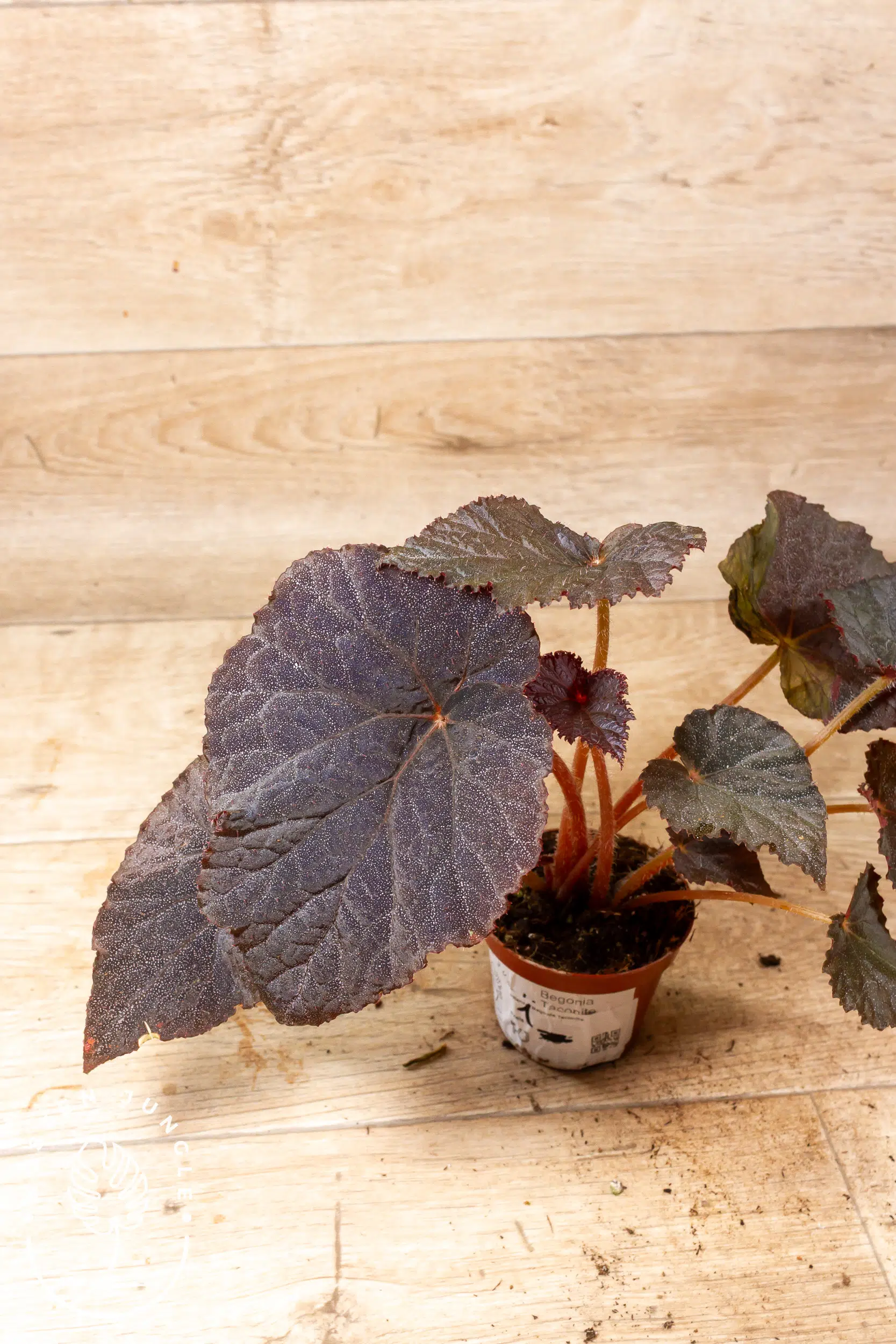
This begonia forms a compact, rhizomatous rosette, usually no more than 20 cm in height, and grows rather slowly overall. Its serrated, dark gray leaves with white, star-like speckles show an iridescent bluish shimmer from certain angles and with the right lighting – a natural characteristic of many begonias from Southeast Asia. The crimson red hair on the petioles and undersides of the leaves is also typical for this species. A pronounced rest period is not documented; if growth noticeably slows down, it is usually due to insufficient light, too low humidity, or temperature fluctuations, rather than a seasonal pause.
Good to know
Like many begonias, this variety also contains calcium oxalate crystals and can cause irritation if ingested – it's best to keep it out of reach of children and pets.
Botanically, it is a begonia species from the Sarawak region of Borneo that has not yet been officially described. The Asian Begonia Society provisionally catalogs it under the collection code „U485.“ In German trade, it is often offered under the name „Taconite“ – to be distinguished from the identically named, distinct cultivar Begonia ‚Taconite‘ by breeder Tim Anderson, which is a different plant with darker, reddish-brown foliage. The common name „Taconite“ has become established in trade for U485 independently of this.
Regularly checking the undersides of leaves is worthwhile, as spider mites and powdery mildew can occur, especially in air that is too dry or stale.