
Begonia sp. „Julau“ Type 1 - Care
Location & Light
The Julau Type 1 prefers it warm but without direct sun, much like its natural rainforest habitat where it grows in the shady undergrowth. A spot with filtered light in a terrarium or slightly away from the window is ideal. It cannot tolerate direct sunlight, as its large, sensitive leaves will quickly burn. Conversely, if it lacks sufficient light, the pink to white speckling will fade, and growth will noticeably slow down.
Pour
Water as soon as the top 2 to 3 cm of the substrate has dried out – the root ball should then be evenly moist, but never waterlogged. Due to its relatively large leaf surface compared to other terrarium begonias, the Julau type 1 also evaporates noticeably more water, which is why it needs water slightly more often than smaller-leaved collector begonias during its active growth phase. Nevertheless, it tolerates neither permanent waterlogging nor prolonged dry periods well. Water should reach the substrate if possible, not the leaves, as standing moisture on the foliage can quickly lead to rot. In autumn and winter, when growth slows down, watering is significantly reduced.
Fertilize
If the Julau Type 1 actively grows new, large leaves, you can provide it with a heavily diluted liquid fertilizer every 4 to 5 weeks during its growth phase (a quarter to a maximum of half the recommended amount). Compared to tiny terrarium begonias with delicate leaves, it can tolerate slightly more nutrients, but like all begonias, it remains sensitive to high salt concentrations in the substrate. A rough guideline for begonias in general is a pH of approximately 5.2 to 6.0 and rather low electrical conductivity of 0.5 to 1.3 mS/cm. Follow the manufacturer's instructions on the respective packaging for precise dosing. If the plant is only placed by a window in autumn and winter, the light becomes weaker, and fertilization should be reduced accordingly or paused. However, if it grows year-round under stable conditions in a terrarium, the usual rhythm can be maintained without further reductions.
We consciously alternate between different fertilizers for our own plants – currently including COMPO COMPLETE, Foliage Focus, Liquid Gold Leaf, and Hesi TNT-Complex, supplemented with Hesi Root Complex, Hesi PowerZyme, and CalMag as needed.
Substrate
A loose, well-draining, yet nutrient-rich substrate is most suitable for the Julau Type 1 – a mix of sphagnum moss, perlite, and peat-based soil works well. Due to its relatively robust foliage, the pot can be somewhat more generous than for tiny terrarium begonias, but should still not be oversized. A drainage layer of gravel or expanded clay at the bottom of the pot also helps excess water drain away quickly and prevents the roots from sitting in water permanently.
Humidity & Temperature
Normal indoor air is not sufficient for the Julau Type 1 in the long term—several independent sources agree that it requires consistently high humidity of at least 70 % to remain healthy. At lower humidity levels, the large leaves in particular dry out quickly at the edges, and the speckled pattern loses its contrast. A closed or partially closed terrarium, display case, or greenhouse cabinet is the most reliable solution here; a simple room humidifier is not sufficient in the long term for most living spaces. As for temperature, the ideal range is a consistently warm 21 to 27 °C; it does not tolerate cold drafts or temperatures below 15 °C well.
Growth & Form
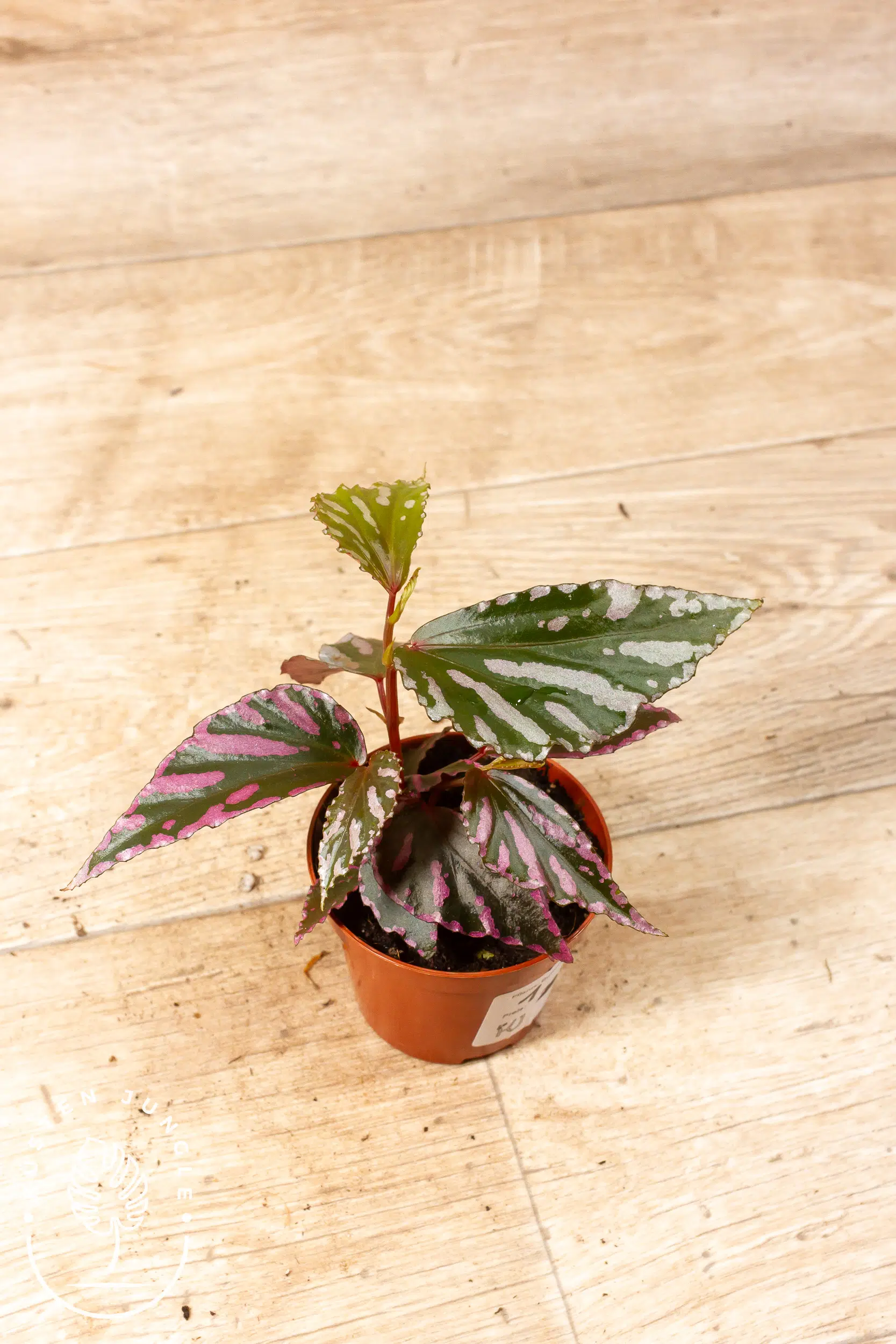
The Julau Type 1 forms unusually large leaves compared to many other terrarium begonias, but grows on a rather thin, less stable stem. As it gets taller, it can become top-heavy and tip over. Occasional, careful trimming of the shoot tips keeps it more compact and stable, while also providing cuttings for propagation from stem sections. The large, asymmetrical leaves show a dark, almost blackish-green surface with pink speckles as young foliage, which becomes lighter with age and transitions to whitish speckles. This color change is normal and not a sign of improper care. A distinct dormancy period is not documented, but growth is noticeably slower in winter.
Good to know
Like many begonias, the Julau Type 1 also contains calcium oxalate crystals and can cause irritation if consumed – it's best to keep it out of reach of children and pets.
Begonia sp. „Julau“ is named after its discovery location, the small town of Julau in the district of Sarawak on the Malaysian side of Borneo. Botanically, it has not yet been officially described and is therefore classified as a collector's form („sp.“); since 2021, it has been listed under the provisional collection number U683. This is Type 1, the form with larger, stronger leaves – Type 2 is closely related but generally remains smaller and more delicate. If you want to propagate it, you should use stem cuttings rather than leaf cuttings – pure leaf cuttings usually rot with this species instead of forming roots.
Regularly checking the undersides of leaves is worthwhile, as spider mites and powdery mildew can occur, especially in air that is too dry or stale.