
Begonia ignita - Care
Location & Light
Begonia ignita is most comfortable in partial to full shade with filtered light, just like the humid forest undergrowth of its native Sulawesi. A spot in a terrarium or slightly away from the window would be suitable. It cannot tolerate direct sunlight, as its sensitive leaves will quickly burn. If there is insufficient light, growth will noticeably slow down, and the striking leaf pattern will be less pronounced.
Pour
Water moderately and allow the substrate to dry slightly between waterings before watering again – Begonia ignita is more sensitive to constantly wet substrate than to a short dry phase. If it is grown in a closed terrarium with very high humidity, it will need noticeably less water overall than on an open windowsill. Water should ideally only reach the substrate, not the leaves, as standing moisture on the foliage can quickly lead to rot. In autumn and winter, when growth slows down, water less frequently.
Fertilize
As a dwarf terrarium begonia, the ignita is not a heavy feeder – during the growth phase, a feeding every 4 to 6 weeks with a highly diluted liquid fertilizer (a quarter to a maximum of half the recommended amount) is sufficient, as begonias are generally sensitive to high salt concentrations in the substrate. As a rough guideline, a pH of about 5.2 to 6.0 and rather low EC values of 0.5 to 1.3 mS/cm are considered suitable for begonias. For precise dosage, follow the manufacturer's instructions on the respective packaging. If the plant is only placed on a windowsill in autumn and winter, the light becomes weaker, and fertilization is reduced accordingly or paused; if it grows year-round under stable conditions in a terrarium, the already restrained rhythm can be maintained without further reduction.
We consciously alternate between different fertilizers for our own plants – currently including COMPO COMPLETE, Foliage Focus, Liquid Gold Leaf, and Hesi TNT-Complex, supplemented with Hesi Root Complex, Hesi PowerZyme, and CalMag as needed.
Substrate
A loose, slightly mineral, and organically enriched substrate suits Begonia ignita best – a mixture of sphagnum moss, perlite, and peat-free soil works well. It also prefers to be slightly root-bound; a pot that is too large tends to keep the substrate too wet for too long, which quickly damages the sensitive roots.
Humidity & Temperature
Normal indoor air is not sufficient for Begonia ignita in the long term—several independent sources agree that it needs consistently high humidity of at least 65 % to stay healthy. At lower levels, the leaves quickly dry out at the edges and growth stagnates. A closed or partially closed terrarium, display case, or greenhouse cabinet is the most reliable solution here; a simple room humidifier is generally not sufficient for long-term use in most living spaces. As for temperature, it should remain consistently warm year-round, ideally between 20 and 26 °C—it does not tolerate consistently cooler temperatures below 18 °C well.
Growth & Form
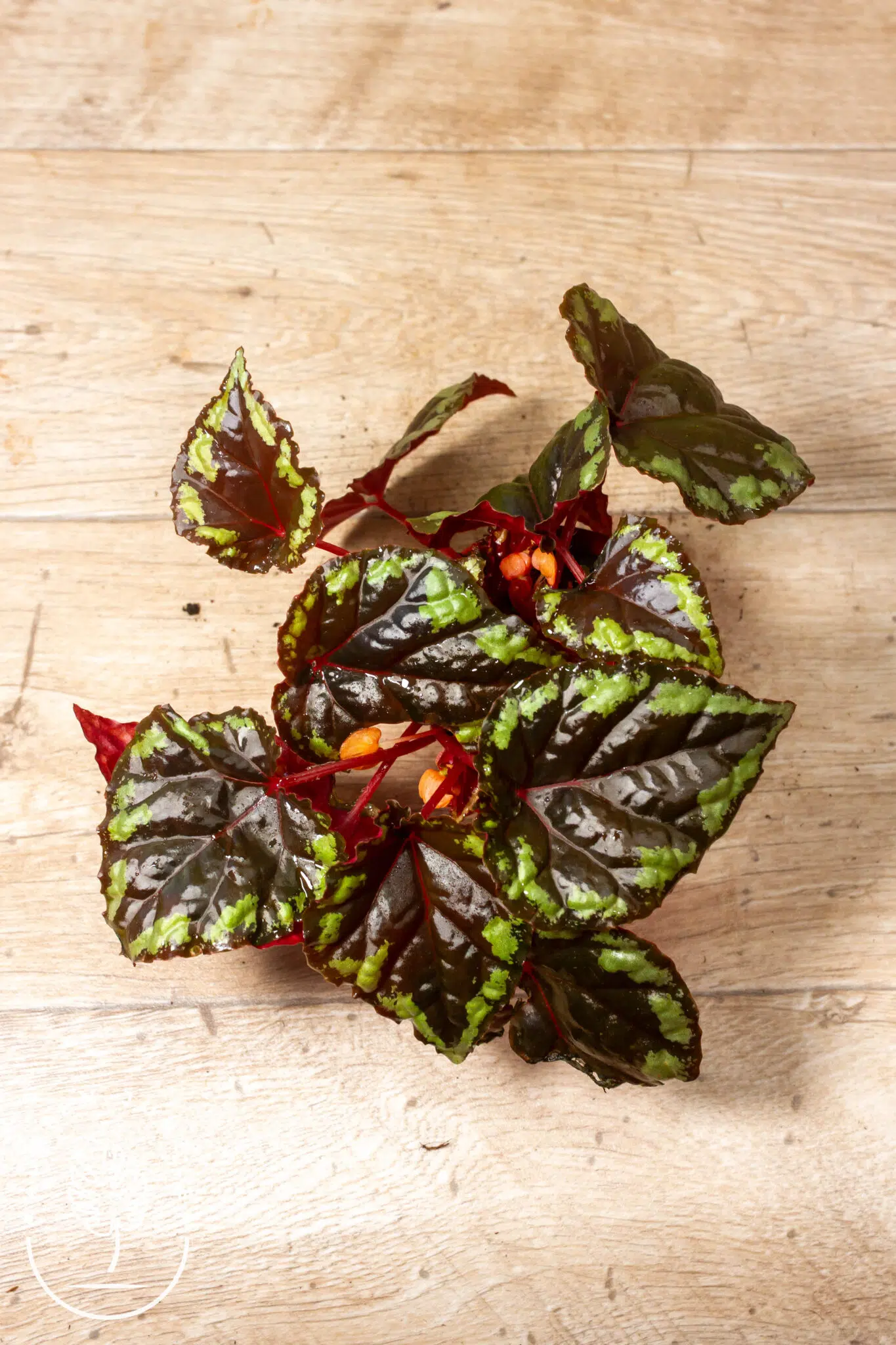
The Begonia ignita remains very compact, usually under 18 cm tall, and forms a dense, bushy rosette of leaves. The symmetrical, heart-shaped leaves show a strong reddish-bronze surface with a yellowish-green edge marking as young foliage; with increasing age, the center of the leaf darkens to a deep maroon to almost black, while the green edge becomes more pronounced – this color gradient is normal and not a sign of improper care. With good care, it blooms with strikingly bright orange male and delicate pink female flowers. A distinct dormancy period is not documented, but it grows noticeably slower in winter.
Good to know
Like many begonias, the ignita also contains calcium oxalate crystals and can cause irritation if ingested – it's best to keep it out of reach of children and pets.
Begonia ignita was scientifically described only in 2017 and originates from the humid forests of the Indonesian island of Sulawesi. It owes its name („ignita“ = „ignited, flaming“) to its bright orange flowers - it is the only known Indonesian Begonia species with this flower color. In addition to the dark maroon form described here, there is also a purely green-leaved form without the dark markings.
Regularly checking the undersides of leaves is worthwhile, as spider mites and powdery mildew can occur, especially in air that is too dry or stale.