
Begonia ‚Dainty Spray‘ Sport Variegata - Care
Location & Light
Bright light with plenty of indirect light allows the Dainty Spray Sport Variegata to grow most vigorously and best highlights the fine, variegated leaf pattern. A spot near an east or west window is well-suited. You should avoid direct sunlight, as the light, variegated leaf areas, in particular, can burn very quickly without the protective chlorophyll content. Conversely, if there is insufficient light, the variegation of new leaves will become increasingly pale or green, and growth will slow down.
Pour
Water once the top 2 to 3 cm of the substrate are slightly dry – the root ball should then be evenly moist, but never waterlogged. The highly variegated, sensitive leaf areas react more sensitively to water stress than solid green leaves, which is why a consistent watering rhythm is important. Water directly onto the substrate rather than over the leaves to avoid spots and rot on the delicate foliage. In autumn and winter, when growth slows, water significantly less.
Fertilize
Due to the significantly reduced green, chlorophyll-containing leaf surface, the Dainty Spray Sport Variegata is fertilized much less frequently than non-variegated begonias. During the growth phase, one application every 5 to 6 weeks with a highly diluted liquid fertilizer (a quarter to a maximum of half the recommended amount) is usually sufficient. As a rough guideline, a pH value of about 5.2 to 6.0 and a rather low electrical conductivity of 0.5 to 1.3 mS/cm are generally considered suitable for begonias. Follow the manufacturer's instructions on the respective packaging for precise dosage, as the sensitive, variegated leaf areas are particularly intolerant of over-fertilization. If the plant is only placed by the window in autumn and winter, the light becomes weaker and fertilization is reduced accordingly or paused. If, on the other hand, it grows year-round under stable conditions in a terrarium, the already moderate fertilization rhythm can be maintained without further reduction.
We consciously alternate between different fertilizers for our own plants – currently including COMPO COMPLETE, Foliage Focus, Liquid Gold Leaf, and Hesi TNT-Complex, supplemented with Hesi Root Complex, Hesi PowerZyme, and CalMag as needed.
Substrate
A loose, well-draining peat-based substrate with some perlite or orchid bark for adequate aeration will best suit the Dainty Spray Sport Variegata. A rather snug pot is preferable to one that is clearly too large, as the substrate will remain too moist in large containers, quickly damaging the delicate roots.
Humidity & Temperature
Normal room air is not permanently sufficient for the Dainty Spray Sport Variegata – several specialized suppliers explicitly emphasize a high humidity requirement, as the variegated, thin leaf areas quickly become brown and crisp without sufficient moisture. A closed or semi-closed terrarium, a display case, or a greenhouse cabinet are the most reliable solution here; a simple room humidifier is not permanently sufficient in most living rooms. The preferred temperature range is between 18 and 24 °C; cold drafts and temperatures below 15 °C quickly lead to leaf drop.
Growth & Form
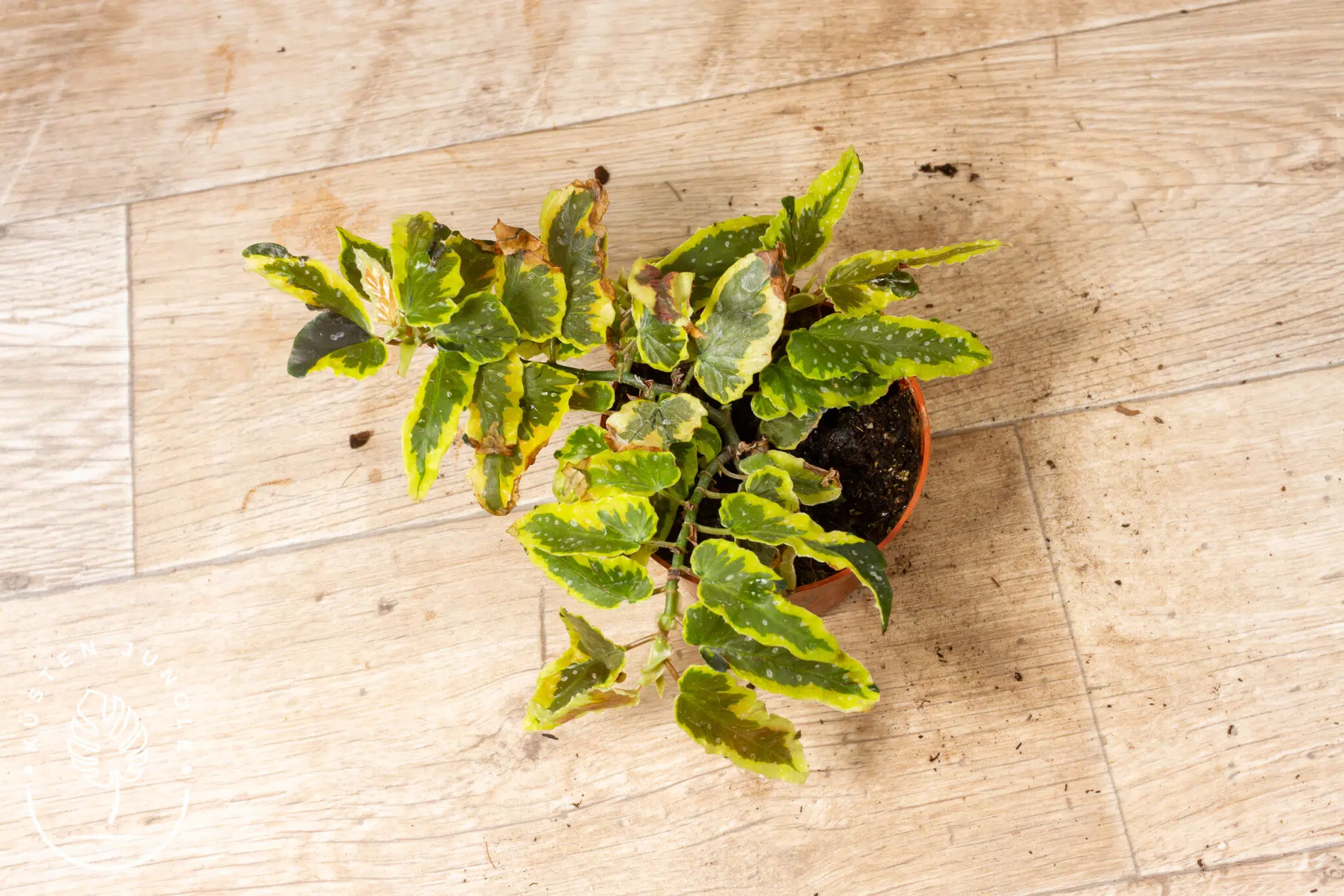
As a cane type, Dainty Spray Sport Variegata grows upright on tubular, articulated stems, forming finely lobed, slightly serrated leaves with green-yellow variegation and pink to copper-colored margins; the undersides of the leaves are a strong red. Due to the reduced green leaf surface, it grows slower overall than the unvariegated original variety and reacts accordingly more sensitively to care errors. With good care, it forms delicate, hanging, pale pink flowers. How much variegation a new leaf shows varies from leaf to leaf and cannot be controlled – this is normal. A pronounced dormancy period is not documented, but growth is noticeably slower in winter.
Good to know
Like many begonias, Dainty Spray Sport Variegata contains calcium oxalate crystals and can cause irritation if ingested – best to place it out of reach of children and pets.
Botanically speaking, the Dainty Spray Sport Variegata is a spontaneously occurring, variegated mutation („sport“) of the non-variegated Cane Begonia ‚Dainty Spray‘. Since such sports arise randomly in cultivation and the variegation is not always stably inherited, the pattern can vary slightly from plant to plant and even from leaf to leaf.
Regularly checking the undersides of leaves is worthwhile, as spider mites and powdery mildew can occur, especially in air that is too dry or stale.