
Anthurium vittarifolium – Care
Location & Light
Anthurium vittarifolium needs more light than many initially assume – a really bright spot with plenty of indirect light, such as near an east or west window, will allow it to grow most vigorously. As a rough guide, the ideal range for anthuriums in general is about 20 to 100 µmol/m²/s PAR (PPFD), which corresponds to a DLI of approximately 1 to 4 mol/m²/day with a light duration of around 10 to 12 hours. Some mild morning or evening sun is usually tolerated, but you should avoid direct midday sun as the leaves can burn or fade from it. If it's too dark, growth will be noticeably slower and new leaves will remain shorter.
Pour
Water as soon as the top half of the substrate has dried out – the root ball should then be evenly moist, but never waterlogged. In its natural habitat, the vittarifolium grows epiphytically on tree trunks, where rainwater drains quickly through the loose substrate, preventing the roots from ever standing in water – ensure quick drainage in the pot accordingly. Room-temperature, low-lime water is best tolerated; always pour off excess water from saucers or cachepots. Water noticeably less in autumn and winter, but the root ball should not dry out completely even then.
Fertilize
*Anthurium vittarifolium* roots are sensitive to undiluted, fast-acting fertilizers. Therefore, during the growing season, a dose every 3 to 4 weeks with a highly diluted liquid fertilizer (one quarter to a maximum of half the recommended amount) is perfectly sufficient – it's best to avoid powdered organic fertilizers and undiluted granular fertilizers with this species. As a rough estimate, a pH of around 5.5 to 6.5 and rather low EC levels of 1.0 to 1.5 mS/cm are generally suitable for *Anthuriums*. For precise dosage, follow the manufacturer's instructions on the respective packaging. If the plant is only kept by a window in autumn and winter, the light weakens, and fertilization should be reduced accordingly or paused. However, if it grows year-round under sufficiently bright plant light, the usual rhythm can be maintained without further reduction.
We consciously alternate between different fertilizers for our own plants – currently including COMPO COMPLETE, Foliage Focus, Liquid Gold Leaf, and Hesi TNT-Complex, supplemented with Hesi Root Complex, Hesi PowerZyme, and CalMag as needed.
Substrate
As an epiphyte, Anthurium vittarifolium needs a coarse, airy substrate that still retains some moisture and provides a firm grip for the roots – a mix of orchid bark, perlite, some coco fiber or sphagnum moss, and charcoal works well. Firm anchorage is particularly important for this species, as the heavy, cascading leaves can otherwise easily tip the plant out of its pot. Regular repotting into appropriately sized pots also promotes good substrate aeration.
Humidity & Temperature
Normal indoor air is not sufficient for Anthurium vittarifolium in the long term—several independent sources agree that it needs consistently high humidity of at least 60 % to produce long, supple, and glossy leaves; otherwise, growth may stall and the leaf tips may become dull and brittle. A humidifier, a tray of pebbles, or a spot among other tropical plants can help maintain these levels over the long term. You should avoid regularly misting the leaves, as moisture left on the foliage can promote fungal growth. The ideal temperature range is between 18 and 27 °C; brief dips to around 13 °C are usually tolerated, but consistently cooler temperatures and frost should be avoided at all costs.
Growth & Form
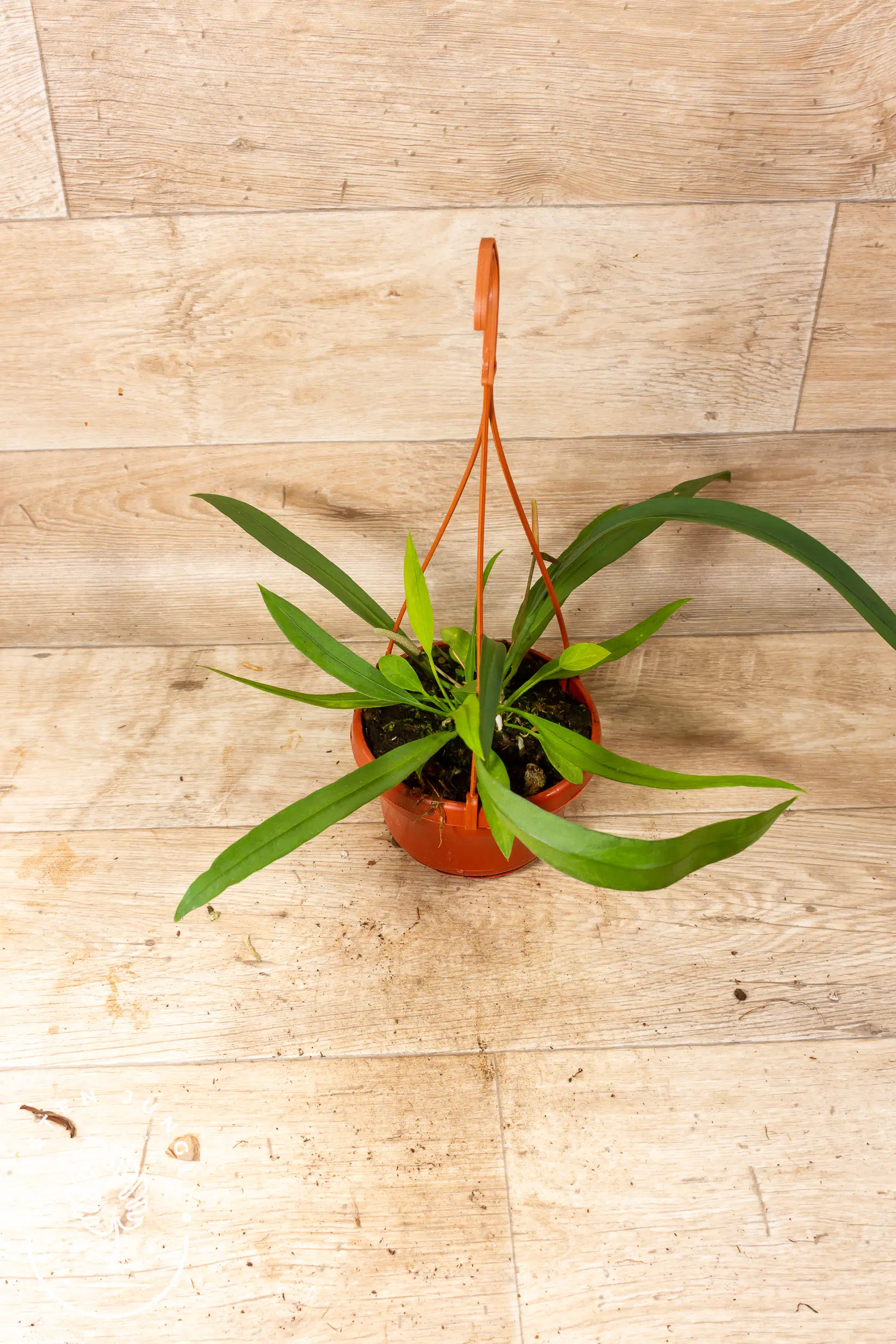
Anthurium vittarifolium forms long, strap-like, leathery leaves that, in their native habitat, hang down from tree branches like a green curtain and can easily reach over a meter in length in cultivation. Unlike most other anthuriums, the leaves lack the upper auricle at the transition to the petiole, and the petioles grow straight down instead of up – this results in the typical, pendulous growth habit that makes this species particularly well-suited for hanging baskets or elevated locations. With good care, it is considered relatively fast-growing. A pronounced dormant period is not documented, but it grows noticeably slower in winter.
Good to know
Like all anthuriums, vittarifolium also contains calcium oxalate crystals and is irritating to pets and children if ingested – best to place out of reach.
The Anthurium vittarifolium originates from the upper Amazon basin, from southeastern Colombia to Peru and Brazil, where it grows epiphytically on tree trunks. Its inconspicuous inflorescence with a greenish-cream spathe and slender spadix hangs downwards on a short stalk and develops pinkish-purple berries after pollination. As a so-called „strap-leaf“ anthurium, it is occasionally confused with the similarly looking Anthurium pallidiflorum, which differs in its flower shape, among other things.
Regularly checking the undersides of leaves is worthwhile, as scale insects and mealybugs like to hide there.