
Begonia baramensis - Care
Location & Light
On the forest floor of Borneo, this begonia grows in partial shade under a dense canopy, which is why direct sunlight is taboo for it – its delicate, dark leaves burn quickly in it. A bright spot with filtered or indirect light best showcases both its vigorous growth and the silvery sheen on the leaf edge. If it's too dark, growth becomes noticeably slower and the color contrasts fade somewhat. As a rough guide, tropical shade begonias like this one are categorized with about 40 to 80 µmol/m²/s PAR (PPFD), which corresponds to a DLI of approximately 1.5 to 3.5 mol/m²/day with 10 to 12 hours of lighting.
Pour
The top substrate layer is allowed to dry out slightly between waterings, but the root ball should not dry out completely – this Borneo begonia does not tolerate large fluctuations between wet and bone dry well. Water directly onto the soil, avoiding the leaves, as standing moisture on them quickly causes rot. Room-temperature, soft water is tolerated much better than calcareous tap water.
Fertilize
A weakly diluted liquid fertilizer approximately every 3 to 4 weeks during the growing season is sufficient for this begonia. It is not a heavy feeder, and fertilizing too often or too concentrated will lead to burnt leaf edges rather than more growth. Generally, a pH range of about 5.5 to 6.2 and an electrical conductivity of the irrigation water of roughly 1.0 to 1.3 mS/cm are considered approximate values for begonias. For precise dosage, follow the manufacturer's instructions. If it is only placed by the window in autumn and winter, fertilizing becomes less frequent or is omitted due to the decreasing light. However, if it continues to grow year-round under sufficiently bright plant lights, fertilizing can continue at the usual rhythm.
We consciously alternate between different fertilizers for our own plants – currently including COMPO COMPLETE, Foliage Focus, Liquid Gold Leaf, and Hesi TNT-Complex, supplemented with Hesi Root Complex, Hesi PowerZyme, and CalMag as needed.
Substrate
A loose, humus-rich mixture of potting soil, perlite, and some orchid bark mimics the loose forest floor on which this begonia grows in the wild. Good drainage is particularly important so that excess watering can drain away quickly and no moisture accumulates at the bottom of the pot.
Humidity & Temperature
Unlike hardier houseplants, this Borneo begonia doesn’t really thrive in normal indoor air conditions over the long term—only at humidity levels of around 70 %, ideally 80 to 90 % humidity—does it remain consistently healthy, which is why a greenhouse cabinet, terrarium, or grow box is actually the most suitable environment for it. In terms of temperature, it thrives best between 20 and 28 °C; it does not tolerate cold drafts or temperatures below 15 °C at all.
Growth & Form
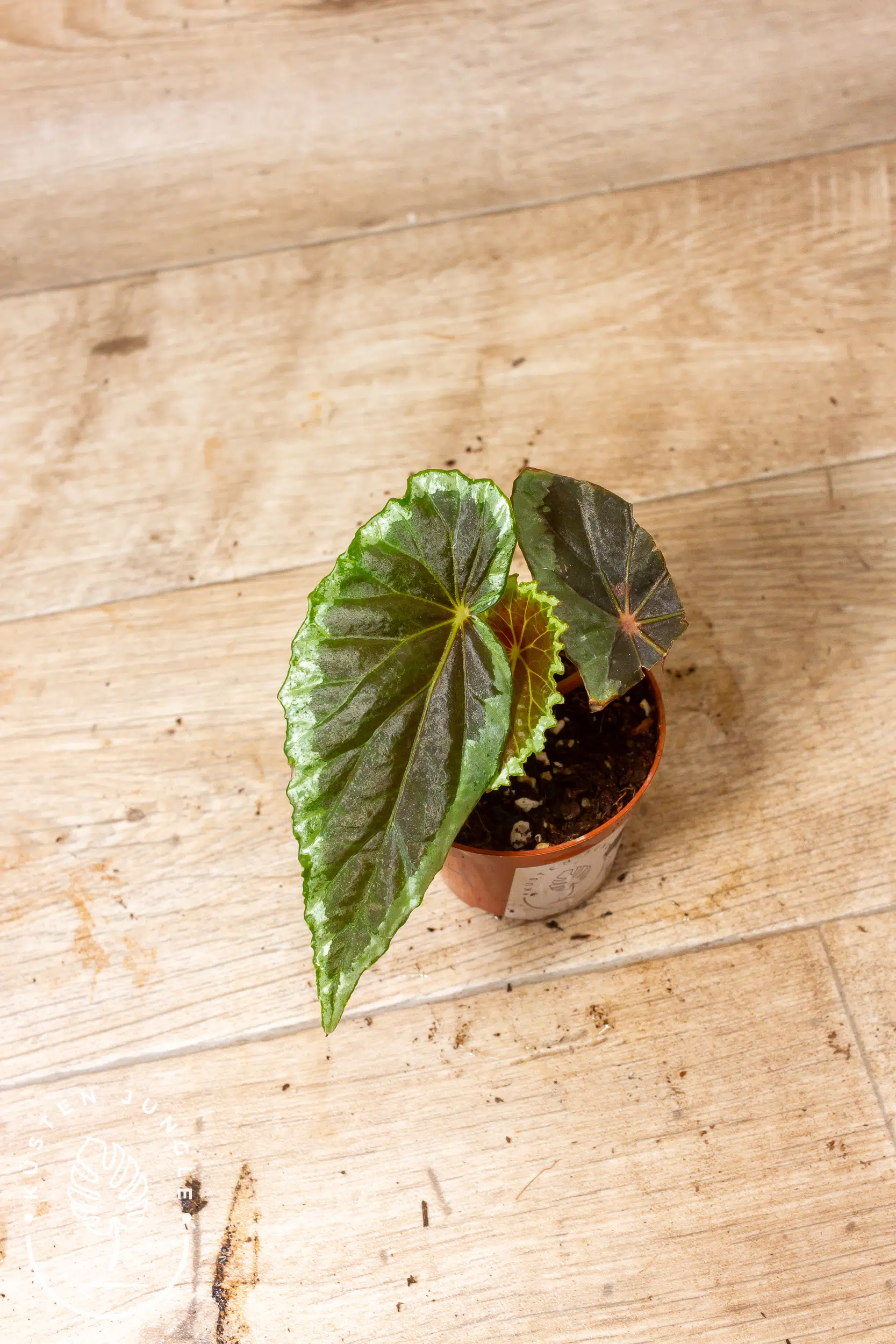
From a short, creeping rhizome, the characteristic asymmetrical leaves with wavy edges typical of begonias emerge. New leaves initially unroll with a reddish tint before unfolding into the characteristic dark green to almost black surface with a shimmering silver edge. The plant remains compact overall, growing wider rather than taller. A distinct dormant period is not known. If growth is persistently weak, it is more worthwhile to check light and moisture levels than to wait for a supposed winter rest.
Good to know
Under the name Begonia baramensis, two different-looking plants are circulated commercially: the botanically confirmed, endemic species from Borneo with slate-gray-brown leaves and a broad silver band, as well as a closely related form with dark green to almost black leaves and a narrower, shimmering silver edge, which is common in collector circles – the latter is the plant shown here. The care requirements for both forms are very similar, but they differ significantly in appearance.
Begonias contain soluble oxalates and are considered irritating to pets and children if consumed – it's best to keep them out of reach. Regular inspection of the rhizome and the undersides of the leaves is also worthwhile, as mealybugs are among the more common problems with this species.