
Alocasia zebrina ‚Reticulata‘ – Care
Location & Light
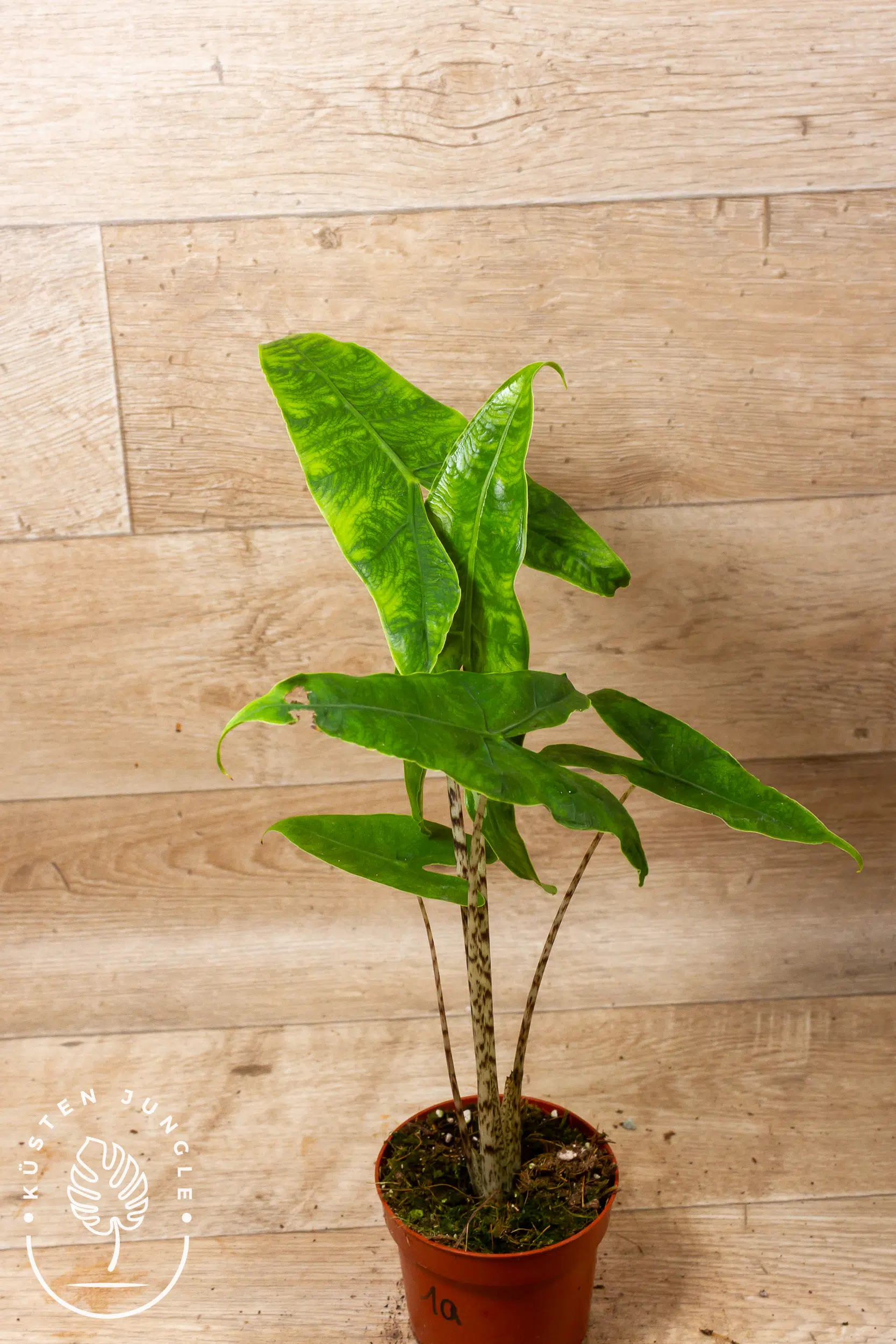
Thanks to its relatively thin leaf structure, this Alocasia can tolerate more light than some of its thick-leaved relatives. A bright location with plenty of indirect light will make the net-like leaf pattern and the striking stripes on the leaf stalks particularly stand out. However, direct midday sun will quickly cause burns and should be avoided. As a rough guide, the suitable range is about 150 to 350 µmol/m²/s PAR (PPFD), which corresponds to a DLI of approximately 6.5 to 15 mol/m²/day with 10 to 12 hours of light.
Pour
The top 2 to 3 cm of the substrate may dry out between waterings, after which water thoroughly until water runs out of the bottom of the pot – but always remove standing water from the saucer. This Alocasia will signal complete drying out with limp, drooping leaves, while continuous wetness can lead to root and tuber rot. Room temperature, low-lime water is tolerated much better than hard tap water.
Fertilize
Like most Alocasias, this variety is a real heavy feeder – during the growing season, fertilize about every 1 to 2 weeks with a highly diluted liquid fertilizer, preferably with every other watering or every watering. General guidelines for Alocasias are a pH range of about 5.5 to 6.5 and a rather low electrical conductivity of the irrigation water, roughly 1.0 to 1.3 mS/cm, as the genus is sensitive to salt accumulation; follow the manufacturer's instructions for precise dosage. If the plant is only near a window in autumn and winter, fertilize less frequently or not at all due to the weaker light; however, under consistently bright artificial plant light, you can continue fertilizing at the usual, frequent rhythm.
We consciously alternate between different fertilizers for our own plants – currently including COMPO COMPLETE, Foliage Focus, Liquid Gold Leaf, and Hesi TNT-Complex, supplemented with Hesi Root Complex, Hesi PowerZyme, and CalMag as needed.
Substrate
A loose, water-retaining, yet well-draining mixture of potting soil, coco coir or peat moss, and a generous amount of perlite suits this Alocasia well. It's important to use a pot with sufficient drainage holes so that excess water can drain away quickly and the sensitive tuber doesn't sit in moisture permanently.
Humidity & Temperature
This Alocasia tolerates normal indoor air humidity levels of 40 to 50 %, but at levels of 60 % or higher, it appears significantly more vigorous and is less prone to brown leaf edges. A humidifier or a bowl of pebbles can help here. The ideal temperature range is between 18 and 25 °C; it does not tolerate large temperature fluctuations or drafts well and may react to them by dropping leaves.
Growth & Dormancy
The plant is named for its narrow, arrow-shaped leaves with their fine, net-like pattern, as well as its striking, zebra-striped leaf stalks, at the tips of which the leaves are attached. If the plant is grown only by a window in autumn and winter, growth noticeably slows due to the weaker light, and it is normal for some older leaves to be shed; however, under sufficiently bright plant light year-round, growth generally remains stable without significant leaf loss. Already dead, brown leaves should only be removed when they have completely dried out, as the plant still extracts nutrients from them beforehand.
Good to know
In trade, this plant is often simply offered as „Alocasia reticulata,“ as if it were a distinct species. In fact, botanically it is a variety of Alocasia zebrina, differing from the unvariegated parent form by the additional reticulated pattern on the leaves – both share the zebra-striped petioles.
Like all aroids, this Alocasia contains calcium oxalate crystals and is irritating to pets and children if consumed – best to place it out of reach. Regular checks of the undersides of the leaves are also worthwhile, as spider mites are among the more common problems with this genus.