
Anthurium veitchii – Care
Location & Light
In the treetops of Colombia, this Anthurium grows high up in the filtered but intense light of the canopy. A truly bright spot with plenty of indirect light comes closest to its natural needs. Direct sun, on the other hand, quickly leads to burns on the large leaves. As a rough guideline, the suitable range is around 80 to 150 µmol/m²/s PAR (PPFD), which corresponds to a DLI of approximately 3.5 to 6.5 mol/m²/day with 10 to 12 hours of lighting. Too little light will further slow down the already leisurely growth.
Pour
Watering should occur once the top 3 to 4 cm of the substrate feel dry. As an epiphyte, this anthurium is accustomed to a cycle of being moist and then drying out slightly; however, it tolerates consistently wet conditions poorly. Excess water should always be removed from the saucer after watering to prevent root rot. Soft water at room temperature is tolerated much better than hard tap water.
Fertilize
In nature, this anthurium draws few nutrients from leaf litter and rainwater, but in a pot, it benefits from a slightly more regular supply: once every 3 to 4 weeks with a highly diluted liquid fertilizer during the growth phase is sufficient to nourish the giant, ribbed leaves without overloading the roots. General guidelines for anthuriums are a pH range of approximately 5.5 to 6.5 and an electrical conductivity of irrigation water of roughly 1.0 to 1.5 mS/cm; follow the manufacturer's instructions for precise dosage. If the plant is only growing by a window in autumn and winter, fertilize less often or not at all due to the weaker light; however, under consistently bright plant lighting, continue fertilizing at the usual rhythm.
We consciously alternate between different fertilizers for our own plants – currently including COMPO COMPLETE, Foliage Focus, Liquid Gold Leaf, and Hesi TNT-Complex, supplemented with Hesi Root Complex, Hesi PowerZyme, and CalMag as needed.
Substrate
A coarse, very porous substrate of orchid bark, some perlite, and a handful of sphagnum moss mimics the epiphytic root environment this anthurium is accustomed to in the wild. Compact, dense potting soil should be avoided as it stays wet for too long. A stable, not-too-light pot provides the necessary support for the plant, given its large, heavy leaves.
Humidity & Temperature
High humidity makes a real difference for this Anthurium: In its native habitat, humidity levels around 80 % are normal, and even as a houseplant, it grows much more slowly at levels below 50 % and tends to develop dry leaf tips. At around 60 to 70 %, it becomes visibly more vigorous; a humidifier or greenhouse cabinet is well worth the investment here. As for temperature, the ideal range is between 20 and 27 °C; it is sensitive to temperatures below 15 °C and to drafts.
Growth & Form
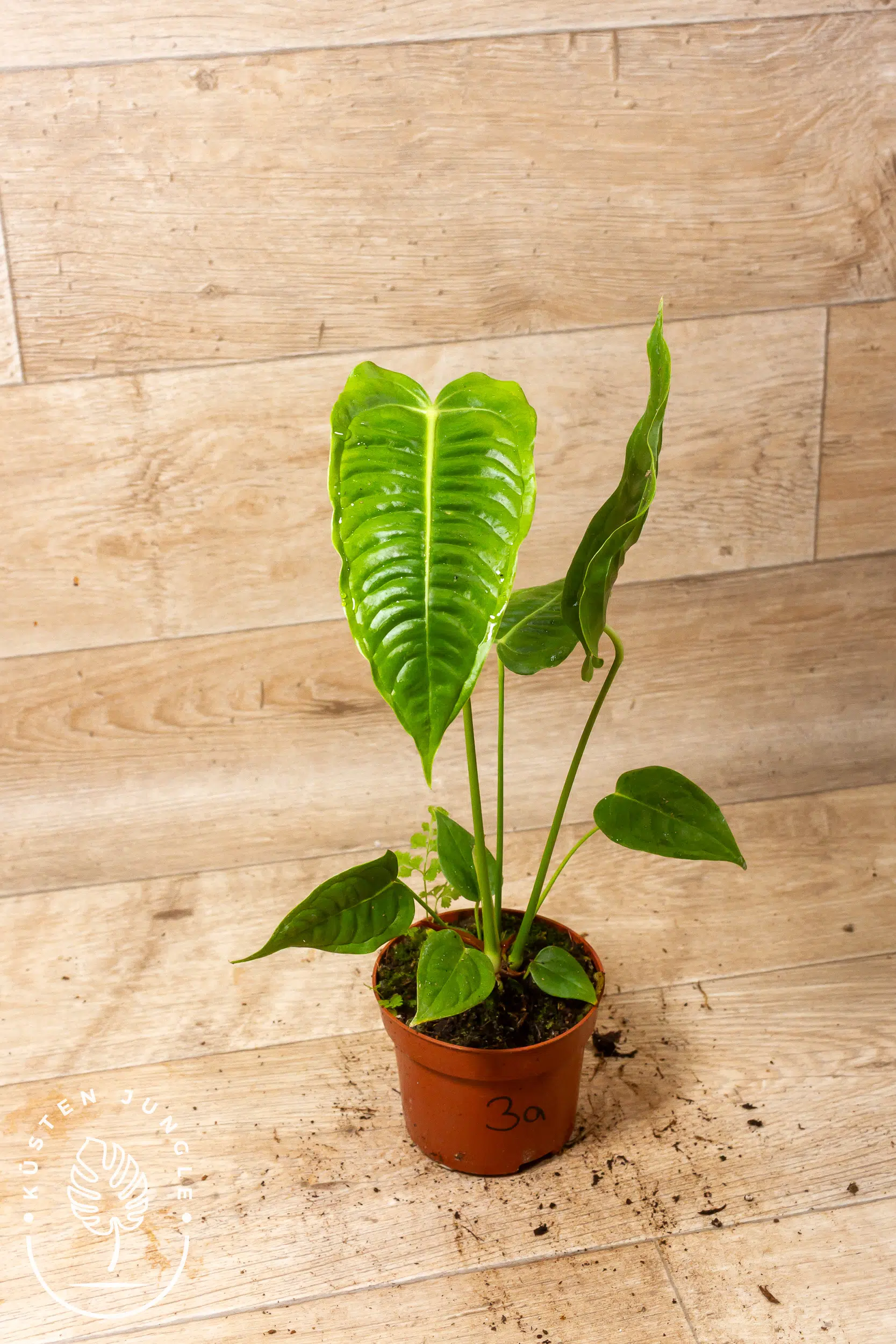
Young leaves initially start out heart-shaped and a delicate rusty pink before maturing into their adult form over time: elongated-oval, dark green with a slight metallic sheen and a deeply ribbed, almost abstract texture reminiscent of a washboard pattern. Mature leaves can reach a good meter in cultivation, and significantly more in the wild. This anthurium is considered a rather slow-growing collector's plant – often several months pass between two new leaves, which is completely normal with proper care and no cause for concern.
Good to know
Anthurium veitchii is also called the „King Anthurium“ due to its impressive leaf size, named after the London plant collector John Veitch. It is occasionally confused with the similarly large-leaved Anthurium warocqueanum („Queen Anthurium“), although the latter has velvety leaves instead of ribbed and leathery ones, and a much narrower leaf shape. It can be distinguished from Anthurium pallidiflorum, which also grows pendulously, by its completely different leaf shape: pallidiflorum forms narrow, strap-like leaves, whereas veitchii has broad, oval, and strongly ribbed leaves.
Like all aroids, this Anthurium contains calcium oxalate crystals and is irritating to pets and children if ingested – it's best to keep it out of reach. Regularly checking the undersides of the leaves is also worthwhile, as spider mites and thrips are among the more common problems with this genus.