
Adenia perrieri - Care
Location & Light
This plant benefits from a two-pronged approach to its care: the delicate, vining leaves grow most vigorously and vibrantly in a very bright spot with a few hours of mild direct sunlight or plenty of bright, indirect light. Meanwhile, the bulbous caudex itself is better kept slightly shaded to protect it from scorching. A bright spot by a south or west-facing window, where the lower part of the plant is somewhat shaded by its own foliage or a curtain, caters well to this need. Despite targeted research, there is no reliable source for a specific PAR or DLI value for this variety, therefore a numerical value is omitted here.
Pour
During the growth phase in spring and summer, water generously as soon as the substrate has completely dried out – the caudex stores excess moisture itself anyway. If the plant loses its leaves in autumn due to lower temperatures and shorter days, watering is drastically reduced accordingly and ideally almost completely stopped during a completely leafless resting phase. If, however, it remains leafy year-round or over winter thanks to stable temperatures and sufficient plant lamp light, you can continue to water regularly, just more sparingly overall. Cold, consistently damp soil is particularly dangerous for the caudex in any case and quickly leads to rot.
Fertilize
Unlike most other plants in our care tips, this Adenia benefits from a phosphorus and potassium-rich succulent or cactus fertilizer rather than a nitrogen-rich leaf fertilizer, approximately every 2 to 3 weeks during its active growing season. If it sheds its leaves in the fall, stop fertilizing completely and only resume in the spring with new growth; if it remains leafy thanks to stable temperatures and a plant lamp, you can continue fertilizing in a reduced form. A general guideline for the genus is a substrate pH of around 6.1 to 6.5; follow the manufacturer's instructions for precise dosage.
We consciously alternate between different fertilizers for our own plants – currently including COMPO COMPLETE, Foliage Focus, Liquid Gold Leaf, and Hesi TNT-Complex, supplemented with Hesi Root Complex, Hesi PowerZyme, and CalMag as needed.
Substrate
A very permeable, mineral soil mix for cacti or succulents with a generous amount of coarse sand, perlite, or pumice is a must for this plant – regular potting soil that retains water will quickly lead to rot at the caudex. A pot with a large drainage hole, which is not significantly larger than the root ball or caudex itself, will further prevent excessive moisture in the substrate.
Humidity & Temperature
As a succulent, this Adenia is extremely undemanding regarding humidity – normal room air is perfectly sufficient, and additional measures such as humidifiers are not necessary. In fact, too much humidity increases the risk of rot on the caudex. During its growth phase, it tolerates temperatures well above 30 °C without any problems. However, during its dormancy, the temperature should not consistently drop below about 7 °C, as the plant is sensitive to frost.
Growth & Dormancy
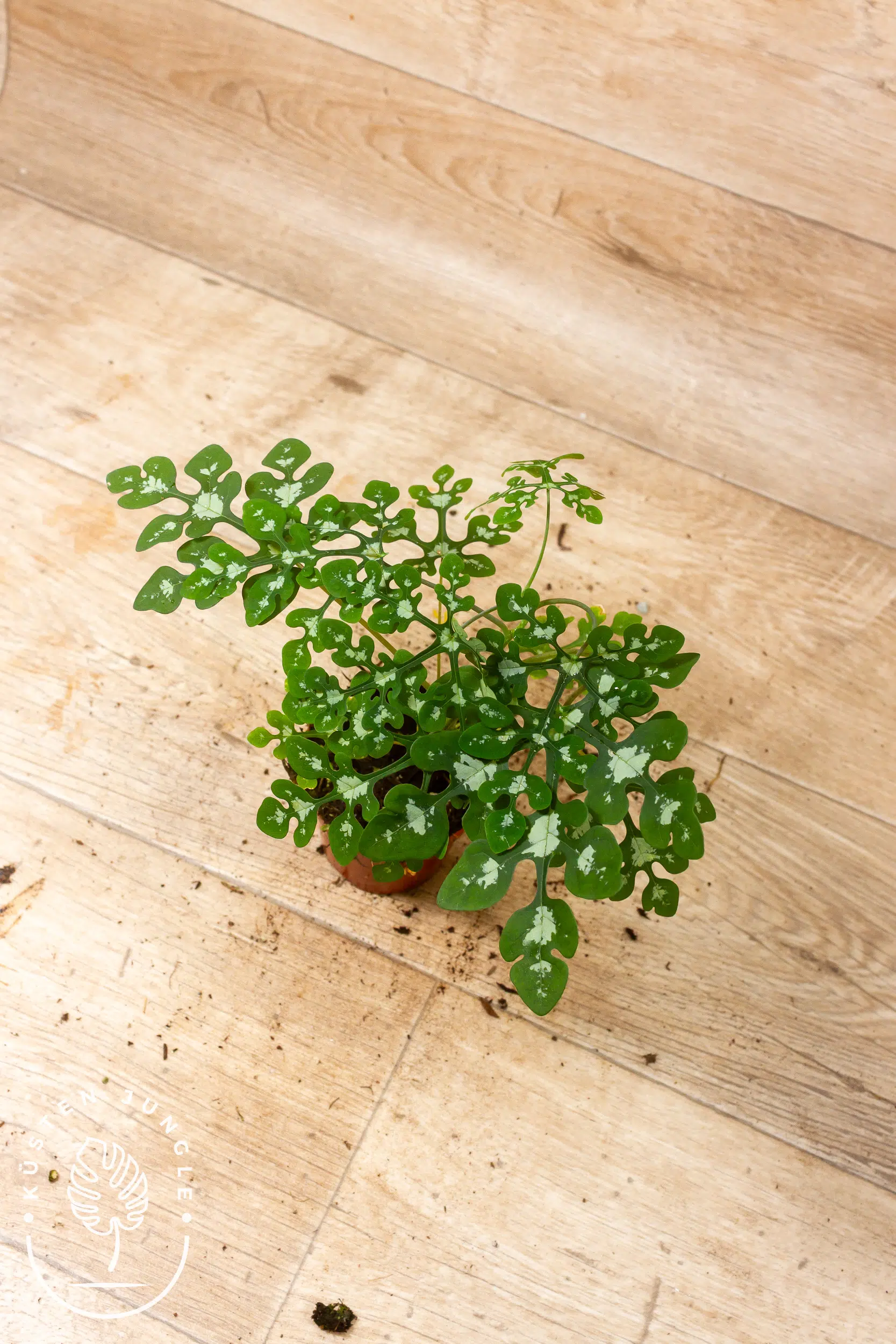
From the knobby thickened caudex, one or more green, climbing shoots develop in spring with finely pinnate, pointed leaves, which often show an irregular white „snowflake“ pattern in cultivation. Leaf drop in winter is mainly triggered by falling temperatures and shorter, weaker daylight hours – if temperature and light availability remain consistently stable and sufficiently high year-round, for instance with the help of a grow light, the plant can remain leafy for significantly longer or go through the dormant phase only briefly and incompletely. If it sheds its vines nonetheless, there is no cause for concern: the caudex remains as a water and nutrient store and reliably sprouts anew when conditions improve again. Whether a pronounced caudex even forms depends on the propagation method: plants grown from seed generally develop a significantly stronger caudex than cuttings.
Good to know
Important safety notice: The genus Adenia is considered significantly more poisonous than most other plants in our assortment. Several closely related species contain highly toxic ingredients in their caudex and tendrils, which can cause serious health damage if ingested. Therefore, this plant should always be kept out of reach of children and pets, no part of the plant should be consumed, and when cutting, it is advisable to avoid contact of the escaping sap with skin and especially eyes.
Adenia perrieri originates from the dry forests of Madagascar, where it grows on sandy soils and basalt rocks. The species is dioecious, meaning there are separate male and female plants – both sexes are needed for seed formation.