
Alocasia infernalis ‚Black Magic‘ - Care
Location & Light
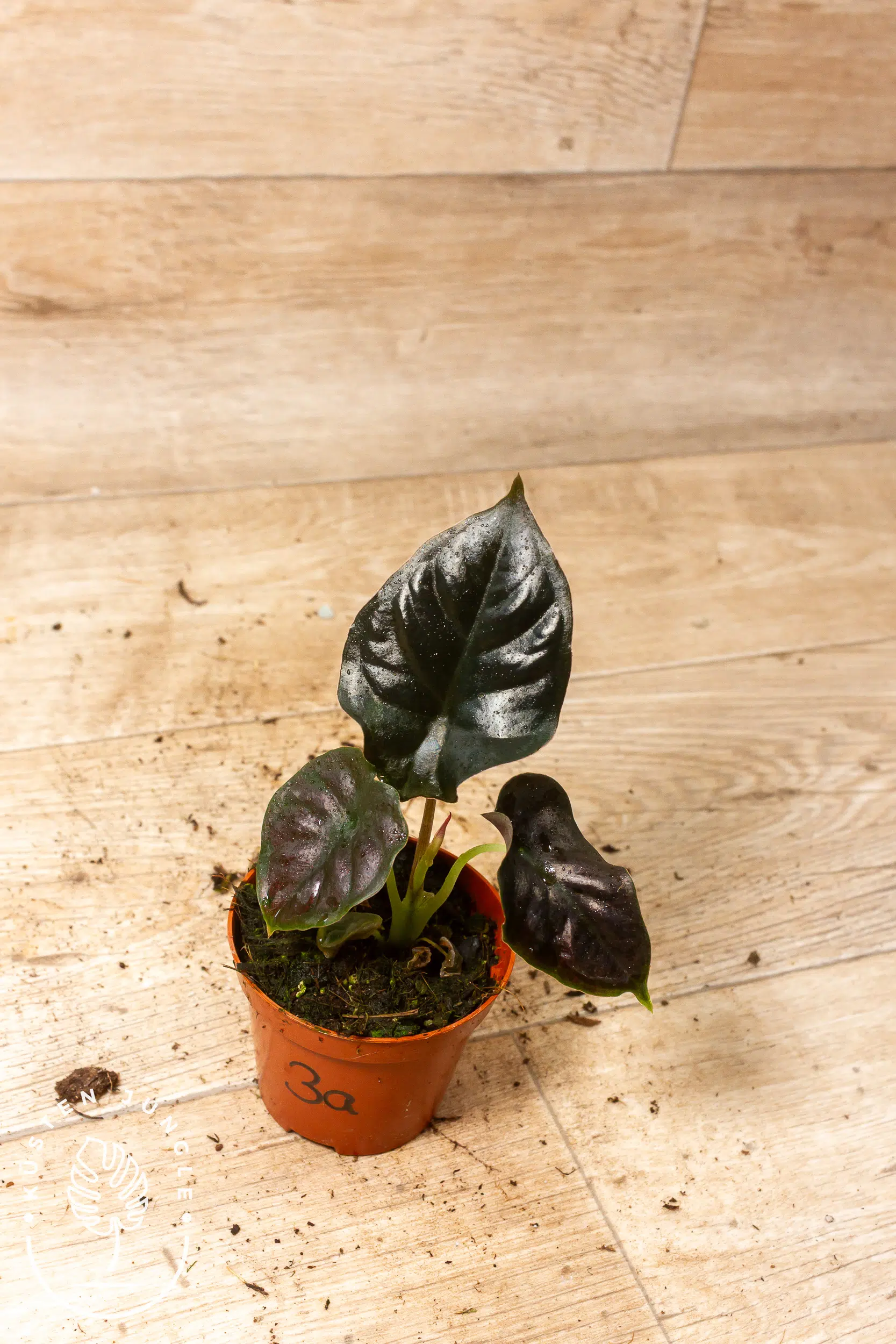
The almost black leaf coloration of this Alocasia is a natural adaptation to the shaded forest floor of Borneo, which is why it can tolerate less light than many other aroids – a bright spot with filtered, indirect light is perfectly sufficient, and even light shade is tolerated. Direct sun, on the other hand, will permanently bleach out the dark, glossy leaf color and cause burns. As a general guideline for the genus, Alocasias typically fall within the range of approximately 150 to 500 µmol/m²/s PAR (PPFD); since this variety is more shade-tolerant than many large-leaved Alocasias, it thrives more in the lower end of this range, which with 10 to 12 hours of light corresponds to a DLI of roughly 6.5 to 13 mol/m²/day.
Pour
This dwarf Alocasia likes to be consistently lightly moist, but by no means waterlogged – water when the top few centimeters of the substrate have dried out. The tuber of this variety is particularly sensitive to prolonged wetness and will quickly rot, so it's better to water more often in smaller amounts than rarely and thoroughly. Room-temperature, low-lime water is best tolerated; excess water in the saucer should always be removed.
Fertilize
Unlike many large-leaved Alocasias, this compact jewel variety is not a particularly heavy feeder. A heavily diluted fertilizer application every 4 to 6 weeks during the growing season is sufficient for its moderate, compact growth. General guidelines for Alocasias include a pH of about 5.5 to 6.5 and a rather low EC (electrical conductivity) of the irrigation water, roughly 1.0 to 1.3 mS/cm, as the genus is sensitive to salt. Follow the manufacturer's instructions for exact dosage. If the plant is only near a window in autumn and winter, less frequent or no fertilization is needed due to weaker light. However, under consistently bright plant lighting year-round, you can continue fertilizing at the usual rhythm.
We consciously alternate between different fertilizers for our own plants – currently including COMPO COMPLETE, Foliage Focus, Liquid Gold Leaf, and Hesi TNT-Complex, supplemented with Hesi Root Complex, Hesi PowerZyme, and CalMag as needed.
Substrate
A very permeable, mineral-rich substrate is practically essential for this variety: a mixture of coarse orchid bark, perlite, some coco fiber, and sphagnum moss keeps the tuber airy and reliably drains without drying out completely. In contrast, normal, dense potting soil promotes waterlogging and thus rot at the sensitive tuber base.
Humidity & Temperature
This Alocasia can generally thrive even outside a terrarium or greenhouse cabinet; however, at temperatures of 70 % or higher, its glossy leaf surface appears significantly more flawless and less prone to crispy edges. If you’re growing it in a normal living room, you can help it along with a humidifier or by grouping it with other plants. Its ideal temperature range is between 20 and 28 °C; if it gets cooler, it will grow more compactly, but also noticeably slower.
Growth & Dormancy
New leaves initially appear dark green, only hardening over time to their characteristic, almost black, glossy color with a violet-shimmering underside. From the compact, tuberous base, the plant grows upright and bushy with densely packed petioles, but remains small overall, rarely exceeding 60 cm. If it only grows on a windowsill in autumn and winter, growth visibly slows due to weaker light, and individual older leaves may be shed; however, with consistently bright plant light year-round, growth typically remains stable. Important to know: If the plant sheds all its leaves under unsuitable conditions, it retreats into its tuber instead of dying completely – it can sprout anew from this when conditions improve again.
Good to know
Under the name „Black Magic,“ an entirely different, significantly larger plant from another genus circulates commercially alongside this compact Jewel Alocasia: Colocasia esculenta ‚Black Magic,‘ an „Elephant Ear“ that grows up to two meters tall with deep purple leaves, differing greatly in both size and care. This page is exclusively about the small-growing Alocasia infernalis ‚Black Magic,‘ also known as „Black Panther,“ which originally comes from Sarawak on Borneo.
Like all aroids, this Alocasia contains calcium oxalate crystals and is irritating to pets and children if consumed – best to place it out of reach. Regular checks of the undersides of the leaves are also worthwhile, as spider mites are among the more common problems with this genus.