
Begonia brevirimosa – Care
Location & Light
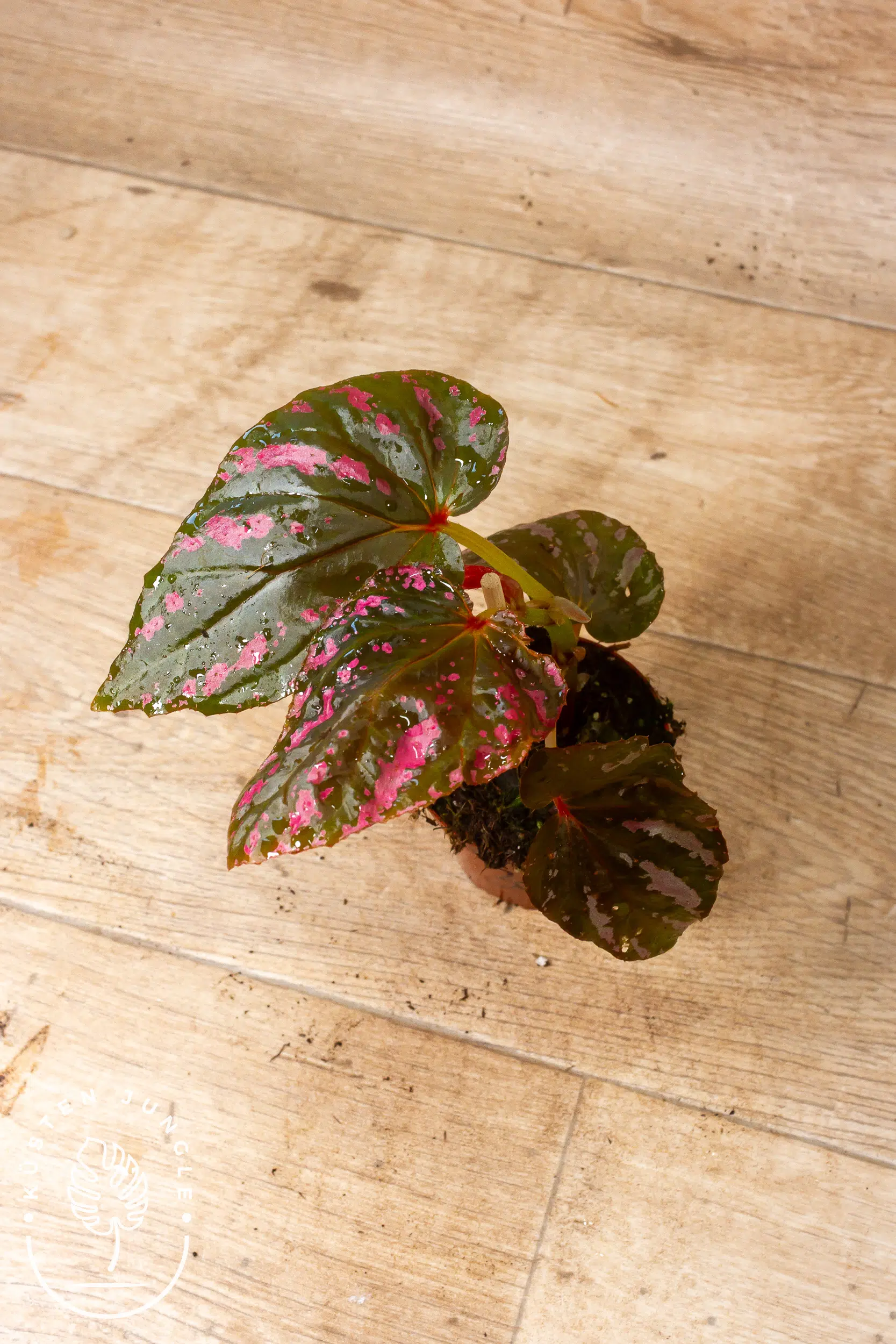
In its native habitat, the undergrowth of the rainforests of Papua New Guinea and the Bismarck Archipelago, this begonia only receives filtered light through the canopy – accordingly, it feels most comfortable in a bright but shady to partially shady spot. It does not tolerate direct midday sun well and quickly reacts with burnt or faded leaf margins, while an east or west window with plenty of diffused light is excellent. If it is too dark, it grows noticeably more hesitantly, and the strong pink markings on the leaves become less prominent.
Pour
Watering will only resume when the top layer of substrate feels dry – this is usually sufficient about once a week, and more often during the warm summer months with strong growth. More important than a fixed schedule is to consistently avoid waterlogging: the fleshy stems and roots are sensitive to prolonged wet substrate and will rot. In winter, when growth is dormant, more time can pass between waterings.
Fertilize
The nutrient requirements of begonias are generally considered moderate rather than extremely high, and even this vigorously growing species does not need to be fertilized weekly – a standard liquid houseplant fertilizer every 2 to 3 weeks during the growing season is usually sufficient to support lush foliage. Guidelines for the genus include a pH of around 5.5 to 6.5 and an electrical conductivity of the irrigation water of roughly 1.0 to 1.5 mS/cm. If the plant is kept by a window only in autumn and winter, fertilization is less frequent or not at all due to weaker light; if, however, it is under a sufficiently bright plant lamp year-round, fertilization can continue at the usual rhythm.
We consciously alternate between different fertilizers for our own plants – currently including COMPO COMPLETE, Foliage Focus, Liquid Gold Leaf, and Hesi TNT-Complex, supplemented with Hesi Root Complex, Hesi PowerZyme, and CalMag as needed.
Substrate
This begonia thrives in loose, well-draining, yet nutrient-rich soil – for example, high-quality potting soil loosened with perlite or coconut coir to allow excess water to drain quickly. A slightly acidic pH is acceptable, and a pot with good drainage is essential due to the plant's sensitivity to waterlogging.
Humidity & Temperature
Begonia brevirimosa thrives even in normal indoor air conditions and does not necessarily need to be kept in a greenhouse or terrarium. While it grows most vigorously at humidity levels between 60 and 80 %, at lower humidity it simply grows a bit more slowly and may occasionally develop a small brown spot on the edge of a leaf—but this isn’t a real problem for the plant. A nearby humidifier can further boost growth, though it’s not a must for this species. The ideal temperature range is between 18 and 26 °C; cool drafts in winter should be avoided.
Growth & Form
This shrub begonia grows upright and bushy with strong, fleshy stems. With a potential final height of 1.5 to 3 meters, it is one of the larger representatives of its genus. Those looking for a compact terrarium begonia are in the wrong place, but those who want a striking specimen plant will be rewarded. Pruning at the right time keeps growth more compact and encourages branching; the plant does not need a trellis. With windowsill cultivation only in autumn and winter, growth slows noticeably due to weaker light; however, with year-round sufficient bright plant lamp lighting, growth remains largely uniform.
Good to know
Begonia brevirimosa was first described in 1913 by the German botanist Edgar Irmscher and originally comes from the rainforests of Papua New Guinea and the adjacent Bismarck Archipelago. The striking pink coloration along the dark green leaf veins is naturally occurring in this species and is not a cultivated variegation – a genetically firmly anchored characteristic of the species itself.
Like most begonias, this species also contains oxalates and should be kept out of reach of pets that tend to nibble on plants. Despite its exotic appearance, the care is generally considered uncomplicated and adaptable to normal living conditions.