
Philodendron ‚Caramel Marble‘ - Care
Location & Light
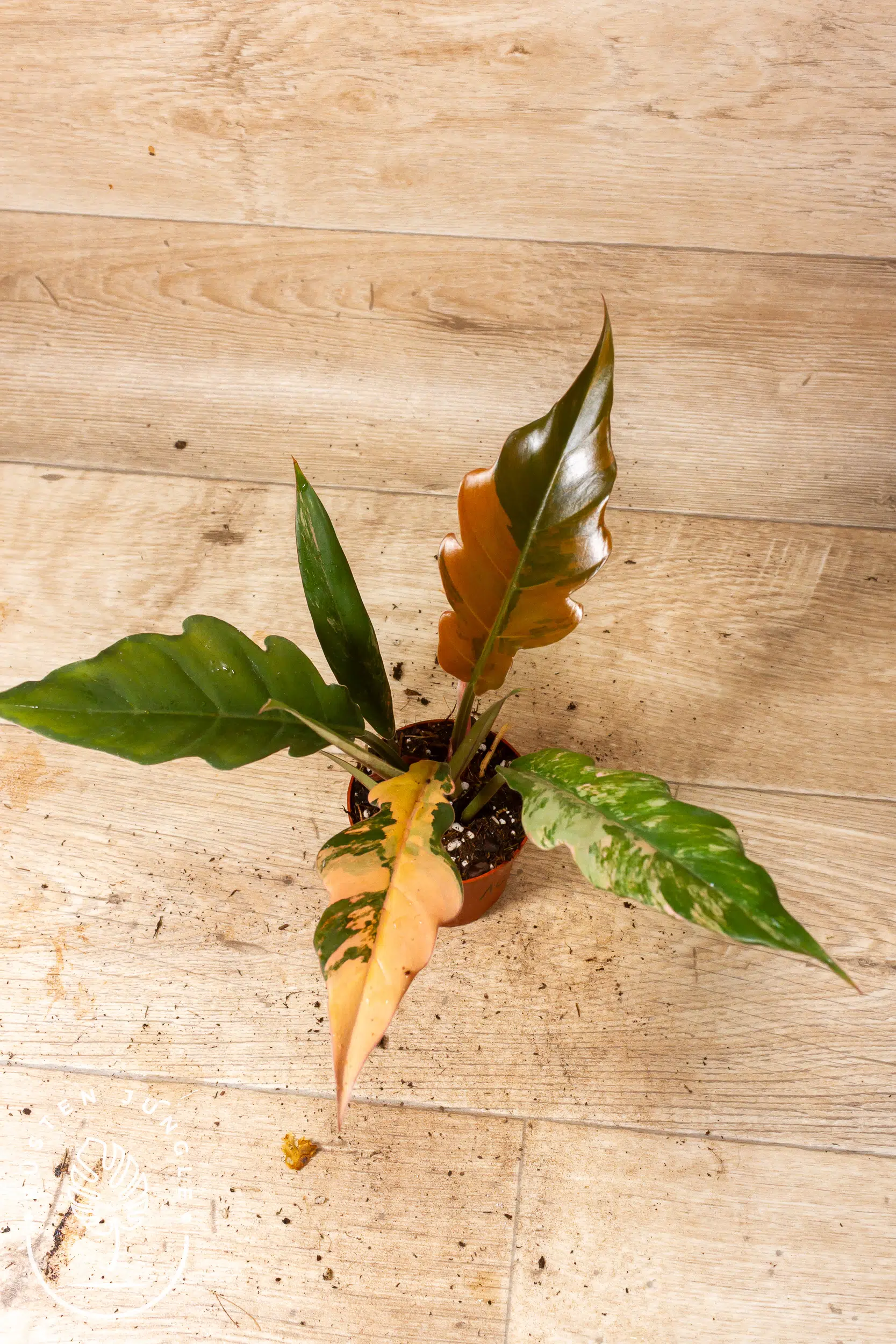
A bright spot without direct sun best showcases this Philodendron's caramel and cream marbling. If it's too dark, the pattern noticeably fades, and the green leaf portions take over as they can form more chlorophyll for photosynthesis. Intense midday sun, on the other hand, quickly leads to burnt spots, especially on the lighter, variegated leaf sections. An east-facing or slightly shaded south-facing window is generally suitable, and it also thrives under a grow light.
Pour
Water when the top 3 to 4 cm of the substrate feel dry – it's best to check with your finger rather than following a rigid schedule. During the growing season in spring and summer, this is usually weekly, while in autumn and winter, every 7 to 10 days is often sufficient. The plant does not tolerate waterlogging well and reacts to it with root rot, which is why excess water should be consistently drained.
Fertilize
Due to its irregular, sometimes very bright variegation, ‚Caramel Marble‘ grows a bit more slowly than fully green Philodendrons and therefore requires less frequent care – a well-diluted liquid fertilizer about every 4 to 5 weeks during the growing season is usually sufficient. General guidelines for the genus are a pH value of approximately 5.5 to 6.5 and an electrical conductivity of the irrigation water of roughly 1.0 to 1.5 mS/cm. If the plant is only placed by a window in autumn and winter, it is fertilized less frequently or not at all due to the weaker light; however, if illuminated by plant lamps year-round, fertilization can continue at the usual rhythm.
We consciously alternate between different fertilizers for our own plants – currently including COMPO COMPLETE, Foliage Focus, Liquid Gold Leaf, and Hesi TNT-Complex, supplemented with Hesi Root Complex, Hesi PowerZyme, and CalMag as needed.
Substrate
A loose, coarse aroid mix made of orchid bark, perlite, and some coco coir or peat moss will provide the necessary drainage and prevent waterlogged roots. A pot with good drainage is essential so that excess watering can reliably drain away.
Humidity & Temperature
Normal indoor air is generally sufficient for this Philodendron, but at levels of about 55 to 60 %, it becomes clear just how much it benefits from it: The leaves appear plumper and the marbling stands out more vividly. A humidifier or a spot with several other plants can also help here, but isn’t a must. The ideal temperature range is between 18 and 29 °C; below 15 °C, growth slows noticeably.
Growth & Support
‚Caramel Marble‘ develops significantly larger and more colorful leaves when grown as a climbing Philodendron on a moss pole or similar climbing support, compared to when it trails freely, where the leaves and internodes tend to remain smaller. The variegation is chimerical and therefore naturally unstable – no two leaves are alike, and occasionally completely green, unvariegated shoots may arise. Such setbacks can be pruned to maintain the striking marbling in the long term. With indoor cultivation in autumn and winter, growth noticeably slows down due to weaker light; however, under year-round bright artificial lighting, growth remains largely consistent.
Good to know
‚Caramel Marble‘ does not occur in nature, but is considered a variegated mutation or cultivated form, presumably originating from Philodendron erubescens or closely related hybrids like ‚Red Emerald‘—a definitive botanical origin has not yet been conclusively determined. The coloring that gives it its name ranges from warm caramel to cream and delicate green, and can vary significantly from leaf to leaf.
Like all aroids, this Philodendron also contains calcium oxalate crystals and is irritating to pets and children if ingested – best to place it out of reach.