
Begonia ‚Midnight Sun‘ Variegata - Care
Location & Light
This hybrid is pleasantly adaptable to light: partial shade to a bright location without direct midday sun works well, and it can even tolerate some direct sun in winter. If placed in too dark a spot, the shoots will grow more hesitantly, but this doesn't cause serious problems – one reason why this variety is considered relatively uncomplicated. For houseplants of this type of Begonia, PAR (PPFD) values of about 40 to 80 µmol/m²/s are considered typical, which corresponds to a DLI of approximately 1.5 to 3.5 mol/m²/day.
Pour
Water when the top 2 to 3 cm of the substrate layer is dry – the goal is evenly moist, not wet. This variety generally tolerates short dry periods quite well, but reacts more sensitively to constantly wet substrate. In winter, when growth is dormant, the soil can dry out a bit longer between waterings.
Fertilize
During the growth phase from spring to summer, this begonia appreciates a well-diluted liquid fertilizer about once a month. Fertilization is completely stopped in autumn and winter. General guidelines for the genus include a pH value of approximately 6.0 to 7.0 and an electrical conductivity of the irrigation water of roughly 1.0 to 1.5 mS/cm. If the plant is only placed by the window in autumn and winter, fertilization is not carried out due to the weaker light anyway; however, with year-round bright plant lamp lighting, fertilization can continue at the normal rhythm for a little longer before being reduced here as well.
We consciously alternate between different fertilizers for our own plants – currently including COMPO COMPLETE, Foliage Focus, Liquid Gold Leaf, and Hesi TNT-Complex, supplemented with Hesi Root Complex, Hesi PowerZyme, and CalMag as needed.
Substrate
The shallow, fine roots of this begonia require a particularly light, airy substrate – a mix of potting soil, perlite, and some fine orchid bark works well and reliably dries out between waterings. Heavy, compact substrate quickly becomes a problem here, as it retains moisture for too long and causes the sensitive roots to rot.
Humidity & Temperature
This hybrid is considered relatively tolerant of low humidity and can survive drier periods in the home without major problems – a humidifier isn't a must, but it helps if you already have one. In terms of temperature, it thrives between approximately 10 and 27°C (50-80°F); prolonged heat beyond this range is less tolerated than by many other house begonias.
Growth & Form
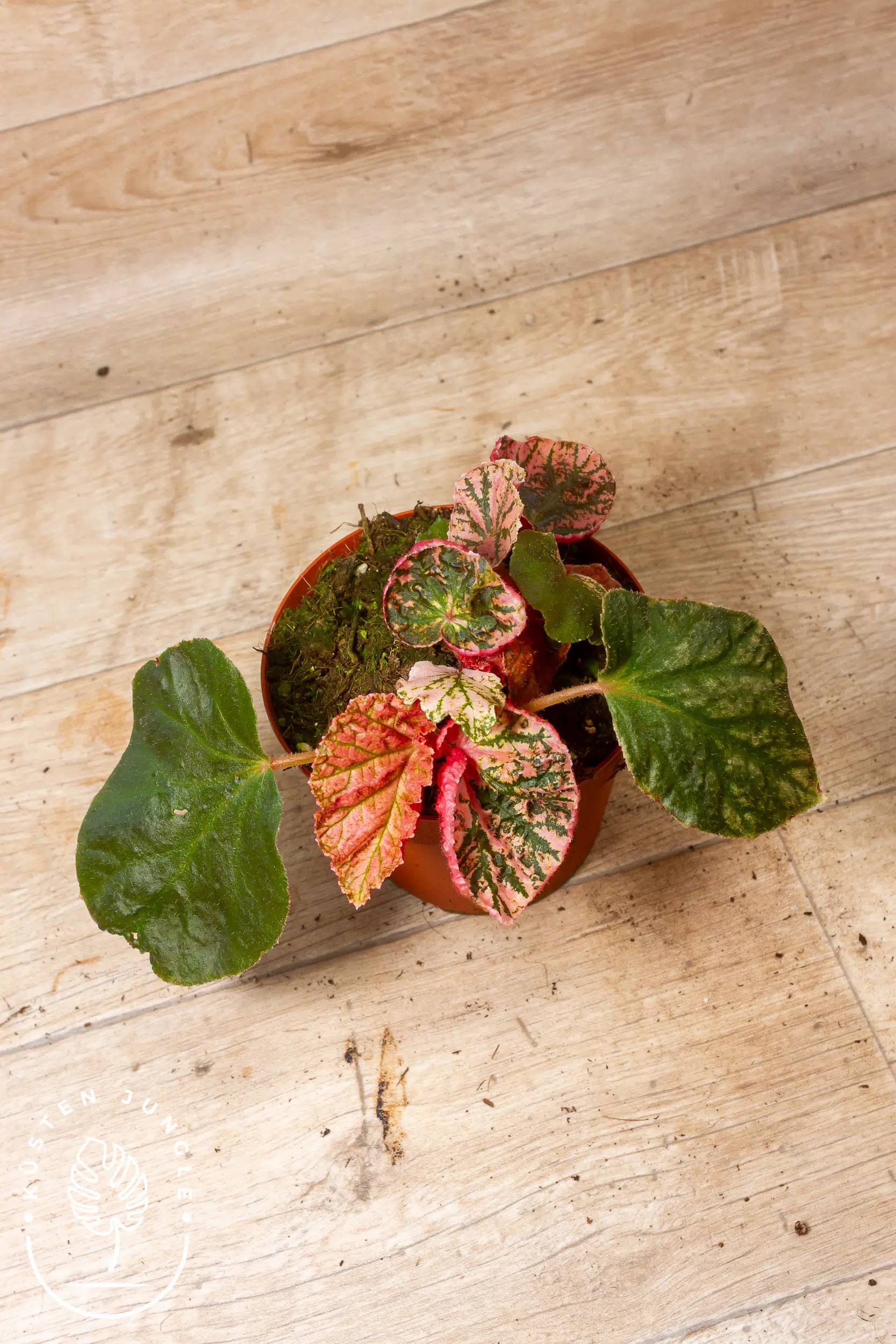
As a rhizomatous begonia, ‚Midnight Sun‘ Variegata remains pleasantly compact, usually reaching only 25 to 30 cm in height, so it doesn't need a support to climb. The leaf coloration changes visibly with age: young leaves often appear delicate pink with red veins, while older leaves turn more mossy green – a normal process, not a sign of improper care. In autumn and winter, the plant usually also blooms with small pink flowers. With window-only placement, growth noticeably slows in the darker season; however, under year-round bright plant lamp lighting, it continues to grow more evenly.
Good to know
This begonia was bred in 1980 by Byron Martin, owner of the American nursery Logee's, and won the „Best New Hybrid Introduction“ award in the same year. It has been continuously cultivated ever since. A much darker, more dramatic Rex begonia variety with an almost black leaf base and a bright red-copper pattern circulates commercially under the name „Midnight Sun“; this is NOT identical to the moss green-pink-cream colored variety described here.
Like most begonias, this species also contains oxalates and should be kept out of reach of pets that tend to nibble on plants.