
Philodendron ‚Emerald Queen Variegata‘ – Care
Location & Light
Bright, indirect light best showcases the cream-white to yellow variegation of this Philodendron and keeps it stable, while locations that are too dark can cause the patterns to fade over time. Direct sun should still be avoided as it can quickly burn the lighter leaf sections. Pleasantly uncomplicated: This variety copes surprisingly well even in slightly shadier corners, though it will grow noticeably slower there.
Pour
Once the top 2 to 3 cm of the substrate are dry, water thoroughly until it drains. In summer, the plant needs watering more frequently than in winter when growth is dormant. Consistently avoid waterlogging in the pot, so always pour out excess water from the saucer.
Fertilize
Unlike some more delicate variegated Philodendrons, ‚Emerald Queen Variegata‘ continues to grow surprisingly vigorously despite its variegation and can be cared for accordingly at its usual pace – a well-diluted liquid fertilizer roughly every 3 to 4 weeks during the growing season is sufficient. General guidelines for the genus are a pH value of approximately 5.5 to 6.5 and an electrical conductivity of the irrigation water of roughly 1.0 to 1.5 mS/cm. If the plant is only placed by a window in autumn and winter, less or no fertilizer is applied due to the weaker light; however, with year-round bright plant lamp illumination, fertilization can continue at the usual pace.
We consciously alternate between different fertilizers for our own plants – currently including COMPO COMPLETE, Foliage Focus, Liquid Gold Leaf, and Hesi TNT-Complex, supplemented with Hesi Root Complex, Hesi PowerZyme, and CalMag as needed.
Substrate
A loose, nutrient-rich, and well-draining substrate made of potting soil, perlite, and some orchid bark ensures the right balance between moisture retention and drainage. A pot with sufficient drainage holes is important so that excess water can drain away quickly.
Humidity & Temperature
This variety is one of the more tolerant Philodendrons when it comes to humidity and does well even in drier living spaces. Higher humidity levels—starting at around 60 %—still promote lush, glossy foliage; a humidifier or placing the plant near other plants can provide additional help here. The ideal temperature range is between 18 and 27 °C; temperatures should not drop below 15 °C for extended periods.
Growth & Form
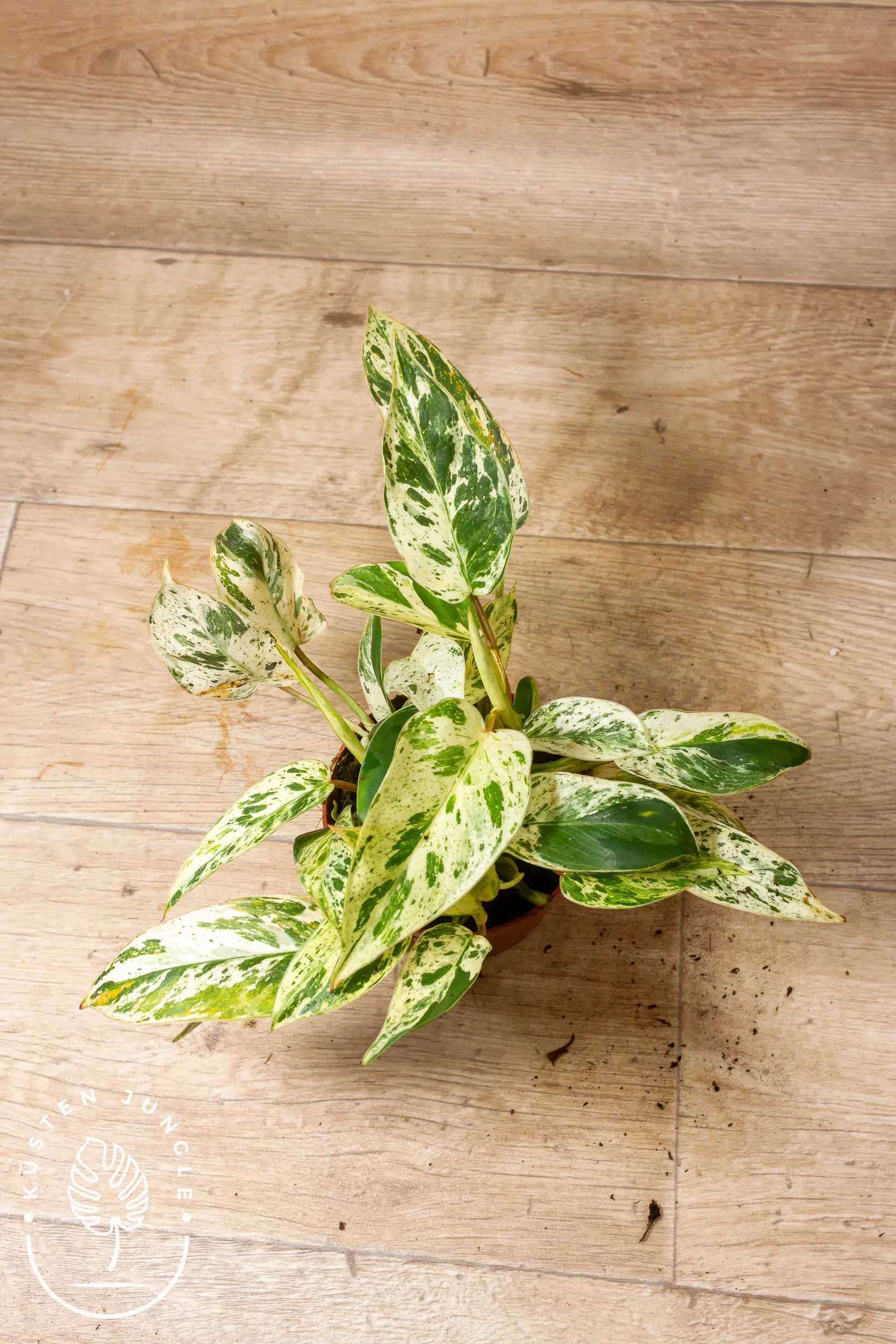
‚Emerald Queen Variegata‘ primarily grows bushy and compact, forming multiple shoots from a single base over time, rather than climbing upwards like a classic climbing Philodendron. With older, well-established specimens, a slight climbing tendency may still emerge – a moss pole will then promote larger, more contrasting leaves, but it is not a must. The variegation varies from leaf to leaf, from delicate speckles to large creamy white areas. With pure window placement in autumn and winter, growth noticeably slows down due to less light; under year-round bright plant lamp lighting, however, growth remains largely consistent.
Good to know
‚Emerald Queen‘ is a cultivar of Philodendron erubescens, a species originally from the tropical forests of Colombia, whose species name means „blushing“ – an allusion to the reddish shimmering young shoots of many varieties of this species. It belongs to a whole series of well-known erubescens cultivars such as ‚Red Emerald‘ or ‚Pink Princess‘.
Like all aroids, this Philodendron also contains calcium oxalate crystals and is irritating to pets and children if ingested – best to place it out of reach.