
Scindapsus ‚Jade Satin‘ Marble - Care
Location & Light
Bright, indirect light best highlights the silvery-white marbling of this pothos; mild morning or evening sun is generally well tolerated. Direct midday sun, however, should be avoided, as it can quickly scorch the velvety leaf surface. While darker locations are tolerated for a while, the leaf pattern will noticeably fade, and growth will become more stunted.
Pour
Let the substrate almost completely dry out between waterings before watering thoroughly again – this pothos will tolerate dry periods much better than too much moisture. If the leaves curl or wilt, the substrate is usually too dry; yellow leaves, on the other hand, tend to indicate too much water. Standing water in the pot should be avoided in any case, so always pour off excess water.
Fertilize
During the growth phase from spring to summer, a well-diluted liquid fertilizer every 2 to 4 weeks is sufficient. Fertilization should be completely stopped in autumn and winter. As guidelines for the genus, a pH value of approximately 5.5 to 6.5 and an electrical conductivity of the irrigation water of roughly 1.0 to 2.0 mS/cm are recommended. If the plant is only placed by the window in autumn and winter, no further fertilization will occur due to the weaker light. However, with year-round bright plant lamp lighting, fertilization can continue at the normal rhythm for a while longer before also being reduced.
We consciously alternate between different fertilizers for our own plants – currently including COMPO COMPLETE, Foliage Focus, Liquid Gold Leaf, and Hesi TNT-Complex, supplemented with Hesi Root Complex, Hesi PowerZyme, and CalMag as needed.
Substrate
A coarse aroid substrate made of coco coir, perlite, coco chunks, and some pine bark ensures proper root aeration and prevents waterlogging. A pot with good drainage is important so that excess watering can drain away quickly.
Humidity & Temperature
This Pothos usually manages well with normal room air, so a humidifier isn't strictly necessary. However, slightly increased humidity promotes lusher, more even growth, and placing it with other plants can also help here. Its preferred temperature range is between 65 and 85 °F (18 to 29 °C), and cool drafts in winter should be avoided.
Growth & Support
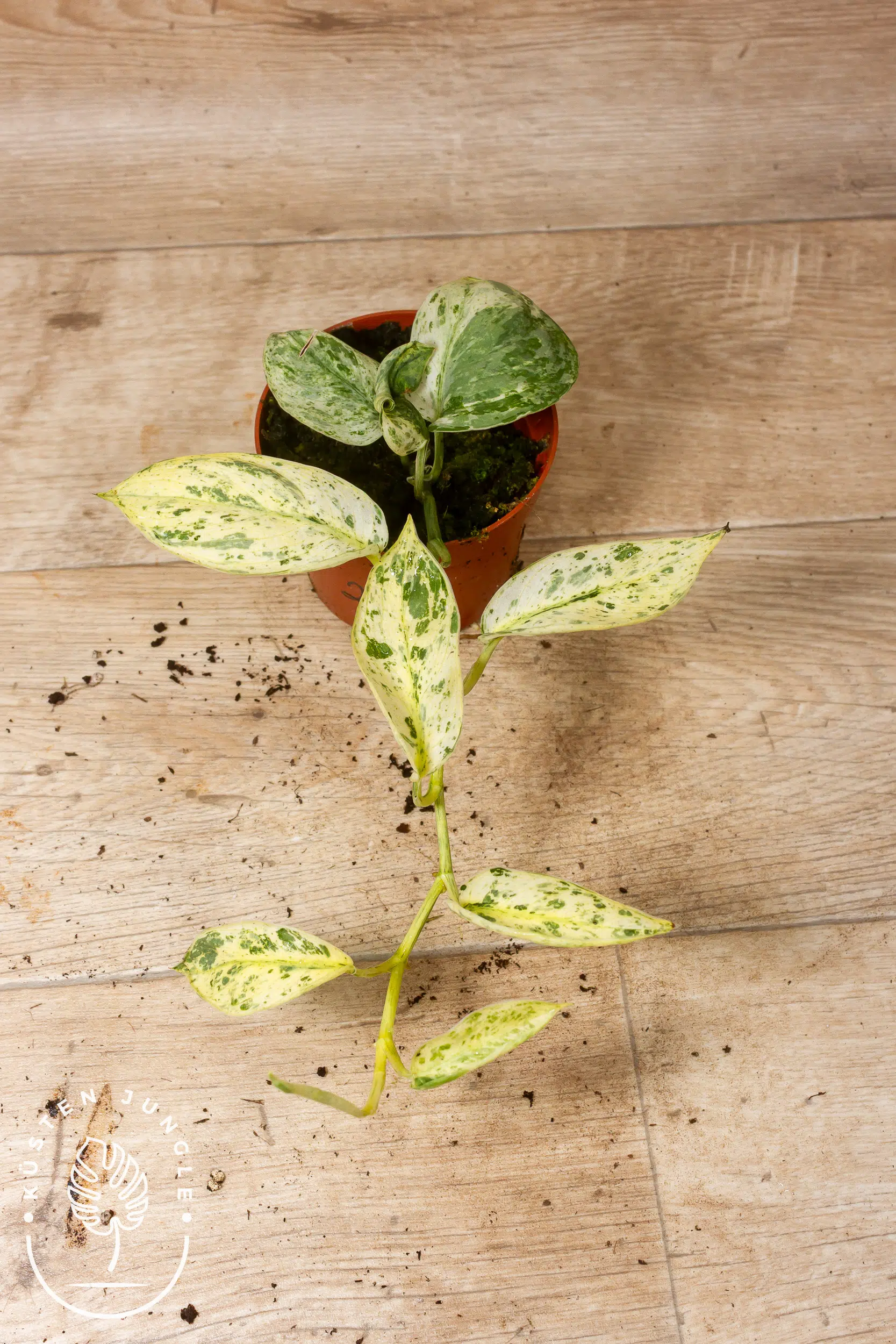
This Pothos grows rather slowly, trailing to climbing, and clings to a moss pole with small aerial roots, but can just as easily be cultivated hanging in a basket. The marbling varies from leaf to leaf, from fine speckling to large silvery-white areas, so no two leaves are alike. With window-only cultivation in autumn and winter, the already leisurely growth slows down further due to the weaker light; under year-round bright plant lamp lighting, however, growth remains largely uniform.
Good to know
Scindapsus is native to the tropical rainforests of Southeast Asia, particularly the Philippines, where the genus begins on the forest floor and climbs up tree trunks. The ‚Marble‘ variegation of this ‚Jade Satin‘ form appears as unpredictable silvery-white patterns, in contrast to the golden-yellow variegated ‚Aurea‘ form of the same variety, with which it can be easily confused.
Like all Aroids, this Pothos also contains calcium oxalate crystals and is irritating to pets and children if consumed – best to place out of reach.