
Begonia curtisii ‚Galaxy‘ – Care
Location & Light
Accustomed to the shade of forests at the foot of limestone cliffs, this begonia prefers bright but filtered light without direct sun. Intense sunlight quickly burns the sensitive, velvety leaves, while too little light makes growth tougher and reduces the clarity of the star-like speckling. As a guideline for houseplants of this type, roughly 40 to 80 µmol/m²/s PAR (PPFD) is considered appropriate, which corresponds to a DLI of approximately 1.5 to 3.5 mol/m²/day.
Pour
While this begonia likes humid air, it absolutely does not like constantly wet roots. Therefore, water only again when the top layer of soil has dried out. It tolerates overly wet roots much less well than a short dry spell. After moving to a new home, it can also take a while for the plant to settle in; occasional leaf curling during this phase is not uncommon and usually not a cause for concern.
Fertilize
During the growth and flowering phases, this begonia tolerates very dilute feeding with every watering, supplemented once a month with a more complete, well-diluted liquid fertilizer. General guidelines for the genus are a pH of approximately 5.5 to 6.5 and an electrical conductivity of the irrigation water of roughly 1.0 to 1.5 mS/cm; begonias are generally sensitive to excessively high salt concentrations, so it's better to dose a little more sparingly. If the plant is only placed on a windowsill in autumn and winter, no further fertilization is needed due to the weaker light anyway; however, with year-round bright grow light illumination, fertilization can continue at the normal rhythm for a bit longer.
We consciously alternate between different fertilizers for our own plants – currently including COMPO COMPLETE, Foliage Focus, Liquid Gold Leaf, and Hesi TNT-Complex, supplemented with Hesi Root Complex, Hesi PowerZyme, and CalMag as needed.
Substrate
A highly permeable substrate is more important for this begonia than for most others – a fine, limestone-adapted mix with a high perlite content comes closest to its natural habitat conditions. A pot with good drainage is a must, as the fine roots should by no means remain permanently wet.
Humidity & Temperature
When it comes to humidity, this begonia is one of the more demanding species: experienced growers describe levels around 90 % as ideal; a closed terrarium without active ventilation is significantly better suited than an open windowsill. If humidity remains consistently low, the plant will find it noticeably more difficult to acclimate and continue growing healthily. The optimal temperature range is between 20 and 26 °C.
Growth & Dormancy
This begonia grows from a small tuber and tends to develop a rather loose, somewhat sprawling habit over time; under very moist conditions, small tubers can also form along the stems. If light, watering, and temperature are kept constant through autumn and winter, for example under a grow light, the dormancy period can be entirely omitted; however, with pure window cultivation in naturally weaker winter light, the plant often retreats, and the tuber can be stored dry until spring. Allowing a dormancy period after flowering is considered beneficial for long-term vitality, but it is not strictly necessary every year.
Good to know
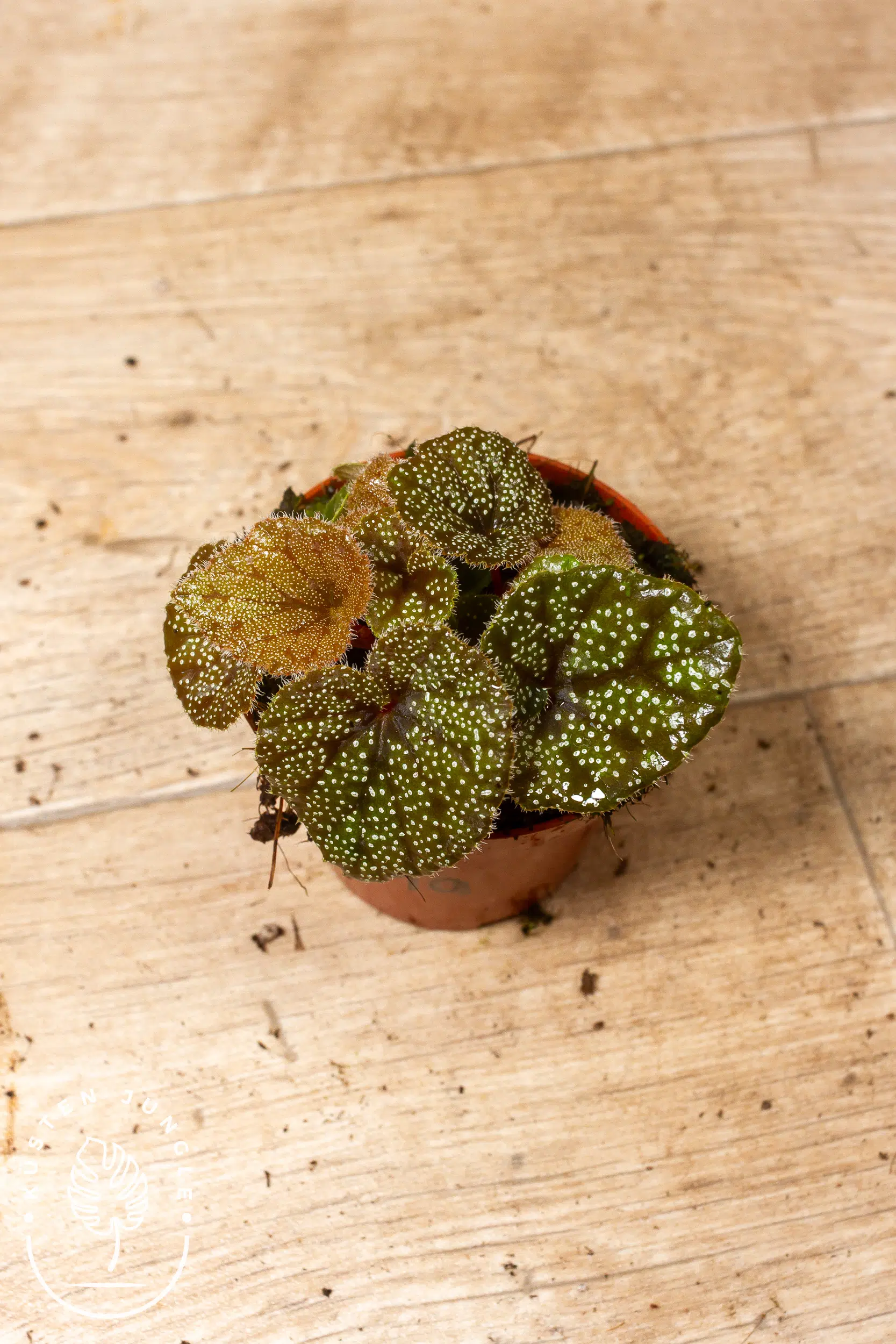
Begonia curtisii originates from the limestone hills of the Phang Nga region in southern Thailand and is known in cultivation in at least two forms: ‚Milky Way‘ and ‚Galaxy‘, described here, both characterized by their star-like speckled leaves. The leaves appear green when young and change to darker shades of purple and red as they mature, with their edges lined by fine, soft hairs.
Like all begonias, this species contains oxalates and should be kept out of reach of pets that tend to nibble on plants.