
Alocasia micholitziana ‚Frydek‘ Variegata – Care
Location & Light
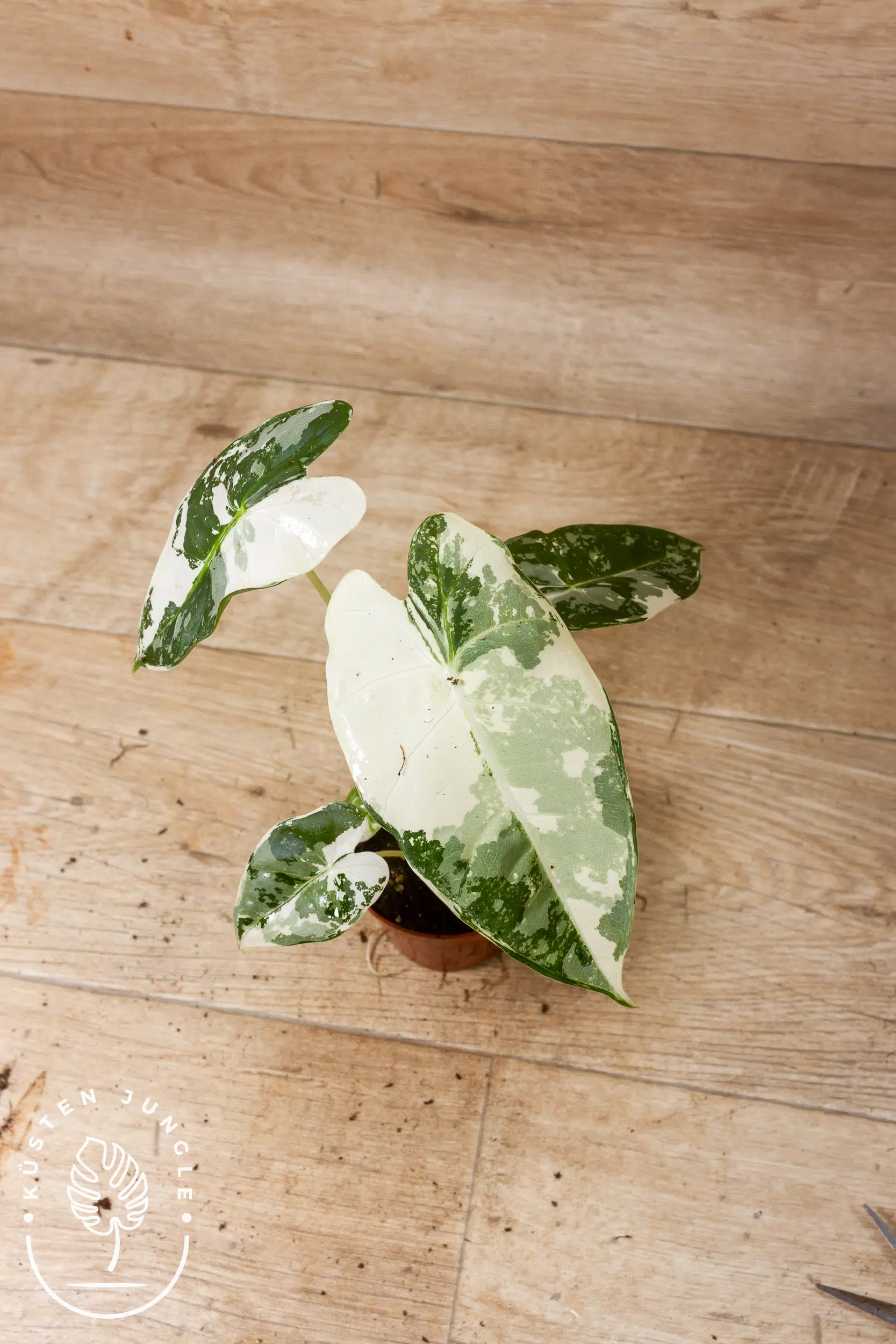
A bright spot with plenty of indirect light best showcases the high-contrast white and green markings of this Alocasia – a north or east-facing window is suitable, and at a sunnier south-facing window, about a meter of distance is usually sufficient. Since the variegated leaf areas, which have less chlorophyll, react more sensitively to direct sun than purely green leaves, they can burn particularly quickly in full sun. If the plant is placed in too dark a location, the variegation will noticeably shrink and growth will become significantly tougher.
Pour
The top 2 to 3 cm of the substrate may dry out, but it should not dry out completely – the goal here is evenly moist, not wet. Watering about once a week is usually sufficient, and less often in winter. Soft, room-temperature water is better tolerated than cold, hard tap water, and waterlogging in the pot should be consistently avoided.
Fertilize
Unlike most fully green Alocasias, this variegated form is not a particularly heavy feeder – due to the less chlorophyll-rich, white leaf areas, it photosynthesizes less overall and therefore requires fewer nutrients. A well-diluted liquid fertilizer about every 2 to 3 weeks at quarter to half strength is sufficient during the growing season. General guidelines for the genus include a pH of approximately 5.5 to 6.5 and an electrical conductivity of the irrigation water of roughly 1.0 to 1.5 mS/cm. If the plant is only placed by a window in autumn and winter, fertilization is done less often or not at all due to the weaker light; conversely, under year-round bright artificial light, fertilization can continue at the usual rhythm.
We consciously alternate between different fertilizers for our own plants – currently including COMPO COMPLETE, Foliage Focus, Liquid Gold Leaf, and Hesi TNT-Complex, supplemented with Hesi Root Complex, Hesi PowerZyme, and CalMag as needed.
Substrate
A coarse, airy, yet consistently moist substrate of orchid bark, perlite, and some coco coir or peat moss is most suitable for this Alocasia. A pot with good drainage is essential to prevent the roots from sitting in moisture permanently.
Humidity & Temperature
Normal indoor air is generally sufficient for this Alocasia, but at a humidity level of about 55 to 70 %, it becomes noticeably more vigorous and its velvety leaf texture stands out more beautifully. A humidifier or a spot in a plant display cabinet can also help here, but isn’t a must. As for temperature, the ideal range is between 18 and 29 °C; it does not tolerate temperatures consistently below 15 °C well.
Growth & Dormancy
Like most Alocasias, this variety also carries only a few leaves at a time, usually 4 to 7, and grows compactly and bushily from the center. Since the emergence of a new leaf requires a lot of energy, the oldest leaf is regularly sacrificed for it – this is a completely normal, cyclical process and not a sign of incorrect care. The variegation is genetically unstable and can recede over time, so individual new leaves may turn green again. With windowsill-only placement in autumn and winter, growth noticeably slows due to weaker light; however, with year-round bright grow light illumination, growth remains largely consistent.
Good to know
The wild species Alocasia micholitziana originates from the Philippines, where it primarily grows on Luzon Island along roadsides and forest clearings at altitudes of approximately 1200 to 1500 meters. It is named after the plant hunter Wilhelm Micholitz, who collected in the tropics in the early 20th century on behalf of the Sander nursery; ‚Frydek‘ originally denotes the entirely green clone, while the lightly variegated „Variegata“ form described here was bred separately.
Like all Araceae, this Alocasia also contains calcium oxalate crystals and is irritating if ingested by pets and children – best to place it out of reach.