
Syngonium podophyllum ‚Strawberry Milk‘ - Care
Location & Light
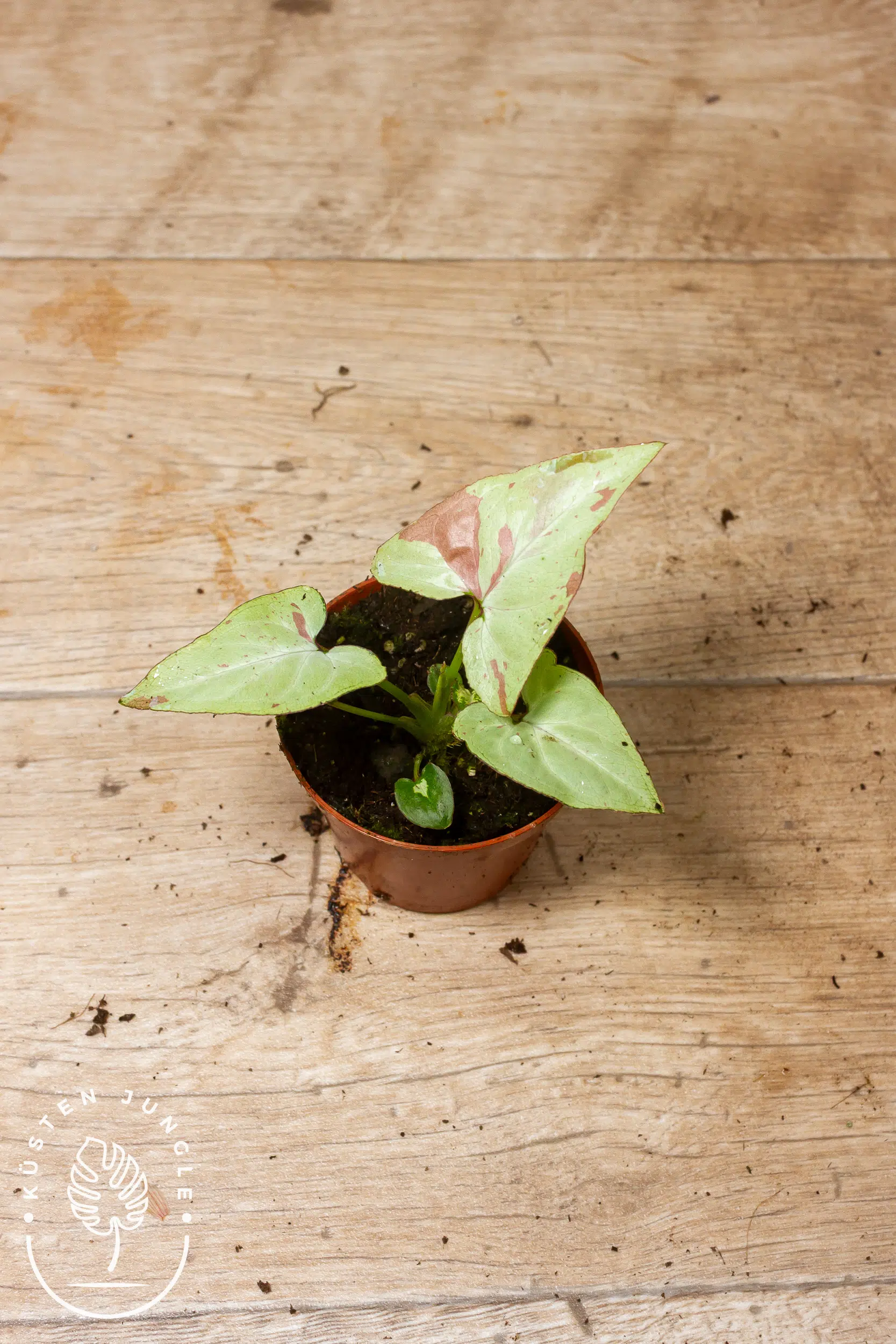
Bright, indirect light keeps the delicate pink, cream, and mint tones of this variety at their most vibrant – placed in too much shade, the green part of the leaves noticeably increases, and the pastel colors fade. Direct midday sun should still be avoided, though mild morning or evening sun is usually tolerated well.
Pour
As soon as the top 2 to 3 cm of the substrate are dry, water thoroughly. Water should not remain on the leaves if possible, as this increases the risk of fungal infection – so when in doubt, it's better to water the substrate directly rather than spraying. In winter, the soil can dry out a bit longer between waterings, but it should not dry out completely even then.
Fertilize
During the growth phase from spring to autumn, a well-diluted liquid fertilizer every 3 to 4 weeks is sufficient; fertilization is discontinued in winter. General guidelines for the genus include a pH value of approximately 5.0 to 6.2 and an electrical conductivity of irrigation water of roughly 1.0 to 2.0 mS/cm. If the plant is only placed by the window in autumn and winter, fertilization will not be necessary due to the weaker light. In contrast, with year-round bright plant lamp lighting, fertilization can continue at the normal rhythm for a bit longer.
We consciously alternate between different fertilizers for our own plants – currently including COMPO COMPLETE, Foliage Focus, Liquid Gold Leaf, and Hesi TNT-Complex, supplemented with Hesi Root Complex, Hesi PowerZyme, and CalMag as needed.
Substrate
A loose, airy substrate made of coco coir, perlite, and some bark ensures good drainage and prevents waterlogging. A pot with sufficient drainage holes is important. Repotting is usually done every 1 to 2 years, as soon as the root ball becomes dense.
Humidity & Temperature
This variety does well in normal indoor air conditions, but at humidity levels of around 60 %, its growth becomes noticeably more vigorous and its pastel colors appear more vivid. Instead of misting—which can lead to fungal problems if the leaves remain wet for too long—it’s better to use a humidifier nearby. The ideal temperature range is between 18 and 28 °C; temperatures should not drop below 10 °C for extended periods.
Growth & Support
‚Strawberry Milk‘ initially grows quite compactly, and only later develops trailing or climbing shoots, which usually remain at 30 to 50 cm without support. When tied up a moss pole or trellis, it develops significantly larger, more lobed leaves than when grown freely. In pure windowsill cultivation during autumn and winter, growth noticeably slows down due to weaker light; however, with year-round bright plant lamp illumination, growth remains largely consistent.
Good to know
The wild form of Syngonium podophyllum originally comes from the tropical rainforests of Central and South America, from Mexico to Bolivia and Brazil. ‚Strawberry Milk‘ is a cultivated color form with particularly soft, milky-pastel variegation – compared to more high-contrast Syngonium varieties, it appears calmer and less conspicuously patterned.
Like all aroids, this Syngonium contains calcium oxalate crystals and is irritating to pets and children if ingested - best to place it out of reach.