
Philodendron patriciae - Care
Location & Light
Bright, indirect light is important for this type of plant. Unlike some more undemanding philodendrons, it doesn't tolerate consistently low light well and grows noticeably more slowly. Direct sun, on the other hand, quickly burns the sensitive, matte leaves. A spot with plenty of diffused light by an east window or a slightly shaded south window is well-suited.
Pour
The soil should be kept evenly moist, but not waterlogged – the top 2 to 3 cm should be allowed to dry out between waterings. Depending on the location and season, this will be approximately every 7 to 10 days. This species does not tolerate waterlogging well and reacts with root rot, so excess water should always be drained off.
Fertilize
During the growth phase from spring to autumn, a well-diluted, balanced liquid fertilizer once a month is sufficient. The recommended pH range for the genus is around 5.0 to 6.0, and the electrical conductivity of the irrigation water should be roughly 1.0 to 1.5 mS/cm. If the plant is only placed by the window in autumn and winter, no further fertilization is necessary due to the weaker light; however, with year-round bright plant lamp lighting, fertilization can continue at the usual rhythm.
We consciously alternate between different fertilizers for our own plants – currently including COMPO COMPLETE, Foliage Focus, Liquid Gold Leaf, and Hesi TNT-Complex, supplemented with Hesi Root Complex, Hesi PowerZyme, and CalMag as needed.
Substrate
An airy, well-draining substrate of orchid bark, perlite, and some coco coir or peat moss comes closest to this epiphytic growing species. A pot with good drainage is important, repot every few years once the root ball becomes dense.
Humidity & Temperature
This species is indeed particular about humidity: levels between 60 and 80 % are universally considered necessary; if humidity falls below this range, the leaves quickly turn yellow or the tips dry out. On the other hand, levels above 80 % can promote mold or fungal problems, so striking a balance with a humidifier or a plant display case is ideal. In terms of temperature, the ideal range is between 18 and 28 °C; both temperatures below 16 °C and prolonged heat above 30 °C should be avoided.
Growth & Support
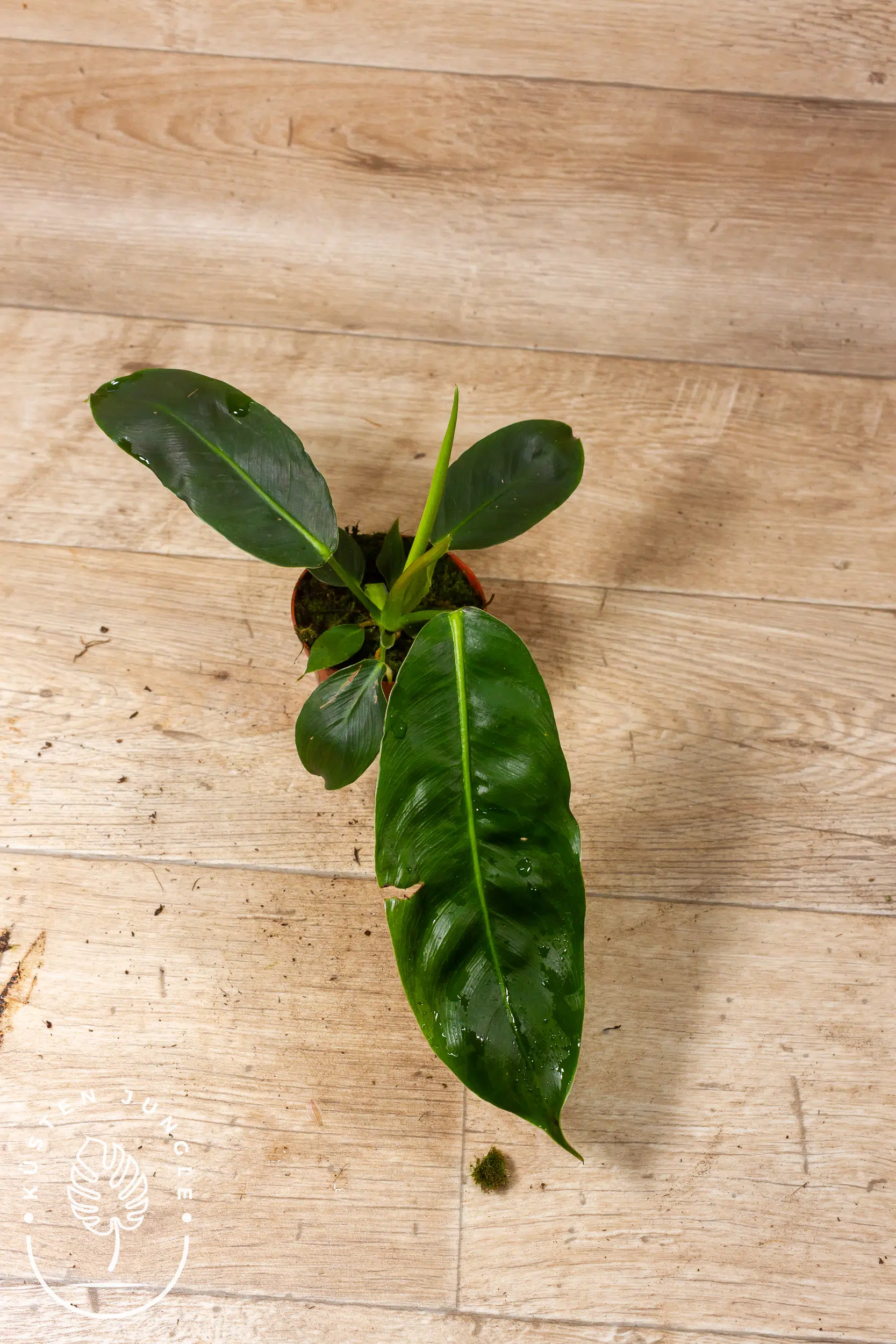
As a hemi-epiphyte, this species climbs tightly up tree trunks with short stems, while its long, narrow leaves elegantly hang downwards – a growth habit that can also be well replicated on a moss pole. With increasing age, the initially smooth leaf surface develops a finely undulated, quilted-like structure that gives the plant its special character. With window-only cultivation in autumn and winter, growth noticeably slows due to weaker light; however, with year-round bright plant lamp illumination, growth remains largely uniform.
Good to know
Philodendron patriciae was scientifically described for the first time in 2010 by the botanist Thomas Croat and named after his wife Patricia; he referred to it as one of the most spectacular Philodendron species he had ever seen. It comes from the Chocó region in northwestern Colombia, where it grows at rather low elevations in the tropical rainforest.
Like all aroids, this Philodendron also contains calcium oxalate crystals and is irritating to pets and children if ingested – best to place it out of reach.