
Rhaphidophora korthalsii ‚Marble Aura‘ – Care
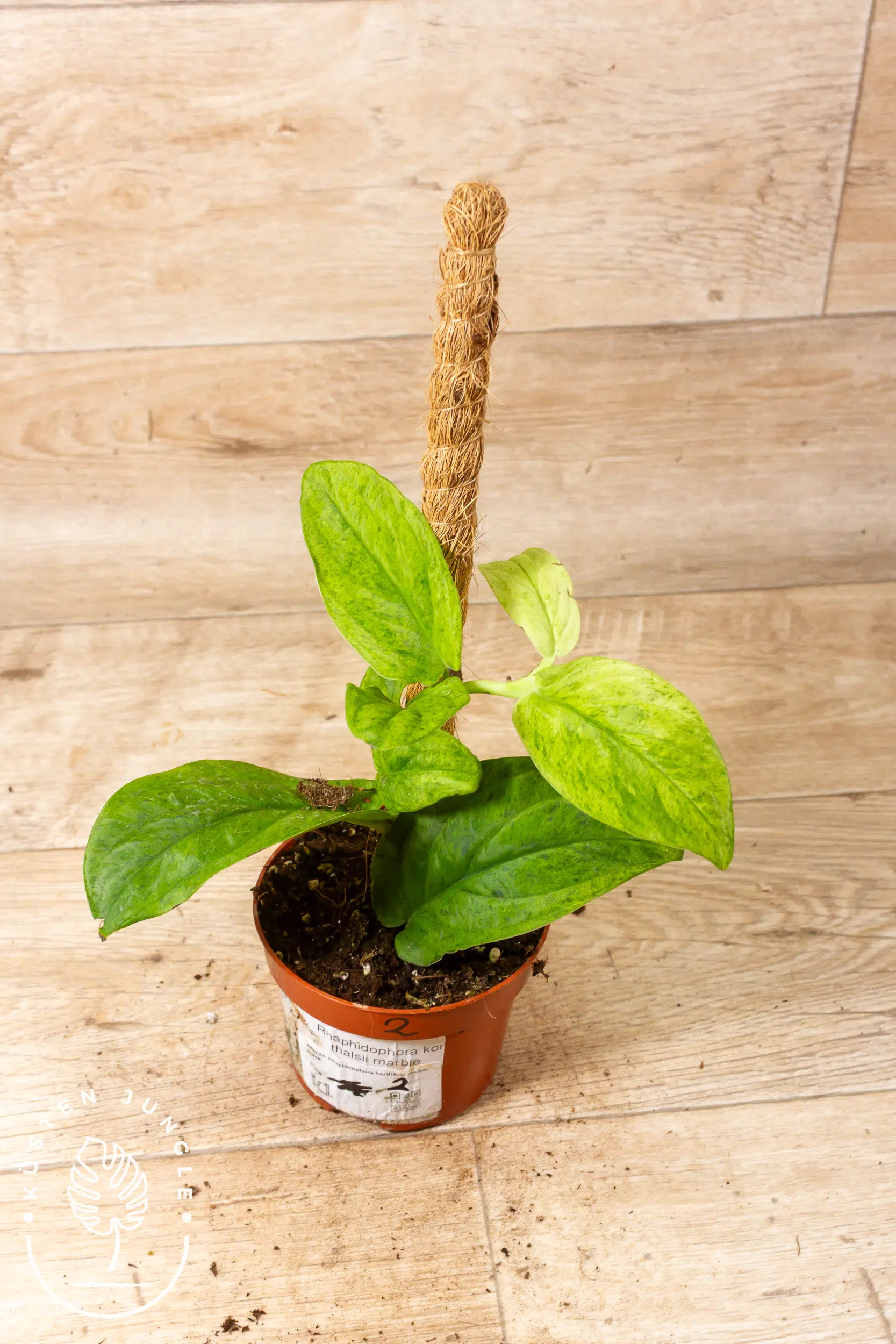
Location & Light
Bright, indirect light best showcases the marbling of this variety, although slightly shadier corners are tolerated – growth will be more hesitant there, however. Direct sun should be avoided as it can quickly burn the white, chlorophyll-poor leaf areas. A spot near an east or west-facing window with filtered light is usually a good fit.
Pour
Water when the top layer of the substrate feels slightly dry to the touch – the goal is evenly moist, not wet. This is usually the case about once a week during the growing season, and less often in winter. Yellowing or mushy leaves are a reliable sign of too much water; in that case, reduce the amount of water and check the drainage.
Fertilize
During the growth phase from spring to summer, a well-diluted liquid fertilizer about once a month is sufficient; fertilization is stopped in autumn and winter. General guidelines for the genus are a pH value of approximately 5.5 to 6.5 and an electrical conductivity of the irrigation water of roughly 1.0 to 2.0 mS/cm. If the plant is only placed by the window in autumn and winter, no further fertilization is needed due to the weaker light anyway; however, with year-round bright plant lamp lighting, fertilization can continue at the usual rhythm.
We consciously alternate between different fertilizers for our own plants – currently including COMPO COMPLETE, Foliage Focus, Liquid Gold Leaf, and Hesi TNT-Complex, supplemented with Hesi Root Complex, Hesi PowerZyme, and CalMag as needed.
Substrate
A mixture of potting soil, some orchid substrate, and perlite allows excess water to drain well while still retaining enough moisture for the roots. A pot with sufficient drainage holes is important. Repotting is usually done every one to two years in the spring, as soon as the root ball becomes dense.
Humidity & Temperature
At around 60 % humidity, this variety grows noticeably more vigorously, though it can also thrive in normal indoor air conditions. Instead of misting—the effect is short-lived anyway, and damp leaves can promote fungal growth—a humidifier or a spot in a plant display case is a much better option. As for temperature, the ideal range is between 18 and 27 °C; drafts and temperatures below 15 °C should be avoided.
Growth & Support
As a so-called shingle plant, the leaves lie flat against their substrate in the juvenile stage, which is why a moss pole or a piece of untreated bark is particularly important here – without a firm hold, the leaves remain small and the characteristic, tightly adhering growth pattern does not occur. With increasing age, the plant transitions into a climbing form with more elongated leaves. In nature, it climbs tree trunks up to 20 meters using this method; as a houseplant, the growth remains significantly more modest but can be pruned back in spring if necessary. With constant window placement in autumn and winter, growth slows down noticeably due to the weaker light; however, with year-round bright grow light illumination, growth remains largely consistent.
Good to know
Rhaphidophora korthalsii is native to Northeast India and the southern Ryukyu Islands, through Thailand to the Malay Archipelago and the western Pacific, with the botanical synonym Rhaphidophora celatocaulis. ‚Marble Aura‘ is a variegated cultivar of the species with irregular white to cream marbling that varies greatly from leaf to leaf.
Like all aroids, this plant also contains calcium oxalate crystals and is toxic to pets and children if ingested – it's best to place it out of reach.