
Kaempferia pulchra Variegata Pink – Care
Location & Light
As a resident of the shady forest floor, this ginger plant needs bright, but filtered light without direct sun to develop its variegation vigorously. Too much direct sun quickly burns the delicate, lightly variegated leaf areas, while too little light noticeably slows growth. A spot near an east or west window usually works well.
Pour
During the growth phase, the substrate may dry out slightly between waterings, but should not dry out completely. The tuber cannot tolerate waterlogging at all and will quickly rot; therefore, always drain excess water. When the plant retreats into its dormant phase and the leaves die back, the amount of water is significantly reduced, and it is only watered minimally until new shoots appear again in spring.
Fertilize
From spring to summer, a well-diluted, balanced liquid fertilizer should be applied about once a month. once the plant enters its dormancy period, fertilization should be completely stopped. As guidelines for tropical houseplants, a pH value of approximately 5.5 to 6.5 and an electrical conductivity of the irrigation water of roughly 1.0 to 1.5 mS/cm are considered, as specific values for this genus could not be found.
We consciously alternate between different fertilizers for our own plants – currently including COMPO COMPLETE, Foliage Focus, Liquid Gold Leaf, and Hesi TNT-Complex, supplemented with Hesi Root Complex, Hesi PowerZyme, and CalMag as needed.
Substrate
A well-draining mix of coco coir, perlite, coco chunks, and some pine bark provides the necessary root aeration and prevents waterlogging. A shallower, wider pot with good drainage is better suited to its low-growing habit than a deep one.
Humidity & Temperature
At around 50 % humidity, this ginger plant thrives, but it can also cope with normal indoor air conditions. Instead of misting it regularly—the effect wears off quickly, and damp leaves can promote fungal growth—a humidifier provides more consistent results. As for temperature, the ideal range is between 18 and 27 °C; cool drafts should be avoided, as they slow down growth.
Growth & Dormancy
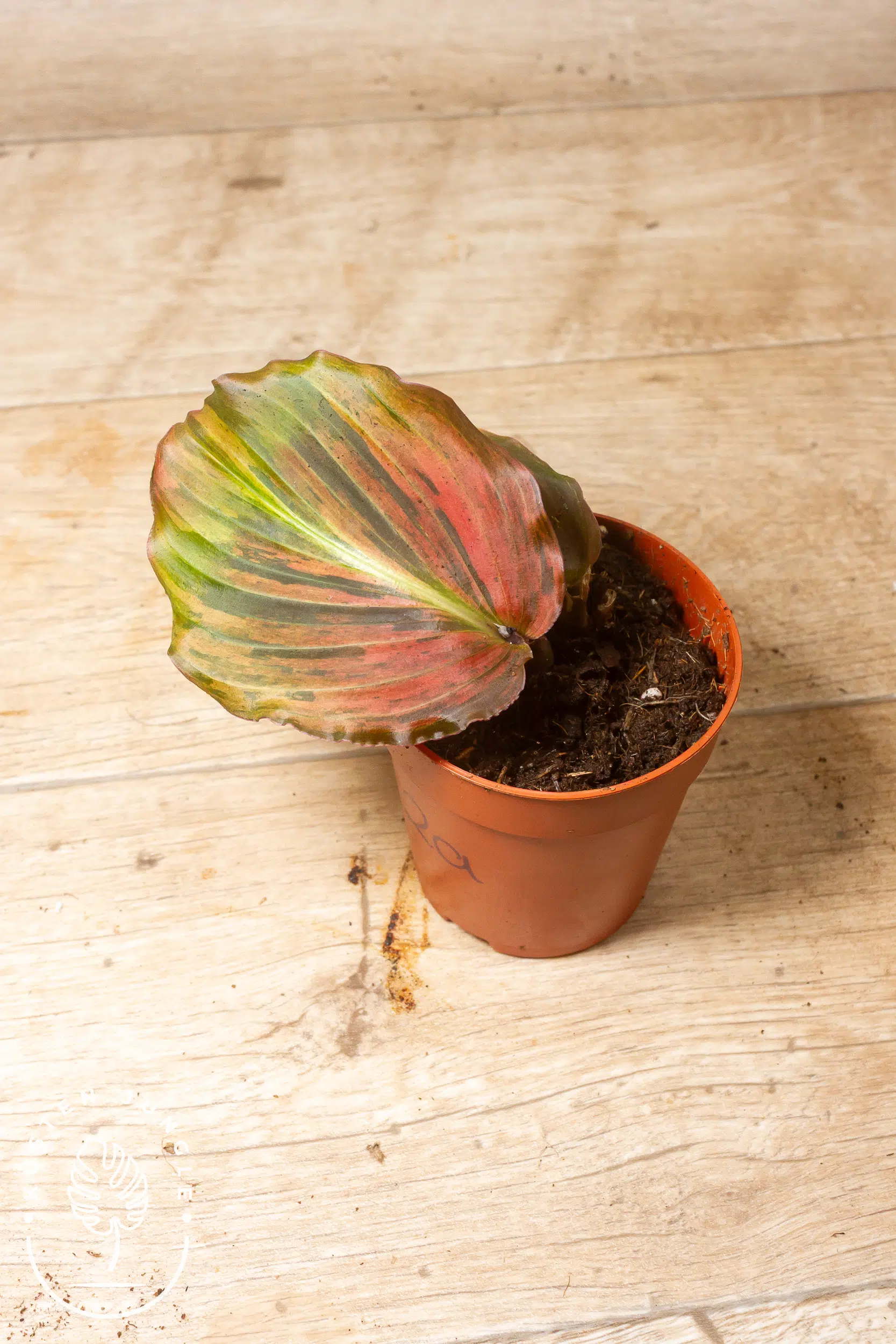
This ginger plant grows from an underground rhizome close to the ground and wide, rather than tall, and occasionally displays delicate, lavender-colored flowers with white centers. Unlike many other houseplants, it goes dormant: the leaves die back, and the rhizome survives the dormancy period underground before new shoots emerge – a natural process primarily triggered by cooler temperatures and shorter light phases. With window-only cultivation, experiencing naturally falling autumn/winter temperatures and weaker light, the plant reliably retreats; however, if kept warm year-round and under a plant lamp with stable lighting duration, the dormancy period may be delayed or milder. The variegation itself varies from leaf to leaf between strong pink and bright yellow.
Good to know
Kaempferia belongs to the ginger family, making it closely related to ginger and turmeric. The genus originally comes from the tropical regions of Asia. Due to its close-to-the-ground growth habit and its annual dormancy, it is occasionally called the „Resurrection Lily“ in English.
Reliable data on the compatibility of this variety with pets is not yet available, so it should be kept out of reach of curious pets as a precaution.