
Alocasia sarawakensis ‚Yucatan Princess‘ Variegata - Care
Location & Light
A bright location with plenty of indirect light not only promotes strong leaf growth for this variety but also makes the watercolor-like variegation stand out more clearly. Direct, intense sun, on the other hand, quickly burns the leaves; an east-facing or slightly shaded south-facing window usually works well. General guidelines for the genus are around 150 to 250 µmol/m²/s PAR (PPFD), which corresponds to a DLI of approximately 6 to 10 mol/m²/day.
Pour
The top few centimeters of the substrate should dry out between waterings. When in doubt, it’s better to water slightly too little than too much – this Alocasia tolerates waterlogged soil much less than a short dry spell and will react with root rot. Watering weekly is usually sufficient in the summer, while in the winter, watering every two weeks is often enough.
Fertilize
Like most Alocasias, ‚Yucatan Princess‘ is a heavy feeder and grows rapidly. During the growth phase, it should be fertilized about every 1 to 2 weeks with a heavily diluted liquid fertilizer. General guidelines for the genus are a pH value of approximately 5.5 to 6.5 and an electrical conductivity of the irrigation water of roughly 1.0 to 1.5 mS/cm. If the plant is only placed by a window in autumn and winter, less frequent or no fertilization will occur due to the weaker light; however, with year-round bright plant lamp lighting, fertilization can continue at the usual rhythm.
We consciously alternate between different fertilizers for our own plants – currently including COMPO COMPLETE, Foliage Focus, Liquid Gold Leaf, and Hesi TNT-Complex, supplemented with Hesi Root Complex, Hesi PowerZyme, and CalMag as needed.
Substrate
A coarse, airy substrate made of orchid bark, perlite, and some coco coir provides the necessary drainage. A pot with good drainage is a must for this Alocasia; due to its vigorous growth, it is usually repotted into a slightly larger pot once a year.
Humidity & Temperature
Normal room air is generally sufficient for this Alocasia, but it appreciates increased humidity and grows visibly more vigorous as a result. Instead of regular misting – the effect barely lasts and moist leaves can encourage fungal infections – a humidifier placed nearby ensures more consistent results. For temperature, the comfort zone is between 18 and 25 °C (64-77 °F), and a spot near the heater should be avoided due to the air being too dry there.
Growth & Dormancy
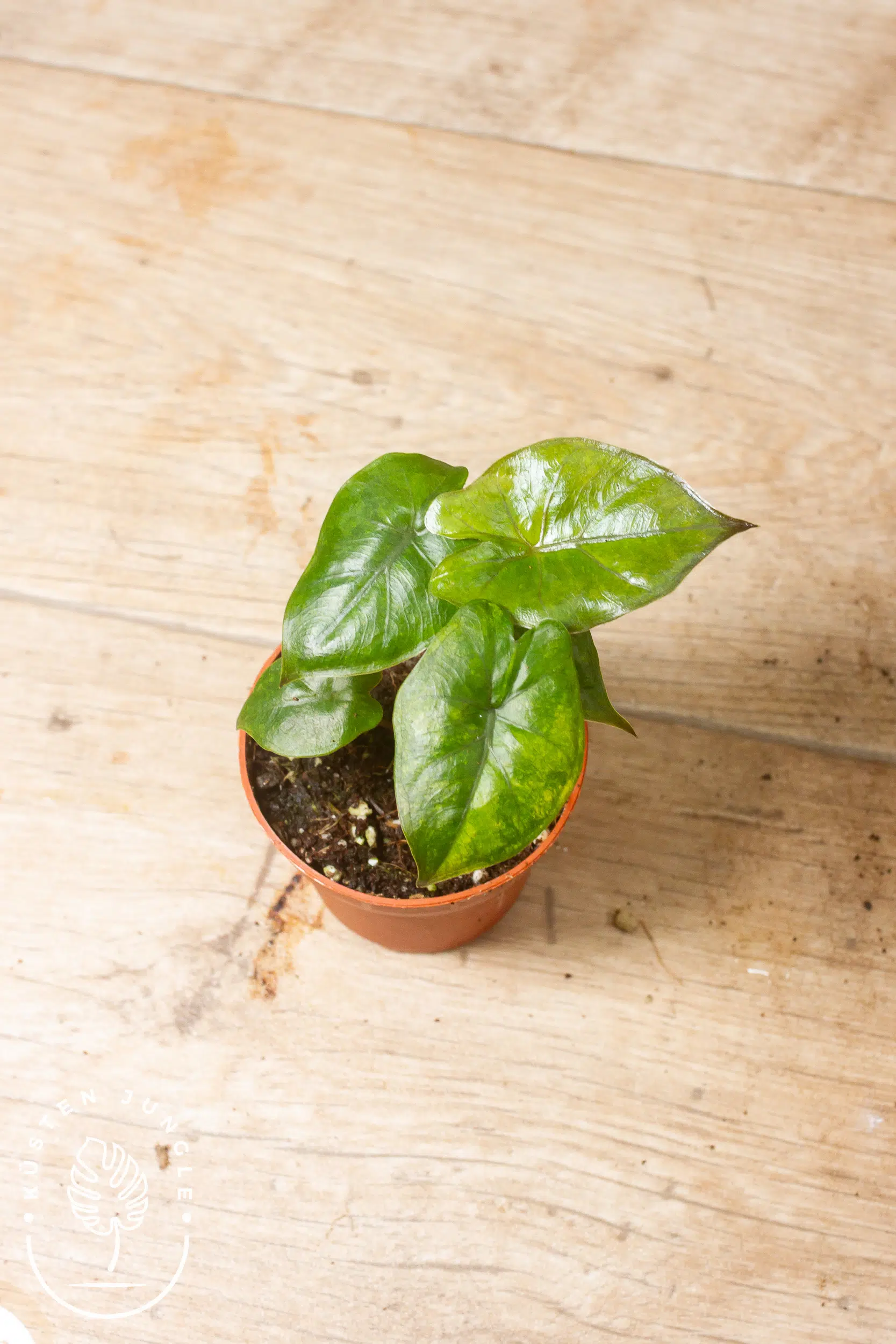
With its large, glossy leaves in flowing dark and light green to yellow, along with its reddish stem and red leaf veins, this variety is among the larger Alocasias for indoor use and can grow to be well over a meter tall when mature. With purely window-based placement in autumn and winter, growth noticeably slows due to weaker light, and the plant may enter a slight resting phase; in contrast, under year-round bright grow light illumination, growth remains largely consistent.
Good to know
Despite the exotic trade name „Yucatan Princess,“ the wild form Alocasia sarawakensis, as the species name already reveals, originally comes from the Sarawak region of Borneo. ‚Yucatan Princess‘ Variegata is a variegated cultivar with unpredictable, watercolor-like blending patterns, which can occasionally even show delicate pink hues.
Like all Araceae, this Alocasia also contains calcium oxalate crystals and is irritating if ingested by pets and children – best to place it out of reach.