
Begonia roseopunctata – Care
Location & Light
Accustomed to the rainforest floor, this begonia thrives best with moderate to bright, but always filtered light. In a terrarium, a spot in the lower area, closer to the ground rather than directly under the light, is often sufficient. Direct sun quickly burns the delicate leaves and causes the vibrant pink pattern to fade. As a guideline for tropical terrarium begonias, roughly 20 to 80 µmol/m²/s PAR (PPFD) is considered appropriate, which corresponds to a DLI of approximately 1 to 3.5 mol/m²/day.
Pour
The top layer of substrate may dry out between waterings, but the substrate should not dry out completely. This begonia does not tolerate waterlogging well and reacts to it with root rot, so always drain off excess water. When watering, as little water as possible should remain on the leaves to prevent fungal spots.
Fertilize
Fresh substrate usually provides this small-growing begonia with sufficient nutrients. A highly diluted liquid fertilizer about every 6 to 8 weeks during the growing season is perfectly sufficient as a gentle supplement. Guidelines for the genus are a pH value of approximately 5.5 to 6.5 and an electrical conductivity of the irrigation water of roughly 1.0 to 1.5 mS/cm. If the plant is only placed by the window in autumn and winter, no more fertilization is done due to the weaker light anyway; however, with year-round bright plant lamp lighting, fertilization can be continued at the normal rhythm for a bit longer.
We consciously alternate between different fertilizers for our own plants – currently including COMPO COMPLETE, Foliage Focus, Liquid Gold Leaf, and Hesi TNT-Complex, supplemented with Hesi Root Complex, Hesi PowerZyme, and CalMag as needed.
Substrate
A loose, well-draining substrate of coco coir with some perlite or vermiculite ensures adequate aeration for the fine roots. Repotting is usually done once a year or as soon as the plant has doubled in size, and a pot with good drainage is important.
Humidity & Temperature
This begonia shows its most beautiful, lush growth in a humid terrarium, but it also manages well with normal room air. Instead of spraying – the effect hardly lasts and damp leaves can promote fungal growth – a closed display case or a humidifier ensures more even results. The comfort zone for temperature is between 65 and 75°F (18 and 24°C); major fluctuations or drafts should be avoided.
Growth & Form
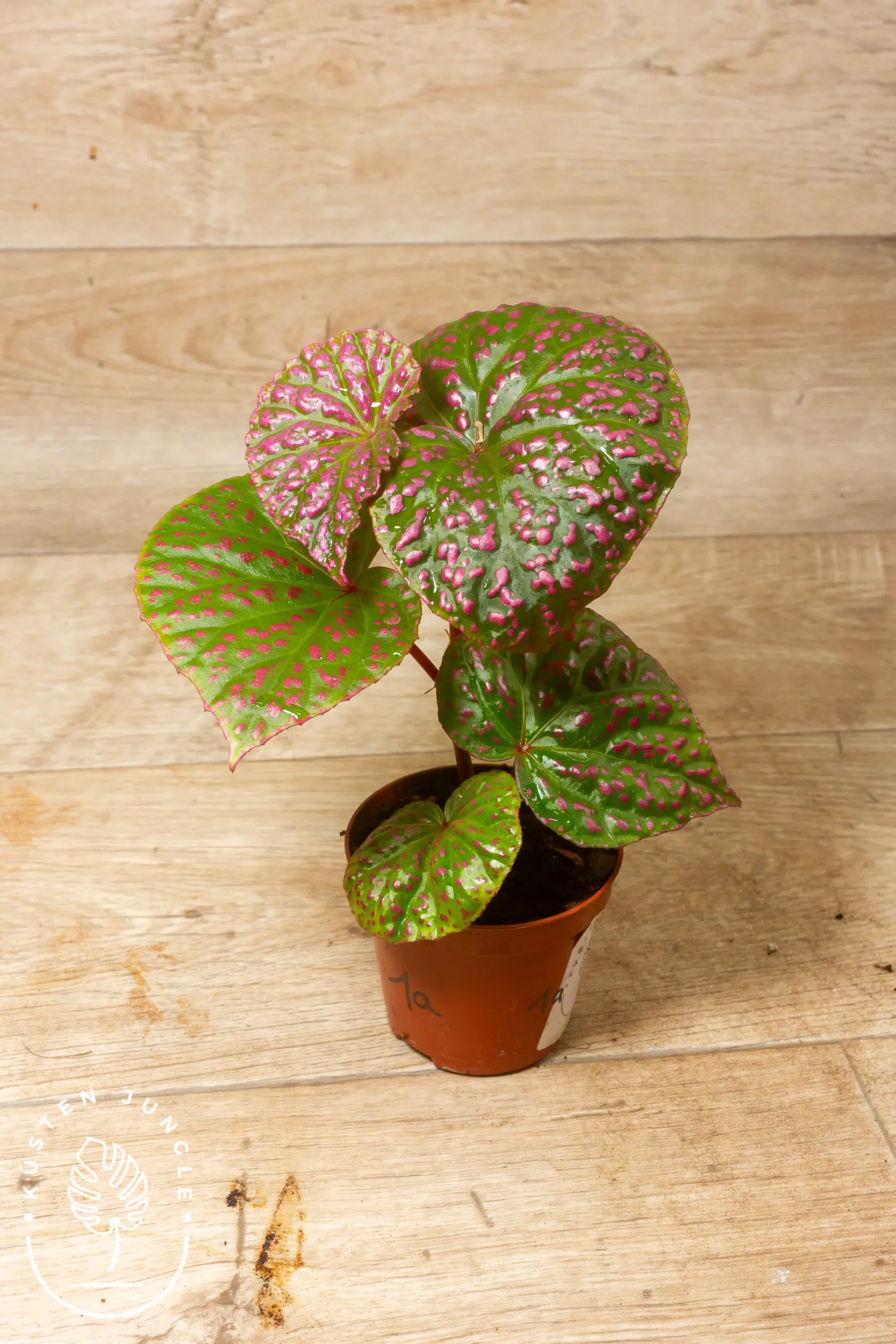
This begonia remains pleasantly compact, making it ideal for smaller display cases or terrariums. The light green leaves are marked with vibrant pink spots and an equally pink leaf margin; the intensity of the color depends heavily on light and location. Getting new leaves on this variety is a reliable sign that the care is appropriate. With only window placement in autumn and winter, growth slows down further due to weaker light; however, with year-round bright plant lamp lighting in the display case, growth remains more consistent.
Good to know
Begonia roseopunctata originates from the island of Borneo, specifically from the Sarawak region, where it grows on the forest floor of humid rainforests. The species name literally means „pink spotted“ and accurately describes the striking pattern of its leaves.
It is easily confused with the similarly patterned Begonia sp. ‚Muara Wahau‘, which also originates from Borneo: In roseopunctata, the pink leaf margin runs as a continuous line, while in ‚Muara Wahau‘, it is made up of individual dots without a continuous line. ‚Muara Wahau‘ also has a striking pinkish-red stem and likes to climb when given the opportunity, producing larger leaves when climbing than when growing flat.
Like all begonias, this species contains oxalates and should be kept out of reach of pets that tend to nibble on plants.