
Alocasia ‚Bambino Arrow‘ Pink Variegata - Care
Location & Light
For strong, stable pink variegation, the Bambino Pink Variegata needs plenty of bright, indirect light. Direct sun burns the pink and white parts of the leaves particularly quickly, as they lack the protective chlorophyll. A spot near an east or west window, without direct sun contact to the leaves, is suitable. If there is insufficient light, the variegation of new leaves will increasingly fade and growth will slow down.
Pour
Water as soon as the top 15 to 25 % of the potting mix has dried out—the root ball should then be evenly moist, but never waterlogged. The heavily variegated, pink-and-white areas of the leaves are more sensitive to water stress than the solid green leaves, which is why a consistent watering schedule is particularly important here. Room-temperature, low-calcium water is best tolerated. In the fall and winter, when growth slows down, watering should be significantly reduced.
Fertilize
Due to its compact growth and significantly reduced green, chlorophyll-containing leaf surface, the Bambino Pink Variegata should be fertilized much less than large-leaved, non-variegated Alocasias. During the growth phase, fertilization every 3 to 4 weeks with a highly diluted liquid fertilizer (a quarter to a maximum of half the recommended amount) is usually sufficient. As a rough guideline for Alocasias in general, a pH value of about 5.5 to 6.5 and rather low EC values of 1.0 to 1.5 mS/cm are recommended, as the genus is considered salt-sensitive. For precise dosage, follow the manufacturer's instructions on the respective packaging, as the sensitive pink-white leaf areas are particularly intolerant of over-fertilization. If the Bambino Pink Variegata is only placed by a window in autumn and winter, the light becomes weaker, and fertilization is reduced accordingly or paused. If, however, it grows year-round under a gently set plant lamp, the usual, already moderate, fertilization rhythm can be maintained without further reduction.
We consciously alternate between different fertilizers for our own plants – currently including COMPO COMPLETE, Foliage Focus, Liquid Gold Leaf, and Hesi TNT-Complex, supplemented with Hesi Root Complex, Hesi PowerZyme, and CalMag as needed.
Substrate
The substrate should be loose, well-draining, yet moisture-retaining – an aroid mix of potting soil, orchid bark, and perlite works well. The Bambino Pink Variegata also prefers to be slightly snug in its pot; an overly large container tends to cause the substrate to stay wet for too long, which quickly damages the sensitive roots.
Humidity & Temperature
The Bambino Pink Variegata does just fine in normal indoor air humidity levels ranging from 40 to 50 %, but it really thrives at higher levels—at around 60 % and above, this is evident in its stronger, juicier leaves. Since the pink-and-white areas of the leaves dry out faster than green tissue due to the lack of chlorophyll, higher humidity levels have a particularly positive effect here. A humidifier or a display case offers the most reliable way to maintain consistently higher humidity levels. You should avoid regularly misting the leaves, as standing moisture on the delicate variegated areas promotes fungal and bacterial growth. The ideal temperature range is between 18 and 27 °C; temperatures consistently below 15 °C and cold drafts can quickly lead to leaf loss.
Growth & Form
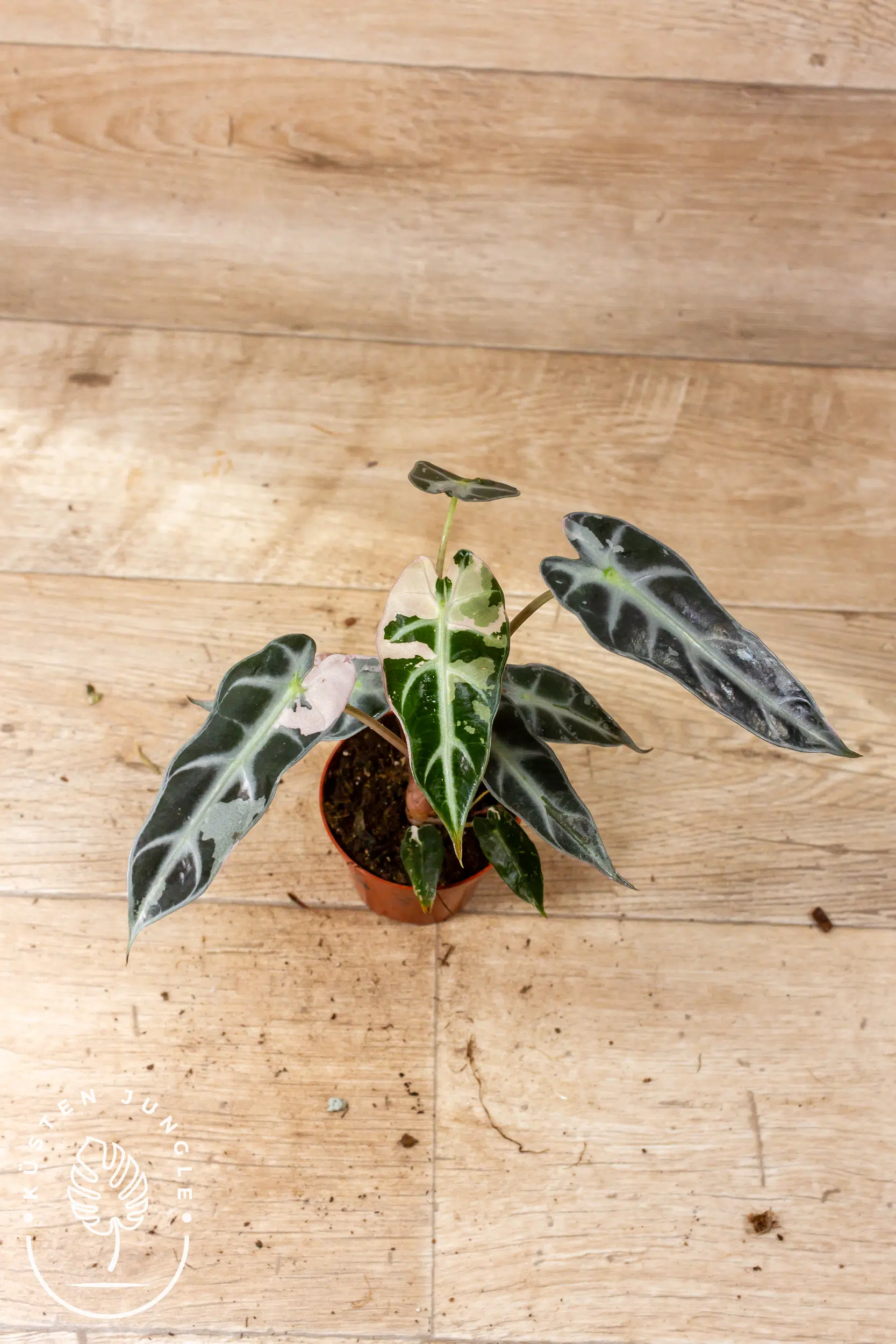
The Bambino Pink Variegata remains significantly more compact than most other Alocasias, reaching a height of about 30 to 40 cm and forming a dense, upright growth with closely spaced, narrow leaves. The amount of variegation a new leaf shows varies from leaf to leaf and cannot be controlled – some are more creamy white, others a strong pink, both are normal. It is also normal for an older leaf to die off as soon as a new one appears.
Good to know
Like all Alocasias, the Bambino Pink Variegata contains calcium oxalate crystals and is irritating to pets and children if consumed – best placed out of reach.
Botanically, Bambino Pink Variegata is a pink variegated cultivar of the compact Alocasia ‚Bambino Arrow‘, recognizable by its narrow, lance-shaped, deep green leaves with irregular pinkish-white speckles and sectors. Since the pink leaf areas contain very little chlorophyll, the plant grows slower overall than non-variegated Alocasias and is correspondingly more sensitive to care errors.
Regularly checking the undersides of leaves is worthwhile, as spider mites and thrips can appear, especially in dry indoor air during winter.