
Alocasia ‚Golden Bone‘ - Care
Location & Light
The Golden Bone likes it bright so that the golden-green veining can unfold its full luminosity, but it cannot tolerate direct sun for extended periods. A spot with plenty of indirect light, such as near an east or north window, is well-suited; however, it can also manage with somewhat dimmer light, although it will grow noticeably slower. If there is a lack of brightness, the leaves lose their sheen and the veining appears less contrasting.
Pour
Water the Golden Bone once the top layer of soil feels dry—the root ball should then be consistently moist, but never waterlogged. This plant does not tolerate waterlogging well and quickly leads to root rot; conversely, if the soil is too dry, the leaves will visibly droop, but they usually recover quickly afterward. Room-temperature, low-lime water is best tolerated. In autumn and winter, when growth slows, water significantly less.
Fertilize
There are differing reports on the growth rate of the Golden Bone – some sources describe it as compact and moderately growing, while others describe it as growing quite vigorously with a good final size. To be on the safe side, it's better to fertilize a bit more generously during the growth phase, about every 2 to 3 weeks, with a highly diluted liquid fertilizer (a quarter to a maximum of half the recommended amount). As a rough guideline for Alocasias in general, a pH of about 5.5 to 6.5 and rather low 1.0 to 1.5 mS/cm apply, as the genus is considered salt-sensitive. Follow the manufacturer's instructions on the respective packaging for precise dosage, as the plant will not tolerate over-fertilization well. If the Golden Bone is only placed by the window in autumn and winter, the light will be weaker and fertilization should be reduced accordingly or paused; however, if it grows year-round under a sufficiently strong plant lamp, the usual rhythm can be maintained without further shortening.
We consciously alternate between different fertilizers for our own plants – currently including COMPO COMPLETE, Foliage Focus, Liquid Gold Leaf, and Hesi TNT-Complex, supplemented with Hesi Root Complex, Hesi PowerZyme, and CalMag as needed.
Substrate
Lightweight, airy, and yet able to retain moisture evenly – an aroid mix of potting soil, orchid bark, perlite, and some coco coir has proven effective. Good drainage at the bottom of the pot is important so that excess water can drain quickly and the sensitive tuber doesn't remain permanently wet.
Humidity & Temperature
The humidity should be between 60 and 80 % so that the Golden Bone can fully develop its slightly leathery leaf texture and characteristic sheen. Normal indoor air humidity in winter—often only 30 to 45 %—isn’t sufficient for it in the long run; a humidifier or a bowl of pebbles provides a reliable solution here. You should avoid regularly misting the leaves, as standing moisture promotes fungal and bacterial growth. The ideal temperature range is between 18 and 27 °C; temperatures consistently below 15 °C and cold drafts can quickly lead to leaf drop or brown edges.
Growth & Form
The Golden Bone grows from a tuber into an upright plant; depending on site conditions, it remains rather compact or gains considerable size over time. It is normal for an older leaf to die off as a new one appears, and there is no cause for concern. Regularly rotating the pot ensures even growth, as the leaves will otherwise orient themselves one-sidedly towards the light.
Good to know
Like all alocasias, the Golden Bone also contains calcium oxalate crystals and is irritating to pets and children if ingested – it's best to place it out of reach.
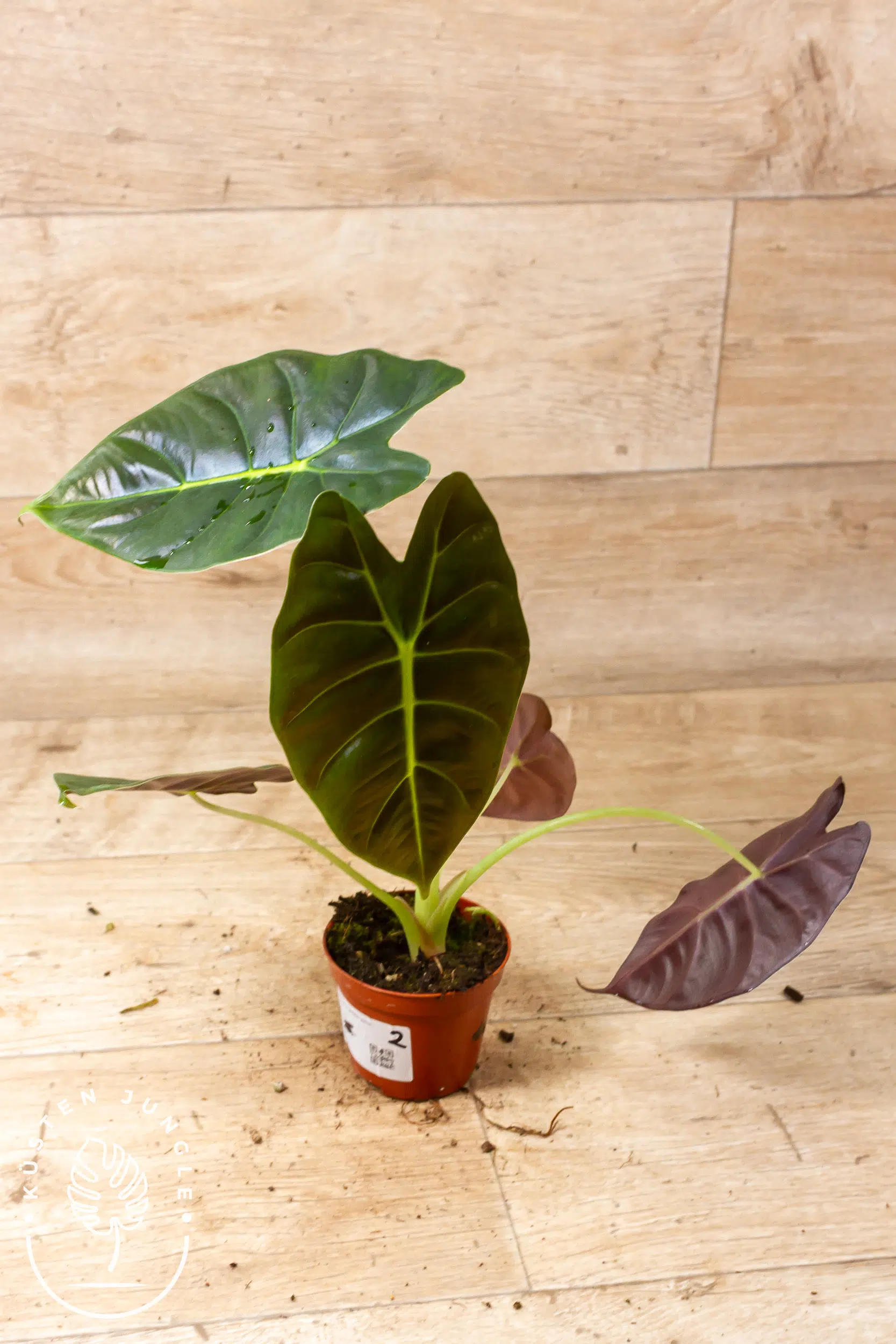
Botanically, the Golden Bone is a hybrid of Alocasia micholitziana and Alocasia cuprea, recognizable by its shield-shaped, slightly leathery leaves with a deep green base color and bright golden-green to lime-colored venation. The undersides of the leaves shimmer with a characteristic purple to burgundy hue.
Regular inspection of the undersides of leaves is worthwhile, as spider mites and scale insects can appear, especially with dry indoor air in winter.