
Alocasia ‚Loco‘ - Care
Location & Light
A bright location with plenty of indirect light best showcases the Alocasia's strong dark green leaf color and sharply defined white veins. Direct sun, especially at midday, quickly leads to scorching; conversely, a lack of light causes the color and veining to fade, and growth becomes noticeably sluggish. As a guideline for the genus, Alocasias generally thrive with about 150 to 500 µmol/m²/s PAR (PPFD), which corresponds to a DLI of approximately 6.5 to 25 mol/m²/day over 12 to 14 hours of light.
Pour
Water as soon as the top layer of the substrate feels dry – the root ball should then be evenly moist, without water standing in the pot. This Alocasia reacts to dryness with drooping leaves, and to permanent waterlogging with rotting roots. Room-temperature, low-lime water is tolerated much better than hard tap water; excess water in the saucer should always be poured off.
Fertilize
Like most Alocasias, ‚Loco‘ is a heavy feeder. During the growth phase, fertilize approximately every 1 to 2 weeks with a highly diluted liquid fertilizer, preferably with every other watering or with every watering. General guidelines for the genus are a pH value of about 5.5 to 6.5 and a rather low conductivity of the irrigation water of roughly 1.0 to 1.3 mS/cm, as Alocasias are sensitive to salt accumulation. Follow the manufacturer's instructions for precise dosage. If the plant is only placed by a window in autumn and winter, fertilize less frequently or not at all due to the weaker light. However, if the plant receives sufficiently bright artificial light year-round, you can continue fertilizing at the usual, frequent rhythm.
We consciously alternate between different fertilizers for our own plants – currently including COMPO COMPLETE, Foliage Focus, Liquid Gold Leaf, and Hesi TNT-Complex, supplemented with Hesi Root Complex, Hesi PowerZyme, and CalMag as needed.
Substrate
A loose, humus-rich substrate like a mix of potting soil, perlite, and some orchid bark allows the roots to breathe well, yet still retains enough moisture. It is important to use a pot with sufficient drainage holes so that excess water can drain away quickly and the tuber does not sit in wetness permanently.
Humidity & Temperature
Normal indoor air humidity of 40 to 50 % is tolerable, but at levels of 60 % or higher, this Alocasia appears significantly more vigorous and less prone to brown leaf edges. A humidifier or a bowl of pebbles can help maintain optimal conditions in a room with normal humidity. The ideal temperature range is between 18 and 27 °C; cold drafts and temperatures below 15 °C should be avoided.
Growth & Dormancy
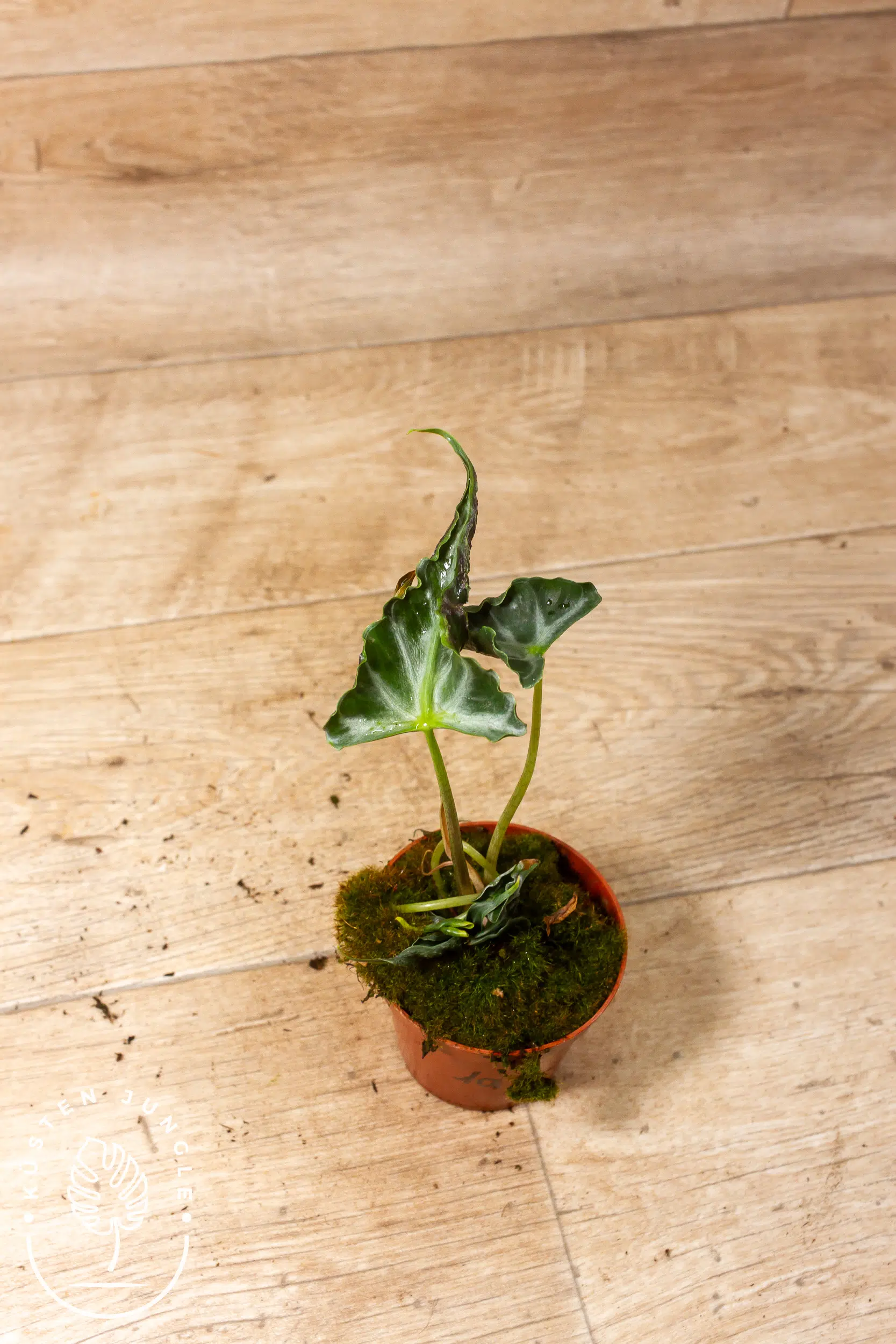
The triangular, slightly wavy leaves with their distinctive white venation on a deep green background are what give it its name. This feature lends this Alocasia a particularly sculpted appearance compared to smooth-leaved jewel varieties. If the plant is kept solely by a window in autumn and winter, its growth slows noticeably due to the weaker light, and individual older leaves may be shed; however, under consistently bright plant light year-round, growth generally remains stable. As with many Alocasias, a regular cycle of new leaves emerging and older, lower leaves being shed is entirely normal and not a sign of neglect.
Good to know
Alocasia ‚Loco‘ was introduced in 2010 by a nursery in Florida and is presumed to be a cross between Alocasia sanderiana and Alocasia longiloba ‚Watsoniana‘, possibly originating as a mutation of Alocasia ‚Mandalay‘ (which is in turn related to ‚Polly‘). The variety almost completely disappeared from trade for several years and was only made available again in 2023 through tissue culture.
Like all aroids, this Alocasia also contains calcium oxalate crystals and is irritating to pets and children if ingested – best to place it out of reach. Regular checks of the undersides of the leaves are also worthwhile, as spider mites and thrips are among the more common problems with this genus.