
Alocasia longiloba ‚Silver‘ - Care
Location & Light
Bright, filtered light near a window helps *Alocasia longiloba* ‚Silver‘ grow most vigorously and best enhances its silvery leaf coloration. A spot near an east or west window is ideal, but avoid intense midday sun through glass, as the leaves can quickly scorch. If the plant lacks light, it will respond with smaller leaves and unusually long, thin petioles instead of compact growth.
Pour
Compared to many other Alocasia varieties, the potting mix for the longiloba ‚Silver‘ can be allowed to dry out a bit more thoroughly between waterings —water thoroughly, then wait until about 30 to 50 % of the pot’s depth has dried out before watering again. This species tolerates consistently wet potting mix much less well than brief dry spells. Room-temperature, low-calcium water is best tolerated; always pour out any excess water from the saucer or planter. Water noticeably less frequently in the fall and winter.
Fertilize
Like most Alocasias, the longiloba ‚Silver‘ is a heavy feeder and should therefore be regularly supplied with nutrients during its growth phase – about every 1 to 2 weeks with a heavily diluted liquid fertilizer (a quarter to a maximum of half the recommended amount), as the genus is considered salt-sensitive. Fertilize specifically when the plant is visibly pushing out new leaves and sufficient light is available – if it is not currently producing new leaves, additional fertilizer will not help and will only increase the risk of salt damage. A rough guideline for Alocasias in general is a pH value of about 5.5 to 6.5 and rather low values of 1.0 to 1.5 mS/cm. For precise dosing, follow the manufacturer's instructions on the respective packaging. If the longiloba ‚Silver‘ is only placed by the window in autumn and winter, the light will weaken and fertilization should be reduced accordingly or paused; if, on the other hand, it grows year-round under a gently adjusted plant lamp, the usual rhythm can be maintained without further shortening.
We consciously alternate between different fertilizers for our own plants – currently including COMPO COMPLETE, Foliage Focus, Liquid Gold Leaf, and Hesi TNT-Complex, supplemented with Hesi Root Complex, Hesi PowerZyme, and CalMag as needed.
Substrate
An airy, coarse substrate that dries out reliably and quickly is more important for this species than for most other Alocasias. An aroid mix of potting soil, coarse orchid bark, and perlite works well. Conversely, peat or compost-heavy, fine mixes should be avoided, as they compact too quickly and remain moist for too long. The longiloba ‚Silver‘ also prefers to be slightly pot-bound rather than in a vessel that is significantly too large, where the substrate around the sensitive roots stays wet for too long. A snug pot, fitted closely to the root mass, is the safer choice here.
Humidity & Temperature
The longiloba ‚Silver‘ generally thrives in normal indoor air humidity levels ranging from 40 to 50 %, but it appears noticeably healthier and more vigorous at higher levels, starting at around 60 %. More important than an exact percentage is a generally stable environment without sharp fluctuations, combined with sufficient oxygen at the roots—humidity alone does not cause any care issues. A humidifier or a display case offers the most reliable way to maintain consistently higher humidity levels. The ideal temperature range is between 18 and 27 °C; in cooler rooms, growth slows noticeably, and wet substrate becomes significantly more risky for the roots.
Growth & Dormancy
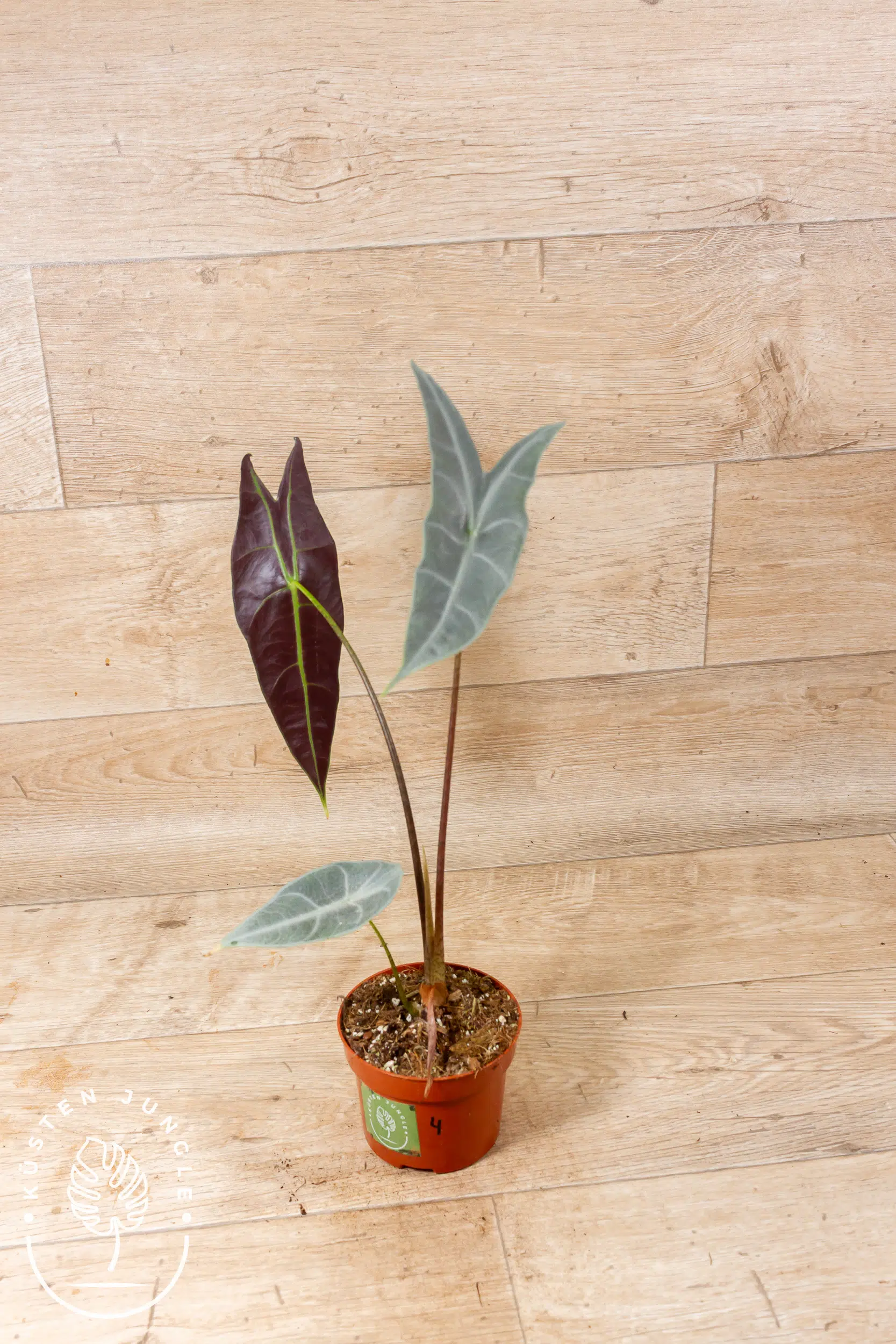
In cultivation, *longiloba* ‚Silver‘ typically reaches a height of 2 to 3 feet, with each leaf differing slightly from the previous one in its pattern and silver content – this is normal for this species and makes each plant somewhat unique. Growth is rather sporadic with pauses in between, especially after a strong new flush of leaves; this is no cause for concern as long as the base remains firm. If it's only placed by a window in autumn and winter, the weaker light combined with cooler temperatures causes growth to slow down, and older leaves may die off while the rhizome underneath remains healthy and sprouts again in spring. However, if it grows year-round under a sufficiently bright plant lamp with stable warmth, growth usually remains stable even in winter, and significant leaf loss is avoided.
Good to know
Like all Alocasias, the longiloba ‚Silver‘ also contains calcium oxalate crystals and is irritating to pets and children if ingested – best placed out of reach.
Alocasia longiloba belongs to the most taxonomically confusing corners of the genus: numerous historical trade names such as ‚Argyrea‘, ‚Korthalsii‘, ‚Lowii‘, or ‚Watsoniana‘ were originally treated as separate species, but are now mostly considered botanically as part of a broader longiloba species complex. ‚Silver‘ is a cultivar that was specifically selected for its particularly silvery-gray leaf surface with contrasting dark green veins.
Regular checks of new growth and the undersides of leaves are worthwhile, as thrips and spider mites often show up there first.