
Alocasia nebula – Care
Location & Light
The leaves of the Nebula are sensitive to direct sunlight and will burn quickly. Therefore, a spot with bright, filtered, or indirect light is ideal, such as near an east or west window or behind a curtain. It can tolerate slightly dimmer light, but will grow noticeably slower. If it is kept in too dark a location, new leaves will remain small and the characteristic silvery coloring will fade.
Pour
The Nebula should be kept consistently lightly moist – complete drying out can send the plant into premature dormancy, while constant wetness quickly leads to rot in the sensitive tuber. It's best to water in smaller amounts as soon as the top layer of soil has dried out, rather than giving large amounts of water less frequently. Water low in lime, ideally distilled or osmosis water, is tolerated much better than hard tap water. In autumn and winter, water significantly less than in summer.
Fertilize
Due to its compact stature and manageable leaf production compared to large-leaved Alocasias, the Nebula requires fewer nutrients. During the growing phase, a fertilization every 3 to 4 weeks with a highly diluted liquid fertilizer (one-quarter to a maximum of half the recommended amount) is usually sufficient. As a general approximation for Alocasias, a pH of around 5.5 to 6.5 and a rather low EC of 1.0 to 1.5 mS/cm are considered appropriate, as the genus is known to be sensitive to salt. Follow the manufacturer's instructions on the respective packaging for precise dosage, as the sensitive tuber tolerates over-fertilization particularly poorly. If the Nebula is only placed by the window in autumn and winter, the light becomes weaker, and fertilization should be reduced accordingly or paused. However, if it grows year-round under a gently set grow light, the usual, already moderate feeding schedule can be maintained without further reduction.
We consciously alternate between different fertilizers for our own plants – currently including COMPO COMPLETE, Foliage Focus, Liquid Gold Leaf, and Hesi TNT-Complex, supplemented with Hesi Root Complex, Hesi PowerZyme, and CalMag as needed.
Substrate
Loose, airy, and yet able to retain moisture evenly – a chunky aroid mix of potting soil, orchid bark, perlite, and some coco coir has proven effective. Since the rhizome and tuber of the Nebula are particularly susceptible to rot, a generous drainage layer at the bottom of the pot is important for excess water to drain quickly.
Humidity & Temperature
The Nebula thrives at humidity levels of around 60 %; in its natural habitat on Borneo, levels in this range are common. Normal indoor air humidity in winter—often only 30 to 45 %—is not sufficient for it in the long run; a greenhouse, display case, or plant cabinet with a humidifier is the most reliable solution here. You should avoid regularly misting the leaves, as standing moisture promotes fungal and bacterial growth. As for temperature, the ideal range is between 18 and 27 °C; sudden cold snaps, drafts, or prolonged temperatures below 16 °C can quickly lead to abrupt leaf loss in this species.
Growth & Dormancy
The Nebula grows from a bulb and usually only has a few leaves at a time – it's normal for an older leaf to die off as soon as a new one appears. New leaves initially appear light green and only develop their characteristic silvery-blue color over time. If the plant doesn't produce new leaves for a longer period or loses several at once, it's usually due to a location that's too cool or waterlogged soil, and less often a regular dormant phase.
Good to know
Like all alocasias, the Nebula also contains calcium oxalate crystals and is irritating to pets and children if ingested – it's best to place it out of reach.
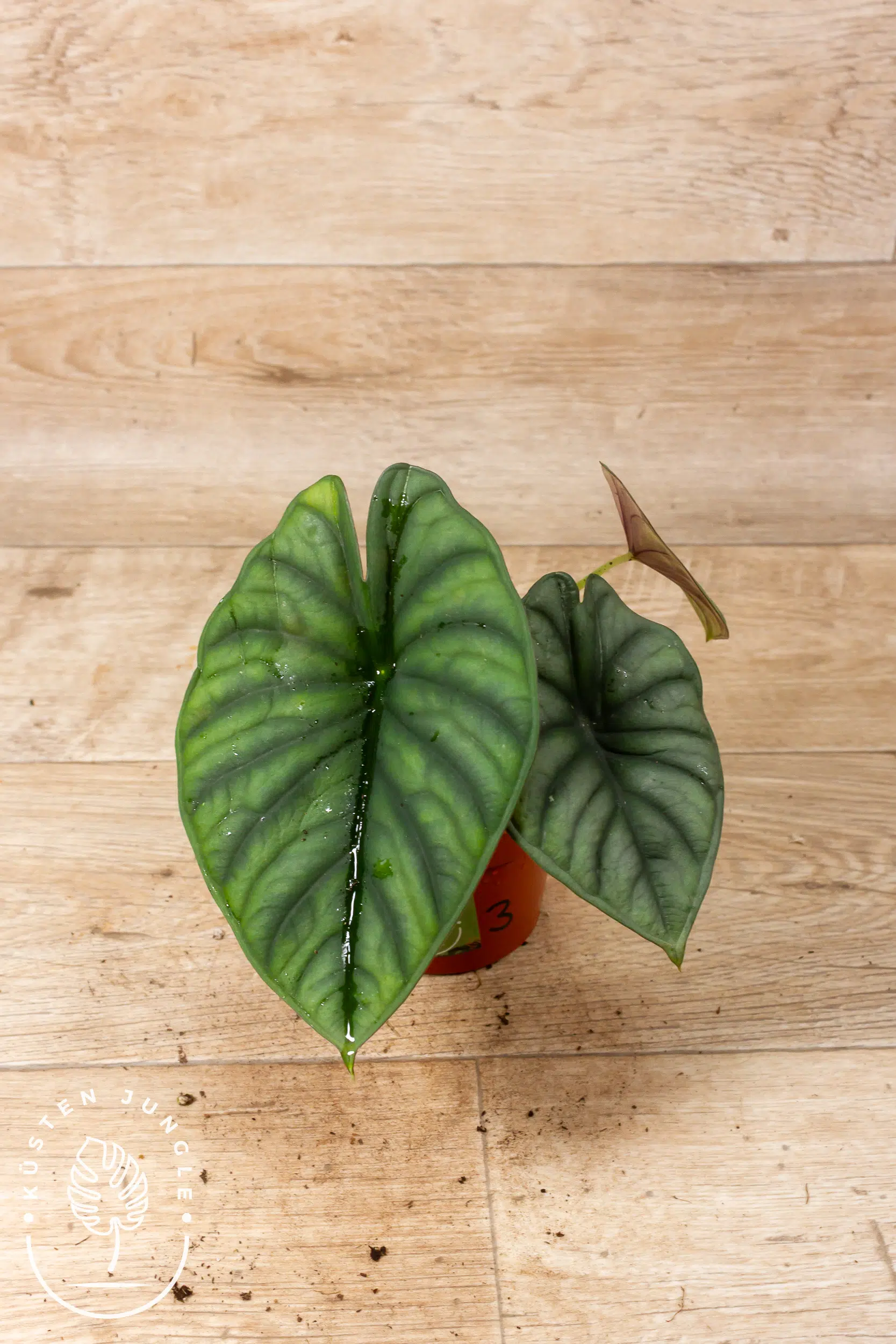
Botanically, the Nebula originates from the humid rainforests of Borneo and features heart-shaped leaves in a striking silvery-blue-green hue with dark, contrasting veins – hence the name, reminiscent of a nebula. It is considered one of the compact „Jewel Alocasias“ and rarely grows larger than 30 to 40 cm.
Regular inspection of the undersides of leaves is worthwhile, as spider mites and scale insects can appear, especially with dry indoor air in winter.