
Alocasia ‚New Guinea Gold‘ - Care
Location & Light
New Guinea Gold prefers bright light without direct midday sun, which can quickly scorch its leaves. A spot with plenty of indirect light, such as near an east or west window, is ideal. After gradual acclimatization, it can usually tolerate mild morning or evening sun without issues. If light is insufficient, it will become increasingly leggy, and its leaves will shrink.
Pour
The New Guinea Gold prefers evenly moist substrate but is sensitive to waterlogging – excess water in the cachepot should always be removed after watering. It is best to water as soon as the top layer of the substrate feels dry; how often this is necessary depends heavily on the amount of light and the pot size. If it receives too little water, the leaves will visibly droop, but they usually recover quickly afterward. Room-temperature, low-lime water is best tolerated.
Fertilize
As a vigorously growing, large-leaved Alocasia, the New Guinea Gold is considered a heavy feeder and can tolerate fertilization with every or every other watering during its growth phase, but only highly diluted (a quarter to a maximum of half the recommended amount). As a rough guideline, Alocasias generally prefer a pH value of around 5.5 to 6.5 and rather low values of 1.0 to 1.5 mS/cm, as the genus is considered salt-sensitive. Follow the manufacturer's instructions on the respective packaging for precise dosing, as the plant does not tolerate over-fertilization well. If the New Guinea Gold is only placed by the window in autumn and winter, the light becomes weaker and fertilization is reduced or paused accordingly; on the other hand, if it grows year-round under a sufficiently strong plant lamp, the usual rhythm can be maintained without further reduction.
We consciously alternate between different fertilizers for our own plants – currently including COMPO COMPLETE, Foliage Focus, Liquid Gold Leaf, and Hesi TNT-Complex, supplemented with Hesi Root Complex, Hesi PowerZyme, and CalMag as needed.
Substrate
The substrate should be loose, humus-rich, and well-draining – a high-quality aroid mix of potting soil, pine bark, and perlite has proven effective. Since the New Guinea Gold grows quite large and has a strong root system, the pot should offer sufficient volume so that the substrate does not dry out completely too quickly.
Humidity & Temperature
The New Guinea Gold thrives at humidity levels of around 60 %, but continues to grow without any problems even at higher levels. Normal indoor air humidity in winter—often only 30 to 45 %—is not sufficient for it in the long run; a humidifier or a bowl of pebbles provides a reliable solution here. You should avoid regularly misting the leaves, as standing moisture promotes fungal and bacterial growth. The ideal temperature range is between 18 and 27 °C; it should not be exposed to temperatures consistently below 15 °C or cold drafts.
Growth & Form
The New Guinea Gold grows from a tuber into an upright, strong plant with large leaves and quickly gains size with good care. It is normal for an older leaf to occasionally die off as a new one appears. Regularly turning the pot ensures even growth, otherwise the leaves will orient themselves one-sidedly towards the light.
Good to know
Like all Alocasias, the New Guinea Gold also contains calcium oxalate crystals and is irritating to pets and children if ingested – best to place it out of reach.
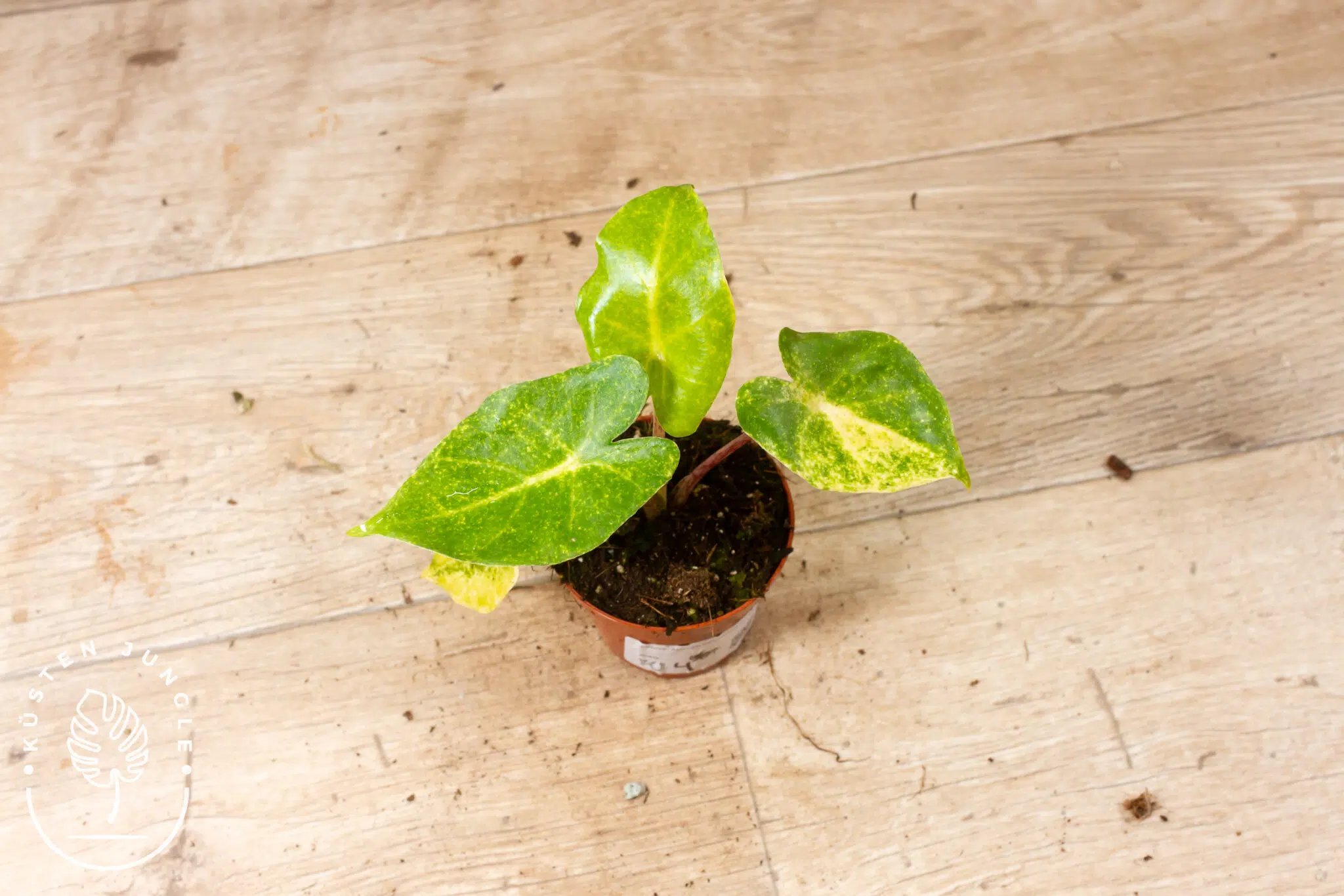
Botanically, it is a form of Alocasia macrorrhizos with dark green leaves and gold-yellow to reddish speckles on the leaf blades and petioles. Its unpredictable color cycle is unusual: for extended periods, the leaves can emerge almost completely green before suddenly speckled leaves reappear – a natural behavior of this variety that has not yet been definitively explained, and not a cultivation error.
Regularly checking the undersides of leaves is worthwhile, as spider mites and thrips can appear, especially in dry indoor air during winter.