
Alocasia puncakborneensis – Care
Location & Light
A bright spot with plenty of indirect light allows Alocasia puncakborneensis to grow most vigorously, for example, near an east or west window. You should avoid direct sun, as the shiny leaves will quickly burn. It tolerates slightly shadier locations quite well compared to many other Alocasias without immediately wilting – however, a really bright spot is clearly advantageous for consistently strong growth and firm leaves.
Pour
In its highland habitat, Alocasia puncakborneensis roots between rocks and pockets of humus where water drains rapidly. Therefore, when potting, water only when the surface of the substrate has dried, using smaller amounts rather than a single large watering. The root ball may be allowed to dry out slightly between waterings, but should not dry out completely for extended periods. Room-temperature, low-calcium water is best tolerated, and any excess water in the saucer or cachepot should always be poured off. Watering is significantly reduced in autumn and winter.
Fertilize
Like most alocasias, Alocasia puncakborneensis is a heavy feeder and should be regularly supplied with nutrients during its growth phase – approximately every 1 to 2 weeks with a highly diluted liquid fertilizer (a quarter to a maximum of half the recommended amount), as the genus is considered salt-sensitive. A rough guideline for alocasias in general is a pH value of about 5.5 to 6.5 and rather low EC values of 1.0 to 1.5 mS/cm. For precise dosage, follow the manufacturer's instructions on the respective packaging. If Alocasia puncakborneensis is only placed by a window in autumn and winter, the light becomes weaker and fertilization should be reduced accordingly or paused; however, if it grows year-round under a gently set plant lamp, the usual rhythm can be maintained without further reduction.
We consciously alternate between different fertilizers for our own plants – currently including COMPO COMPLETE, Foliage Focus, Liquid Gold Leaf, and Hesi TNT-Complex, supplemented with Hesi Root Complex, Hesi PowerZyme, and CalMag as needed.
Substrate
In nature, Alocasia puncakensis grows on mineral sandstone substrates between rocks and humus. A similarly airy, mineral-rich substrate is closest to its needs when potted. An aroid mix of potting soil, coarse bark, and perlite works well; the most important thing is that water drains quickly and oxygen reaches the rhizome. A rather small pot is preferable to one that is clearly too large, as in large containers with heavy soil, the substrate around the rhizome remains too moist for too long.
Humidity & Temperature
In their native habitat—the humid mountain forests of the Penrissen Mountains on Borneo—the humidity is usually well above 80 % —so it’s equally important to maintain a noticeably higher humidity level of at least 60 % indoors to keep the leaves plump and prevent the edges from turning brown. A humidifier or a display case offers the most reliable way to maintain consistently higher humidity levels. You should avoid regularly misting the leaves, as standing moisture can promote fungal and bacterial growth. The ideal temperature range is between 18 and 27 °C; cold drafts and consistently lower temperatures can quickly lead to stunted growth and leaf loss.
Growth & Form
With a rather short, slow-growing rhizome, Alocasia puncakborneensis remains compact and usually reaches a height of around 40 to 60 cm in cultivation. How the leaves attach to the stem can vary from leaf to leaf – sometimes closer to the edge, sometimes further towards the center of the leaf – and also changes with the plant's increasing age, which is completely normal for this species. It does not have a true, temperature-controlled winter dormancy at normal room temperatures – the light availability is primarily decisive. If it is only placed by a window in autumn and winter, the weaker daylight noticeably slows down growth; on the other hand, if it grows year-round under a sufficiently bright plant lamp, growth usually remains stable even in winter.
Good to know
Like all Alocasias, Alocasia puncakborneensis contains calcium oxalate crystals and is irritating to pets and children if ingested – it is best placed out of reach.
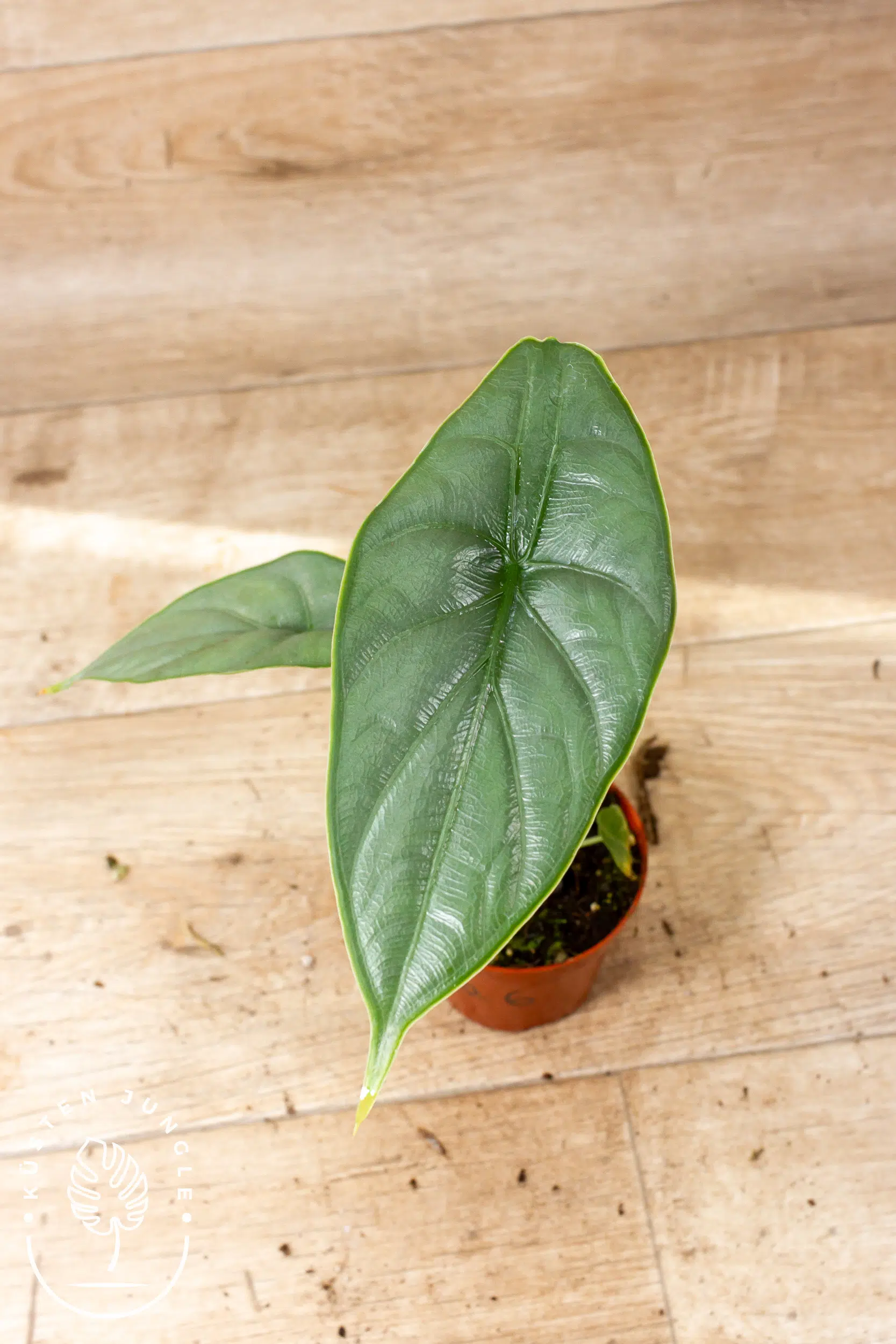
*Alocasia puncakborneensis* was scientifically described only in 2020 and originates from the Penrissen Mountains in the Malaysian part of Borneo, where it grows on sandstone rocks at an altitude of approximately 880 to 1170 meters – hence the name part „Puncak“ (Malay for summit). Botanically, it belongs to the so-called *Alocasia princeps* complex, and within this group, it can be recognized by its shiny, leathery leaves with a distinctly raised, reticulate vein structure.
Regularly checking the undersides of leaves is worthwhile, as spider mites can appear, especially during dry, heated air in winter.