
Alocasia sp. Sulawesi ‚Green Carpet‘ - Care
Location & Light
Unlike many tall-growing Alocasias, Green Carpet prefers subdued light. It originates from the shaded forest floor of Sulawesi and thrives in low to medium, diffuse light. Too much direct or very bright light can cause the velvety leaf surface to fade, while too little light noticeably slows growth. A spot slightly away from the window, in a display cabinet, or under a gently set plant lamp is well-suited.
Pour
The Green Carpet likes to be kept slightly moist and should never dry out completely – water as soon as the top 1 to 2 cm of the substrate have dried. Its fine roots are sensitive to waterlogging, so good drainage is important, even though the substrate as a whole can retain moisture. Room-temperature, low-calcium water is best tolerated. In autumn and winter, when growth slows down, you should water noticeably less.
Fertilize
As a dwarf, slow to moderately growing Alocasia, the Green Carpet needs significantly less fertilizer than its larger relatives – during the growth phase, one application every 4 to 6 weeks with a highly diluted liquid fertilizer (a quarter to a maximum of half the recommended amount) is usually sufficient. A rough guideline for Alocasias in general is a pH value of about 5.5 to 6.5 and rather low 1.0 to 1.5 mS/cm, as the genus is considered salt-sensitive. Follow the manufacturer's instructions on the respective packaging for precise dosage; the sensitive roots of the Green Carpet tolerate over-fertilization particularly poorly. If the Green Carpet is only placed by the window in fall and winter, the light becomes weaker and fertilization is reduced or paused accordingly; if, on the other hand, it grows year-round under a gently set plant lamp, the usual, already reserved rhythm can be maintained without further reduction.
We consciously alternate between different fertilizers for our own plants – currently including COMPO COMPLETE, Foliage Focus, Liquid Gold Leaf, and Hesi TNT-Complex, supplemented with Hesi Root Complex, Hesi PowerZyme, and CalMag as needed.
Substrate
The substrate should be loose, airy, and moisture-retaining – a finer aroid or terrarium mix of potting soil, perlite, some coco coir, and pine bark works well. Since the Green Carpet grows low and compactly, the pot doesn't need to be large; a good balance between airiness and moisture retention is more important so that the fine roots neither dry out nor remain permanently waterlogged.
Humidity & Temperature
Very high humidity levels of 70 to 90 % are practically essential for the Green Carpet—normal indoor air humidity is nowhere near sufficient for it in the long run. It thrives most reliably in a display case, a plant cabinet, or a terrarium with a stable microclimate; at the same time, ensure adequate air circulation to prevent fungal growth in such high humidity. Avoid spraying the velvety leaves directly, as moisture left on the leaf surface can quickly lead to spots or rot. As for temperature, the ideal range is between 20 and 28 °C; it should not be kept below 16 °C for extended periods, and it should be protected from drafts.
Growth & Form
The Green Carpet grows flat and compact into a dense rosette, rather than striving upwards – hence the name. New leaves emerge directly from the base, while older ones are occasionally shed; this is a normal, not concerning, process. Growth and leaf formation are significantly slower than with most other Alocasia varieties, which is typical for this cultivar and not a sign of improper care.
Good to know
Like all Alocasias, Green Carpet contains calcium oxalate crystals and is irritating if ingested by pets and children – it's best to place it out of reach.
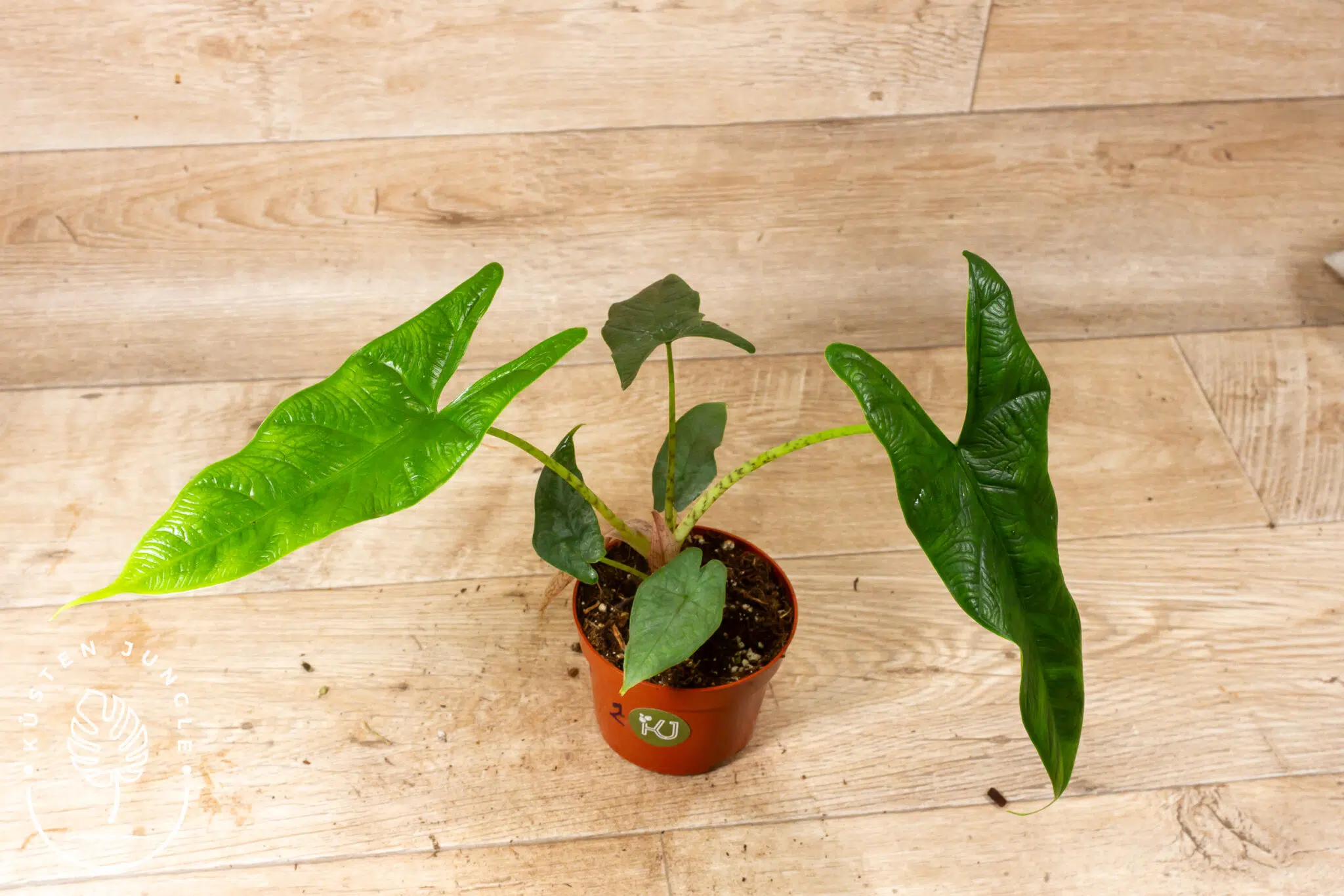
Botanically, the Green Carpet is an Alocasia form from the Indonesian island of Sulawesi that has not yet been fully scientifically described. It belongs to the velvety-leaved „Jewel Alocasias.“ Its small, heart-shaped leaves with a dark green, moss-like velvet surface and fine venation are clearly distinct from the large-leaved, tall-growing Alocasia species, making it an ideal choice for display cases or terrariums.
Because of its velvety leaf surface and the high humidity it needs, it's prone to thrips and spider mites – regular inspection of the undersides of the leaves is worthwhile.