
Alocasia ‚Teletubbies‘ - Care
Location & Light
As a compact offshoot of the vigorously growing Stingray/Loco line, the Alocasia Teletubbies can tolerate more light than most other Alocasias and can be placed in bright to very bright conditions, preferably near an east or south-facing window. Gentle morning or evening sun is usually tolerated, but you should still avoid direct midday sun behind glass, as even its thick, glossy leaves can burn. If it's placed in too much shade, the petioles will become thin and soft, and the compact, upright growth will be lost.
Pour
During the growth phase, Teletubbies are thirstier than many small-leaved Alocasias. Water as soon as the top half of the substrate has dried out, then keep the root ball consistently moist, but never waterlogged. Room-temperature, low-lime water is best tolerated. Always pour off excess water from saucers or decorative pots, as waterlogging can quickly damage the roots. In autumn and winter, when growth slows down, water noticeably less frequently.
Fertilize
Due to their generous, thick foliage and vigorous growth, 'Teletubbies' are considered heavy feeders among Alocasias. During the growing season, feeding once every 1 to 2 weeks with a highly diluted liquid fertilizer (one quarter to a maximum of half the recommended amount) is usually sufficient, as the genus remains sensitive to salt despite its strong growth. A general rule of thumb for Alocasias is a pH value of approximately 5.5 to 6.5 and rather low EC levels of 1.0 to 1.5 mS/cm. For precise dosage, follow the manufacturer's instructions on the respective packaging. If 'Teletubbies' is only placed by a window in autumn and winter, the light becomes weaker, and fertilization should be reduced accordingly or paused. However, if it grows year-round under a sufficiently bright plant lamp, the usual rhythm can be maintained without further reductions.
We consciously alternate between different fertilizers for our own plants – currently including COMPO COMPLETE, Foliage Focus, Liquid Gold Leaf, and Hesi TNT-Complex, supplemented with Hesi Root Complex, Hesi PowerZyme, and CalMag as needed.
Substrate
A loose, nutrient-rich, yet well-draining substrate is most beneficial for Teletubbies – an aroid mix of potting soil, coarse bark, and perlite works well. Since they root quite vigorously and grow quickly, the pot can be slightly more generous than for compact Jewel alocasias, but should still not be oversized so that the substrate dries reliably after watering.
Humidity & Temperature
The Teletubbies cope surprisingly well with normal indoor air humidity in the range of 40 to 50 %—much more easily than many sensitive Jewel Alocasias. However, slightly higher humidity—starting at around 60 %—is rewarded with stronger, juicier leaves. A humidifier or a tray of pebbles offers a reliable way to raise humidity levels as needed. The ideal temperature range is between 18 and 27 °C; cold drafts and consistently lower temperatures quickly lead to stunted growth.
Growth & Form
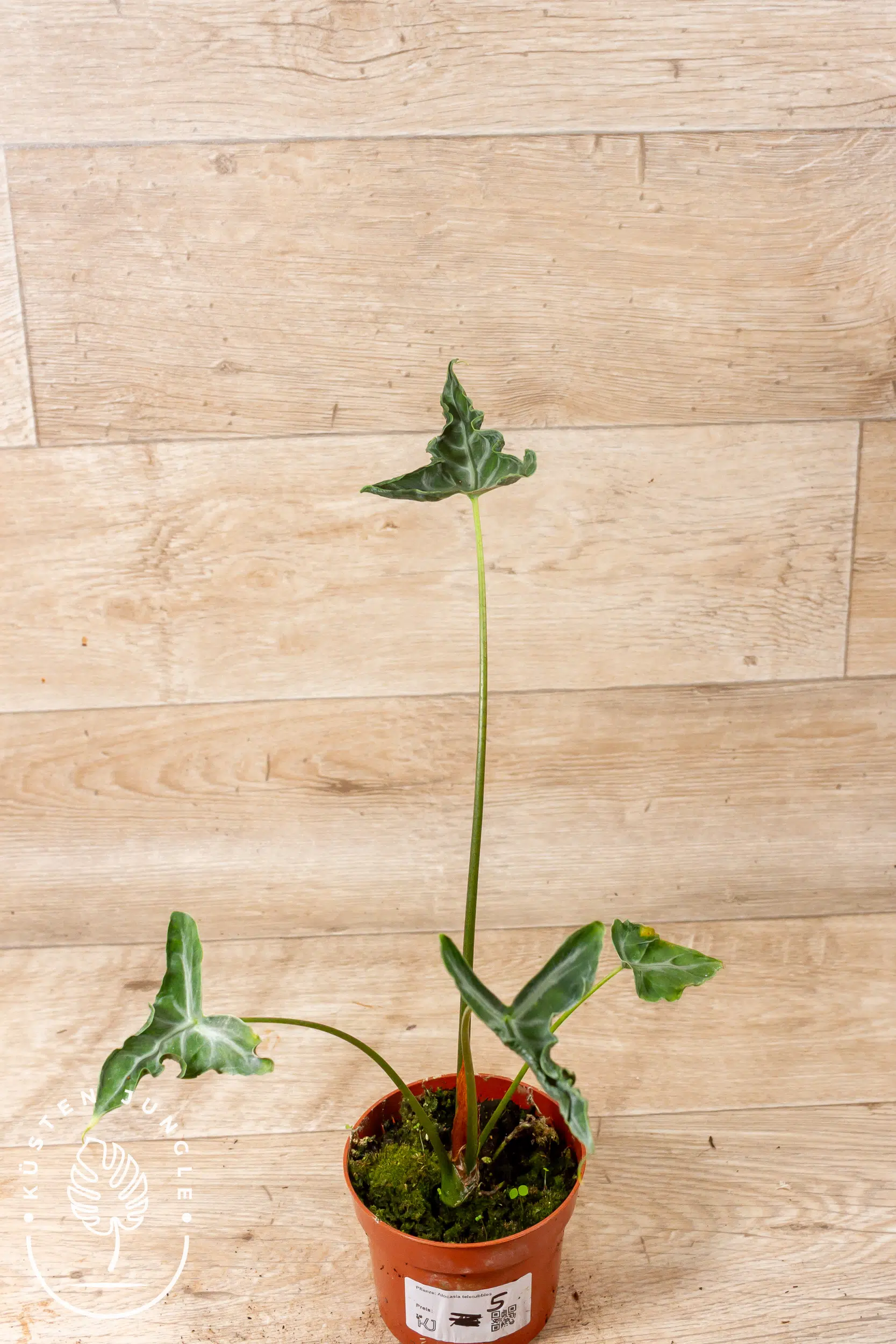
The Teletubbies remain significantly more compact than their large-growing relatives Stingray and Loco, instead forming thick, upright, paddle-shaped leaves with wavy, slightly twisted edges on stout stems – hence the playful name. It doesn't truly have a temperature-controlled winter dormancy at normal room temperatures; the light supply is the main factor. If it's placed only by the window in autumn and winter, the weaker daylight noticeably slows its growth; conversely, if it grows year-round under a sufficiently bright plant lamp, its growth usually remains stable even in winter.
Good to know
Like all Alocasias, the Teletubby also contains calcium oxalate crystals and is irritating for pets and children if ingested – best to place it out of reach.
Botanically, the Teletubbies is considered a spontaneous mutation within the Alocasia macrorrhizos breeding line, presumably related to the better-known varieties ‚Stingray‘ or ‚Loco‘—its exact lineage has not yet been definitively clarified among breeders. It owes its name to its thick, bulbous, wavy leaf shapes that remotely resemble the antennae of the characters from the children's television series of the same name.
Regular inspection of the undersides of leaves is worthwhile, as scale insects and spider mites can appear, especially in dry, heated air during winter.