
Alocasia ‚Venom‘ - Care
Location & Light
At least a few hours of bright, indirect light are not optional for this Alocasia, but rather a prerequisite for strong growth – without sufficient brightness, it tends to lose leaves more quickly than many other varieties. Direct sun, especially at midday, quickly leads to burns on the matte green leaf surface, while mild morning or evening sun is usually well tolerated. As a guideline for the genus, Alocasias generally require about 150 to 500 µmol/m²/s PAR (PPFD), which corresponds to a DLI of approximately 6.5 to 25 mol/m²/day with 12 to 14 hours of lighting.
Pour
The top 2 to 3 cm of the substrate can dry out between waterings, after which it should be watered thoroughly and evenly. In summer, this can be every few days for this Alocasia, while in winter it's often only once a week or less. Permanent waterlogging is the quickest way to root rot and should be avoided at all costs, so always pour out excess water from the saucer.
Fertilize
Like most alocasias, ‚Venom‘ is also a heavy feeder – during the growing season, it should be fertilized approximately every 1 to 2 weeks with a highly diluted liquid fertilizer, preferably with every or every other watering. For the genus, pH values of around 5.5 to 6.5 and a rather low electrical conductivity of the irrigation water of roughly 1.0 to 1.3 mS/cm are considered guideline values, as alocasias are sensitive to salt buildup; follow the manufacturer's instructions for precise dosage. If the plant is only placed by the window in autumn and winter, fertilizing is done less frequently or not at all due to the weaker light; under consistently bright plant lighting year-round, however, you can continue fertilizing at the usual, frequent rhythm.
We consciously alternate between different fertilizers for our own plants – currently including COMPO COMPLETE, Foliage Focus, Liquid Gold Leaf, and Hesi TNT-Complex, supplemented with Hesi Root Complex, Hesi PowerZyme, and CalMag as needed.
Substrate
A coarse, well-draining Aroid mix of orchid bark, perlite, and some coco coir or peat moss will ensure that water drains quickly without the substrate completely drying out. A pot with ample drainage holes is a must for this Alocasia to prevent the roots from standing in moisture permanently.
Humidity & Temperature
When it comes to humidity, ‚Venom‘ is more demanding than many other Alocasia varieties: levels of 65 % or higher are necessary; otherwise, brown edges will quickly appear—the thin, long tip of the leaf is usually the first part to react to air that’s too dry. Placing a humidifier nearby is the most reliable solution here; simply grouping it with other plants is often not enough in normal indoor air conditions. As for temperature, the ideal range is between 18 and 28 °C; below about 15 °C, growth slows noticeably, and below 10 °C, leaf loss or a dormant phase may occur.
Growth & Dormancy
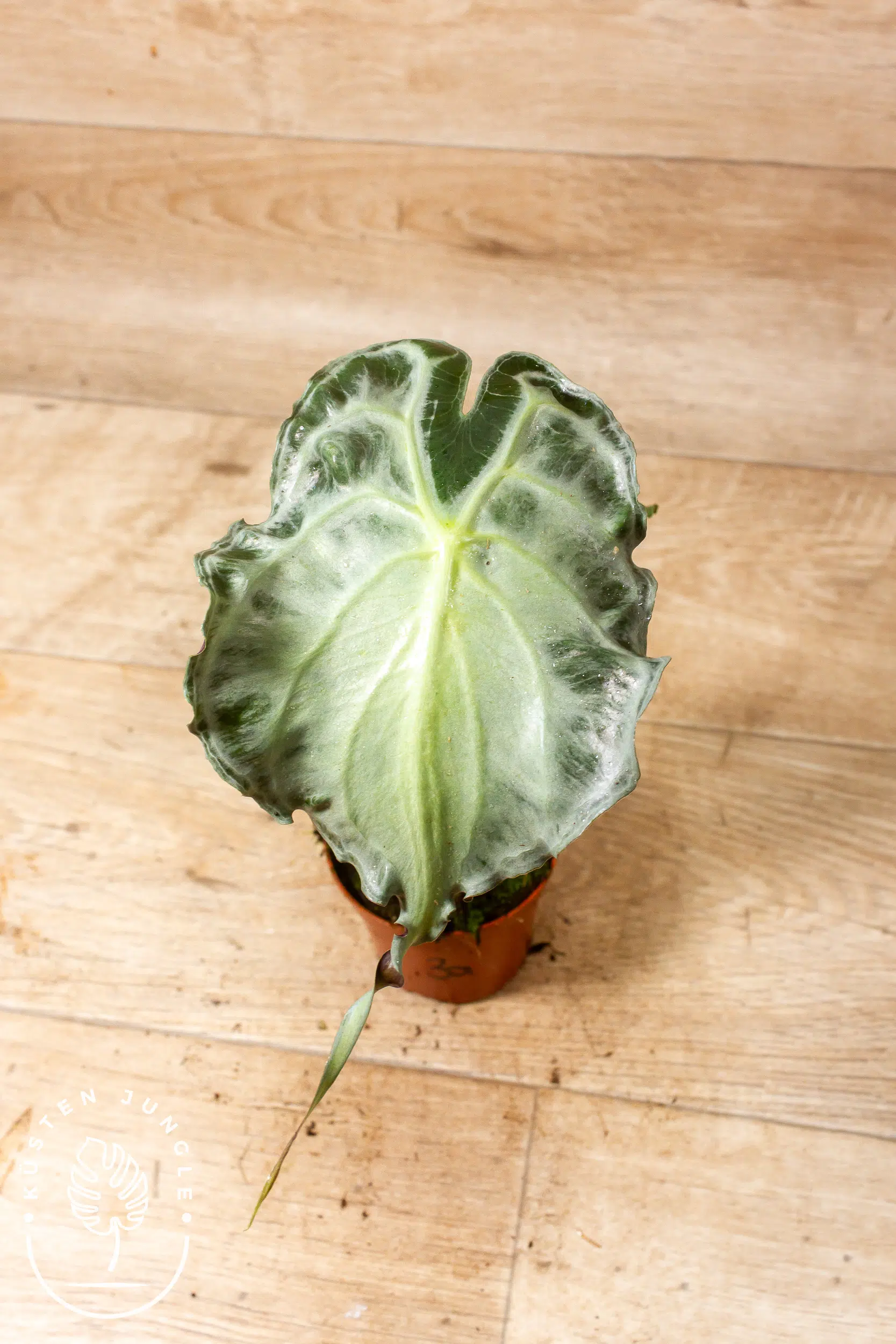
The shield-shaped leaves with their gently wavy edge and distinctly raised veining are striking enough, but the actual identifying feature of this variety sits at the leaf tip: it tapers long and narrow and curls into a trap-like ripple at the end. Young leaves initially appear darker green and gradually lighten to a consistent matte silvery green over time, instead of darkening with age as with many other Alocasias. If the plant is grown only by a window in autumn and winter, growth noticeably slows due to weaker light, and it may enter a slight dormancy phase with reduced foliage; however, with consistently bright plant light year-round, growth generally remains stable.
Good to know
Alocasia ‚Venom‘ was discovered in 2019 by South Korean breeder Mason Lee as a spontaneous mutation of the well-known Alocasia amazonica – itself a cross between Alocasia sanderiana and Alocasia longiloba ‚Watsoniana‘ bred in Miami in the 1950s. Unlike its parent plant, whose leaves usually taper to a uniform point, a random genetic alteration in ‚Venom‘ causes the eponymous rolled-up leaf tip, reminiscent of the tongue of the Marvel villain of the same name.
Like all aroids, this Alocasia also contains calcium oxalate crystals and is irritating to pets and children if ingested – it's best to place it out of reach. Regular checks of the undersides of the leaves are also worthwhile, as spider mites are among the more common problems with this genus, especially in overly dry air.