
Alocasia watsoniana ‚Lightning‘ - Care
Location & Light
As an inhabitant of the shady undergrowth of the tropical forests of Borneo, Sumatra, and the Malay Peninsula, this Alocasia is adapted to bright but filtered light – it cannot tolerate direct sun and reacts with burnt spots on its otherwise so contrasting leaves. A spot with plenty of indirect light, perhaps set back a bit from a south-facing window or directly by an east/west window, comes closest to its natural habitat. For the genus, approximately 150 to 250 µmol/m²/s PAR (PPFD) and a DLI of about 6 to 10 mol/m²/day are considered benchmarks – placed in too much darkness, it grows noticeably slower and the bright lightning-like venation becomes less pronounced.
Pour
Once the top 2-3 cm of the substrate feel dry, water thoroughly until it penetrates, ensuring no excess water remains in the saucer. Depending on the location and season, this may be necessary every few days in the summer, but much less frequently in the winter. If watering is delayed too long, the leaves will droop noticeably quite quickly – a reliable warning sign, but one the plant responds to just as reliably once watered again.
Fertilize
Like most Alocasias, the ‚Lightning‘ is a heavy feeder and should be fertilized approximately every 1 to 2 weeks during the growing season with a highly diluted liquid fertilizer. General guidelines for the genus include a pH of around 5.5 to 6.5 and an electrical conductivity of the irrigation water of roughly 1.0 to 1.5 mS/cm. If the plant is only placed by the window in autumn and winter, less or no fertilizer is applied due to the weaker light; however, with a plant lamp that provides sufficient light year-round, fertilization can continue at the usual rhythm.
We consciously alternate between different fertilizers for our own plants – currently including COMPO COMPLETE, Foliage Focus, Liquid Gold Leaf, and Hesi TNT-Complex, supplemented with Hesi Root Complex, Hesi PowerZyme, and CalMag as needed.
Substrate
A fluffy, coarse aroid mix of orchid bark, perlite, and some coco coir or peat moss allows excess watering to drain quickly and prevents root rot. Since the plant has quite strong roots, the pot can be a bit generously sized, with good drainage at the bottom of the pot being mandatory.
Humidity & Temperature
The ‚Lightning‘ generally does well in normal indoor air, but in consistently very dry conditions, the leaves droop more quickly and the edges may turn brown in some places. It therefore thrives best at temperatures between 55 and 70 %; a spot in the bathroom or kitchen is often naturally well-suited, or alternatively, a humidifier nearby can make a noticeable difference. As for temperature, the ideal range is between 18 and 28 °C; cool drafts in winter should be avoided.
Growth & Dormancy
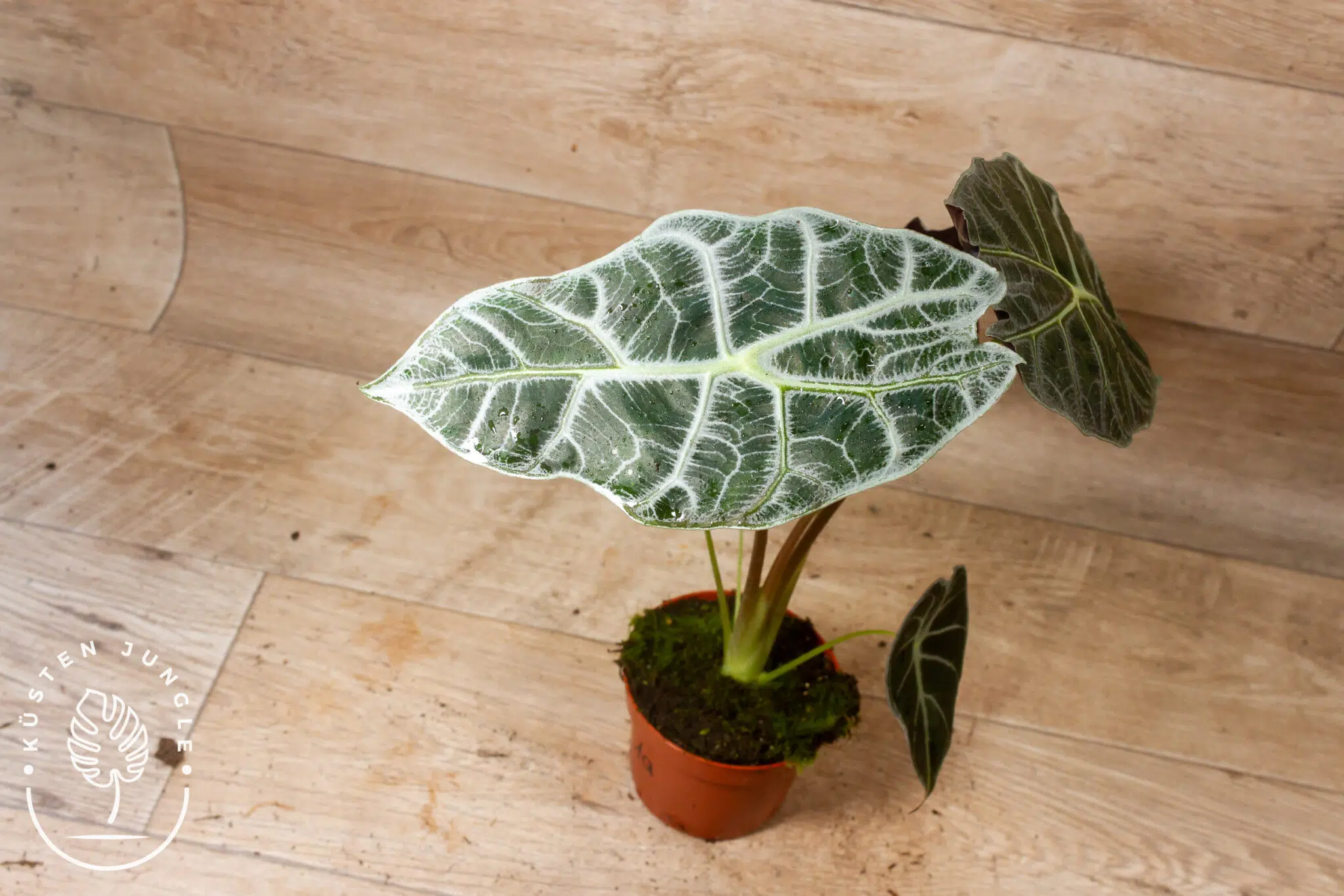
When fully grown, this Alocasia develops stately, shield-shaped leaves up to 60 cm long and 30 cm wide on a comparatively compact growth habit – a true statement piece that, despite its leaf size, doesn't demand an excessive amount of space. The undersides of the leaves shimmer with a contrasting purple hue. With window-only placement in autumn and winter, growth noticeably slows due to weaker light, and individual older leaves may be shed; however, with all-year-round bright plant lamp lighting, growth remains largely consistent.
Good to know
Botanically, the ‚Watsoniana‘ form belongs to the broadly defined Alocasia longiloba complex and was originally introduced to Europe in the 19th century by Sander's nursery. It does not have its own officially recognized species status, but the name has nonetheless become established as a form designation in the houseplant scene. The ‚Lightning‘ is a particularly high-contrast color form with strikingly bright, lightning-like veins on a dark green leaf background – it is most easily confused with the silvery-veined ‚Silver‘ form, which has much more delicate and less vibrant markings.
Like all Araceae, this Alocasia also contains calcium oxalate crystals and is irritating if ingested by pets and children – best to place it out of reach.