
Amydrium medium ‚Silver‘ Variegata - Care
Location & Light
A bright spot with plenty of indirect light is most beneficial for this climbing plant. Too little light will cause it to shed significantly more leaves than it can replace. Direct sunlight will quickly burn the delicate leaves and cause both the silvery-blue base color and the white variegation to fade. To maintain the striking, irregular patterns, bright, filtered light is more important than for purely green relatives.
Pour
Water when the top 2 to 3 cm of the substrate have dried out, but then water thoroughly. The goal is evenly moist, not wet, because this plant is sensitive to root rot if it gets too wet. Therefore, always empty any excess water from the saucer.
Fertilize
During the growth phase, from spring to summer, a liquid fertilizer diluted to half strength every 2 to 4 weeks is sufficient; fertilization is stopped in autumn and winter. General guidelines for the genus are a pH value of approximately 5.5 to 6.5 and a conductivity of the irrigation water of roughly 1.0 to 1.5 mS/cm. If the plant is only kept by the window in autumn and winter, no further fertilization will occur due to the weaker light anyway; however, with year-round bright grow light illumination, fertilization can continue somewhat longer at the normal rhythm.
We consciously alternate between different fertilizers for our own plants – currently including COMPO COMPLETE, Foliage Focus, Liquid Gold Leaf, and Hesi TNT-Complex, supplemented with Hesi Root Complex, Hesi PowerZyme, and CalMag as needed.
Substrate
An airy, well-draining aroid soil made of bark, perlite, and some coco coir ensures sufficient root aeration and prevents waterlogging. A pot with good drainage holes is important; repotting is usually not necessary for about two years.
Humidity & Temperature
When it comes to humidity, this variegated variety is indeed demanding: Experienced growers unanimously report that it needs high humidity to reliably produce new leaves—if the air is too dry, brown edges quickly appear and growth stalls. Levels around 65 to 70 % are considered ideal; a humidifier or a spot in a plant display case is significantly more effective here than simply misting the plant. As for temperature, the optimal range is between 18 and 29 °C; it should not drop below 15 °C for extended periods.
Growth & Support
With its aerial roots, this plant climbs tree trunks and rocks in its native habitat, which is why it is affectionately called „Spiderman Monstera.“ In young leaves, the white variegation can visibly distort the leaf shape, but as it matures and grows on a moss pole, the leaves grow larger and develop increasing notches and fenestrations, much like a young Monstera. Therefore, a climbing aid for this variety is not only aesthetically pleasing but almost indispensable for full leaf development. With purely window-based placement in autumn and winter, growth noticeably slows due to weaker light; however, with year-round bright grow light, the growth remains largely consistent.
Good to know
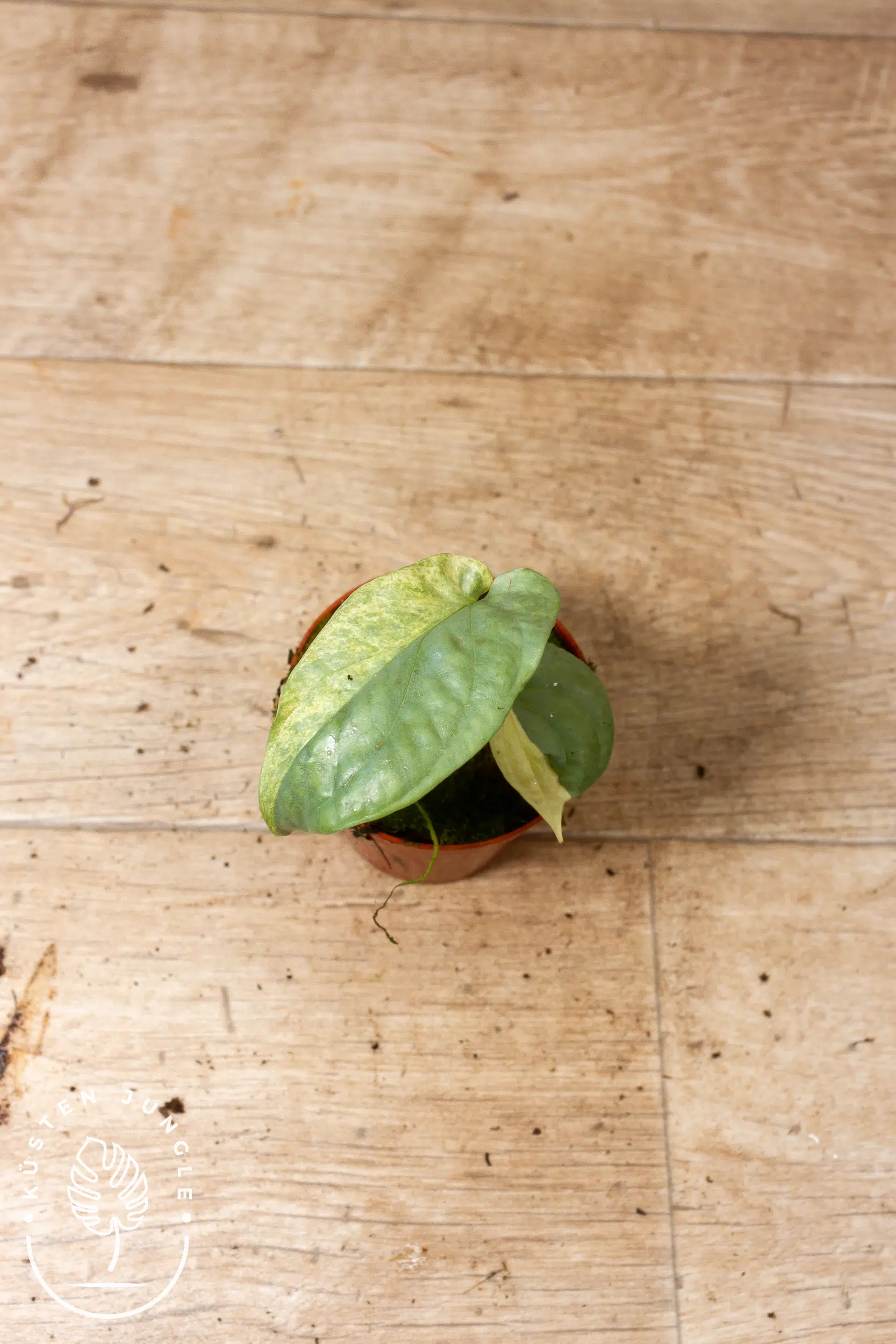
This form combines the characteristic blue-silvery base coloration of the ‚Silver‘ cultivar with a true white variegation, which visually resembles the pattern of Epipremnum ‚Cebu Blue Ghost‘ and remains genetically stable with consistent care. Amydrium medium originates from the humid forests of Southeast Asia, such as Malaysia and Indonesia, and is closely related to Monstera and Philodendron.
Like all aroids, this plant contains calcium oxalate crystals and is irritating to pets and children if ingested – best to place it out of reach.