
Anthurium ‚Delta Force‘ - Care
Location & Light
A bright spot with plenty of indirect light best showcases the silvery veining of this hybrid – without sufficient light, it will shed leaves rather than simply grow slower. In contrast, direct, hot sunrays quickly scorch the velvety leaf surface, so a spot a little distance from a south-facing window usually works well. Rough guidelines for velvety-leaved anthuriums are 20 to 100 µmol/m²/s PAR (PPFD), which corresponds to a DLI of approximately 1 to 4 mol/m²/day.
Pour
The substrate should be kept evenly moist without becoming waterlogged – too much water quickly leads to waterlogging and subsequent root rot. The best way to check is with your finger: if the top 2 to 3 cm feel dry, water again. Excess water in the saucer should always be poured off.
Fertilize
During the growth phase, a well-diluted liquid fertilizer once a month is sufficient. As a guideline for the genus, a pH of about 5.5 to 6.5 and an electrical conductivity of the irrigation water of roughly 1.0 to 1.5 mS/cm are considered. If the plant is only placed by the window in autumn and winter, no further fertilization is needed due to the weaker light; however, with year-round bright plant lamp lighting, fertilization can continue at the usual rhythm.
We consciously alternate between different fertilizers for our own plants – currently including COMPO COMPLETE, Foliage Focus, Liquid Gold Leaf, and Hesi TNT-Complex, supplemented with Hesi Root Complex, Hesi PowerZyme, and CalMag as needed.
Substrate
An airy, well-draining mix of equal parts orchid bark, peat substitute or coco coir, and perlite will provide ample oxygen to the roots without suffocating them. A pot with good drainage is important; repotting is usually done once a year or as soon as the plant has doubled in size.
Humidity & Temperature
This hybrid is pleasantly adaptable to humidity levels and can cope with slightly lower levels than many other velvety-leaved Anthuriums, but it grows noticeably more vigorously at levels of about 60 % or higher. Instead of misting—the effect is short-lived, and damp leaves can promote fungal growth—a nearby humidifier provides more reliable results. As for temperature, the ideal range is between 18 and 27 °C; the plant does not tolerate temperatures consistently below 15 °C well.
Growth & Form
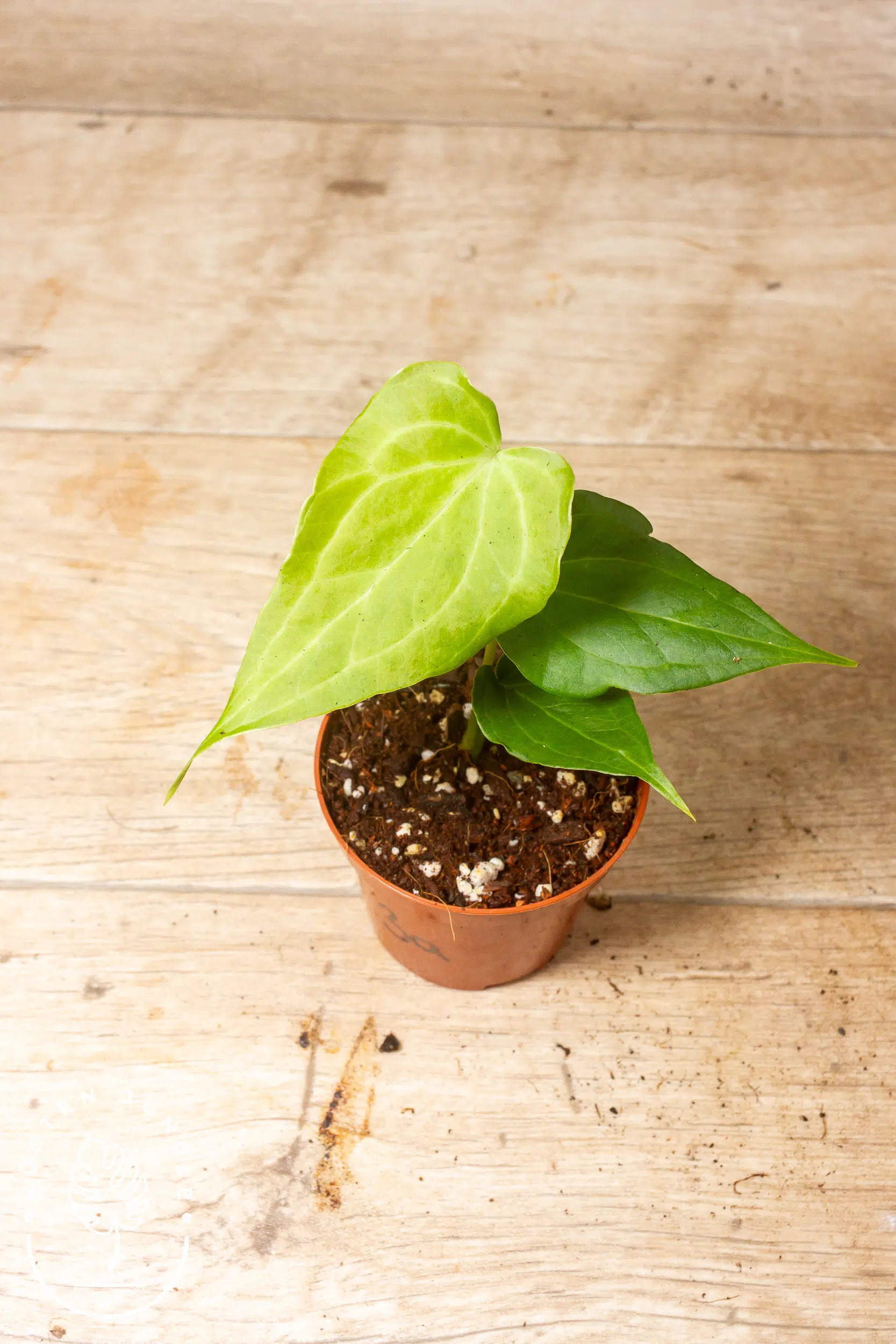
As a self-heading rosette plant, ‚Delta Force‘ grows upright without climbing ambitions and therefore does not require a support. Its name comes from its distinctive triangular-delta shaped leaves, which deviate significantly from the classic heart-shaped anthurium silhouette—a legacy of the lobed, finger-like parent in its lineage. When grown solely indoors in the fall and winter, growth noticeably slows due to weaker light; however, with year-round bright grow light illumination, growth remains largely consistent.
Good to know
‚Delta Force‘ traces back to breeder Steve Nock of Ree Gardens' crossing attempts in the mid-1990s between Anthurium clarinervium and Anthurium pedatoradiatum. From a highly variable batch of seedlings, a single clone stood out with its distinctively triangular leaf shape and was established as its own cultivar, propagated through tissue culture.
Like all aroids, this Anthurium also contains calcium oxalate crystals and is irritating to pets and children if ingested – best to place out of reach.