
Anthurium ‚Radicans x Luxurians‘ – Care
Location & Light
A bright spot with plenty of indirect light, such as near an east or west window, will allow this Anthurium to grow most vigorously and best showcase the veined leaf surface. As a rough guideline, the ideal range is about 20 to 80 µmol/m²/s PAR (PPFD), which corresponds to a DLI of approximately 1 to 3.5 mol/m²/day with about 12 hours of light duration. You should avoid direct sunlight, as the thick, leathery leaves can burn from it. Overall, this Anthurium is more adaptable to different light conditions than many other species.
Pour
Water as soon as the top 4 to 5 cm of the substrate have dried out. The root ball should be evenly moist afterward, but never waterlogged. This Anthurium tolerates complete drying out for extended periods just as little as permanent waterlogging; a balanced rhythm is more important here than strictly keeping it dry or constantly moist. Room-temperature, low-lime water is best tolerated; always pour off excess water from saucers or cachepots. In autumn and winter, when growth slows down, water significantly less.
Fertilize
Since this anthurium grows new leaves quite quickly during its growth phase and thus uses up the nutrients in the substrate accordingly faster, a dose every 3 to 4 weeks with a highly diluted liquid fertilizer (a quarter to a maximum of half the recommended amount) is usually sufficient. As a rough approximation, anthuriums generally have a pH value of about 5.5 to 6.5 and rather low values of 1.0 to 1.5 mS/cm. For exact dosage, follow the manufacturer's instructions on the respective packaging. If the plant is only on the windowsill in autumn and winter, the light becomes weaker and the fertilization is reduced or paused accordingly; if, on the other hand, it grows year-round under sufficiently bright plant light, the usual rhythm can be maintained without further reduction.
We consciously alternate between different fertilizers for our own plants – currently including COMPO COMPLETE, Foliage Focus, Liquid Gold Leaf, and Hesi TNT-Complex, supplemented with Hesi Root Complex, Hesi PowerZyme, and CalMag as needed.
Substrate
A coarse, airy, yet organically enriched substrate is best for this Anthurium – a mix of orchid bark, perlite, coco coir, and some charcoal works well. The most important thing is that water drains quickly and oxygen reaches the roots; a substrate that is too densely packed quickly promotes root rot. Repot as soon as the pot becomes visibly too small or the plant has grown significantly.
Humidity & Temperature
This anthurium copes surprisingly well with normal indoor air humidity in the range of 40 to 50 % and is generally less demanding than many other species —but it grows significantly more vigorously and lushly at higher humidity levels between 50 and 70 %. A humidifier or a tray of pebbles can help raise humidity levels as needed. In terms of temperature, the ideal range is between 18 and 27 °C; cold drafts and sudden temperature fluctuations should be avoided.
Growth & Form
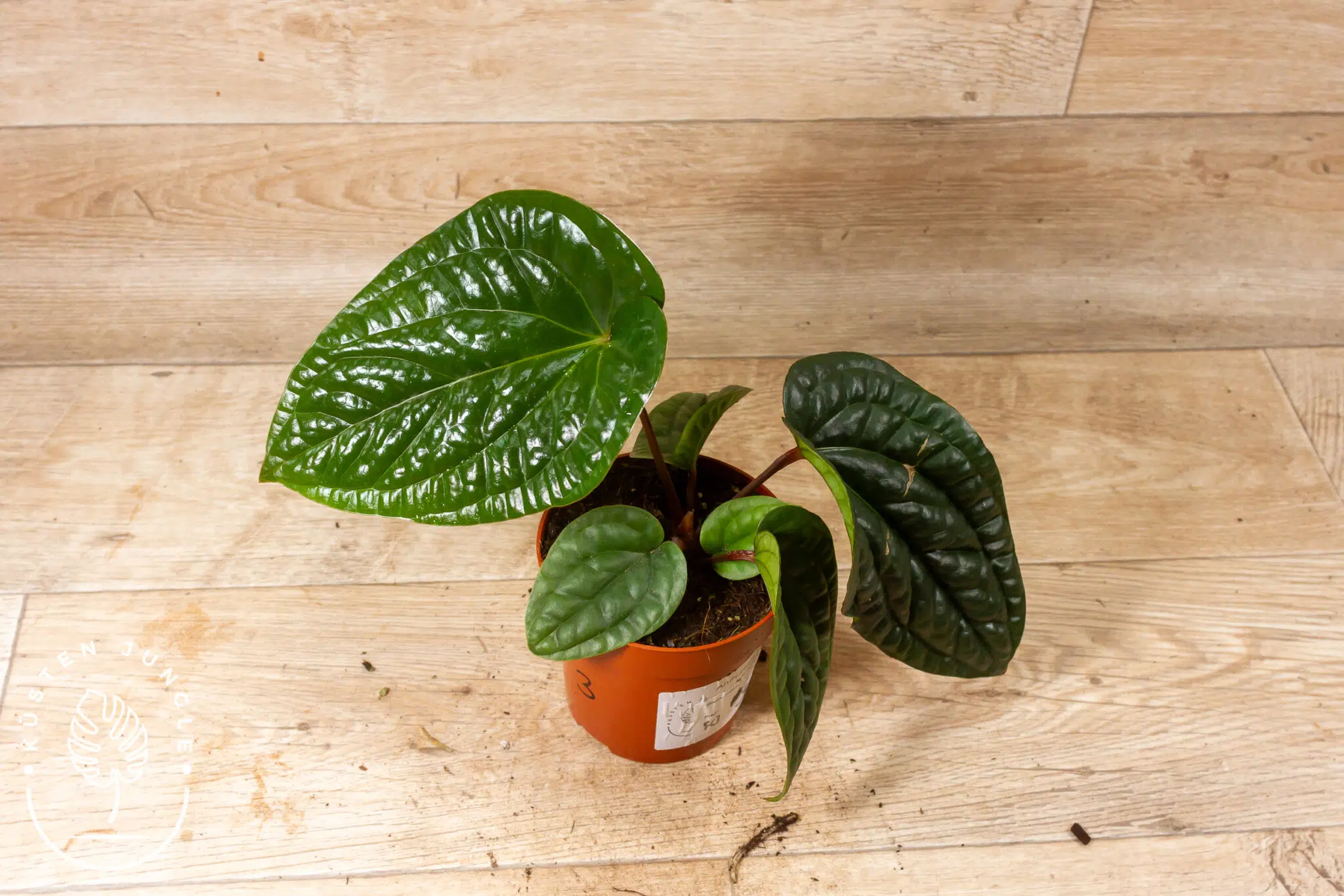
This Anthurium forms thick, heart-shaped leaves with a strongly arched, quilted-looking surface, growing in a low-creeping to slightly climbing habit, which is why a trellis or moss pole suits it well. New leaves initially appear in a strong pink to bronze tone and only gradually mature to a rich dark green, accompanied by strikingly dark red to brownish leaf stalks. Overall, it grows quite quickly. A distinct resting phase is not uniformly documented, but it grows noticeably slower in winter.
Good to know
Like all anthuriums, this hybrid also contains calcium oxalate crystals and is irritating to pets and children if ingested – best to place it out of reach.
Botanically, it is a sterile hybrid of the pointed-leaved Anthurium radicans and the broader, more oval Anthurium luxurians, occasionally traded under the nickname „Quilted Hearts.“ What distinguishes this cross from pure Anthurium luxurians is primarily its overall faster growth and slightly greater adaptability to different light and humidity conditions – a typical effect of crosses between two parents with differing requirements.
Regularly checking the undersides of leaves is worthwhile, as scale insects and mealybugs like to hide there.