
Anthurium pallidiflorum – Care
Location & Light
In its native habitat, the cloud forests of Ecuador and Colombia, this Anthurium hangs epiphytically on moss-covered branches in the diffused, but by no means weak, light of the canopy. Accordingly, at home it needs a very bright spot with plenty of indirect light so that the long ribbon leaves grow quickly in length – with too little light, growth remains noticeably shorter and significantly slower. However, the velvety leaf surface cannot tolerate direct sun, as burns can quickly occur. As a rough guide, the suitable range is around 80 to 160 µmol/m²/s PAR (PPFD), which corresponds to a DLI of approximately 3.5 to 7 mol/m²/day with 10 to 12 hours of illumination.
Pour
As an epiphyte, this Anthurium is accustomed to short dry spells between waterings – water again only when the top 2 to 3 cm of the substrate feel dry. It reacts to drought stress with drooping, wilting leaves, but usually recovers quickly afterward; however, it hardly forgives permanent waterlogging and responds with root rot. Soft water that is room temperature is tolerated much better than hard tap water.
Fertilize
Every 4 to 6 weeks during the growing season, a highly diluted liquid fertilizer is sufficient for this Anthurium to continuously produce new, long leaves without salt buildup in the substrate. Generally, a pH range of approximately 5.5 to 6.5 and an electrical conductivity of irrigation water of roughly 1.0 to 1.5 mS/cm are considered guidelines for Anthuriums; follow the manufacturer's instructions for precise dosage. If the plant is only growing by a window in the fall and winter, fertilizing is done less frequently or not at all due to weaker light; however, if provided with sufficiently bright plant light year-round, fertilizing can continue at the usual rhythm.
We consciously alternate between different fertilizers for our own plants – currently including COMPO COMPLETE, Foliage Focus, Liquid Gold Leaf, and Hesi TNT-Complex, supplemented with Hesi Root Complex, Hesi PowerZyme, and CalMag as needed.
Substrate
A coarse, airy mix of orchid bark, some sphagnum moss or coir, and perlite mimics the epiphytic substrate this Anthurium is accustomed to in the wild. Because of the weight of the long spathes, it also needs a stable, not-too-light pot or a firmly anchored hanging basket so it doesn't tip over.
Humidity & Temperature
High humidity isn’t just a nice-to-have for this Anthurium—it makes a real difference: Below 50 %, the leaf tips tend to dry out and the characteristic ribbon shape becomes less pronounced; only at around 60 to 70 % does the plant appear consistently healthy. A humidifier, a greenhouse cabinet, or a more humid spot in the bathroom can help. The ideal temperature range is between 20 and 27 °C; the plant is sensitive to temperatures below 15 °C and to drafts.
Growth & Form
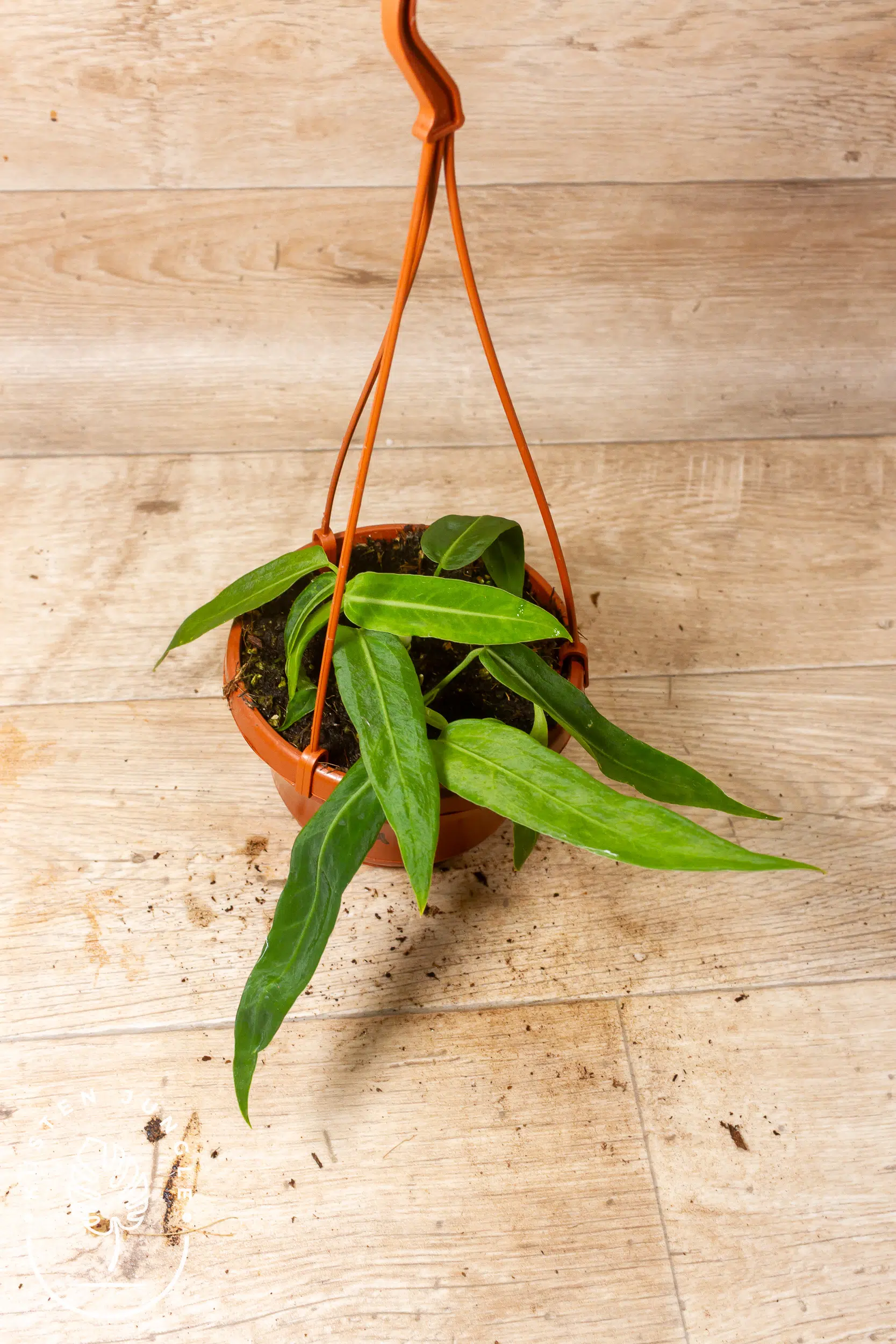
Instead of the classic heart-shaped anthurium leaves, this species forms narrow, ribbon-like leaves that can grow a meter or more long in mature specimens, while remaining only a few centimeters wide. They do not grow climbing, but hang straight down – a hanging basket or elevated position is therefore much more suited to this growth habit than a normal table or windowsill placement. The inflorescences, with their narrow, pale spadix, are rather inconspicuous, which is normal for this species and not a sign of poor care.
Good to know
Optically, Anthurium pallidiflorum can easily be confused with Anthurium vittarifolium, as both develop similarly long, hanging, strap-like leaves. A reliable distinguishing feature is the flower shape: while vittarifolium has a straight inflorescence, the inflorescence of pallidiflorum is usually somewhat shorter and more compact.
Like all aroids, this Anthurium also contains calcium oxalate crystals and is irritating to pets and children if ingested – best to place it out of reach. Due to the dense, velvety leaf hair, regular checks for spider mites and thrips, which like to hide here, are also worthwhile.