
Anthurium papillilaminum x ‚Dark Phoenix‘ – Care
Location & Light
A warm spot with bright, well-filtered light best showcases the velvety sheen of this dark variety. Direct sun quickly burns the sensitive leaf surface, while too much darkness makes the velvety leaves appear dull and growth becomes tougher. As a guideline for velvety anthuriums, roughly 20 to 100 µmol/m²/s PAR (PPFD) is recommended, which corresponds to a DLI of approximately 1 to 4 mol/m²/day.
Pour
The substrate should be kept evenly moist without becoming waterlogged – the top 2 to 3 cm should be allowed to dry out slightly before the next watering. Consistent, steady watering ensures that new leaves unfurl more smoothly and with more intense color. Waterlogging in the pot must be strictly avoided, so always drain excess water.
Fertilize
During the growth phase, a well-diluted liquid fertilizer every 4 to 6 weeks is sufficient. The pH range of approximately 5.5 to 6.5 and an electrical conductivity of the irrigation water of roughly 1.0 to 1.5 mS/cm are considered guidelines for the genus. If the plant is only placed by the window in autumn and winter, fertilizing is done less frequently or not at all due to the weaker light; however, with year-round bright plant lamp lighting, fertilization can continue at the usual rhythm.
We consciously alternate between different fertilizers for our own plants – currently including COMPO COMPLETE, Foliage Focus, Liquid Gold Leaf, and Hesi TNT-Complex, supplemented with Hesi Root Complex, Hesi PowerZyme, and CalMag as needed.
Substrate
A coarse, very permeable aroid substrate made of orchid bark, perlite, and some sphagnum moss is best suited for the active roots of this anthurium. A pot with good drainage is important; repotting is usually done in spring as soon as the pot becomes noticeably too small.
Humidity & Temperature
This variety is particular about humidity: levels between 60 and 80 % are considered ideal; below that, the velvety leaf surface noticeably loses its depth and luster. Instead of misting—the effect is short-lived, and damp leaves can promote fungal growth—a humidifier ensures more consistent results. The temperature should not drop below 16 °C for extended periods; the plant thrives between 18 and 27 °C.
Growth & Form
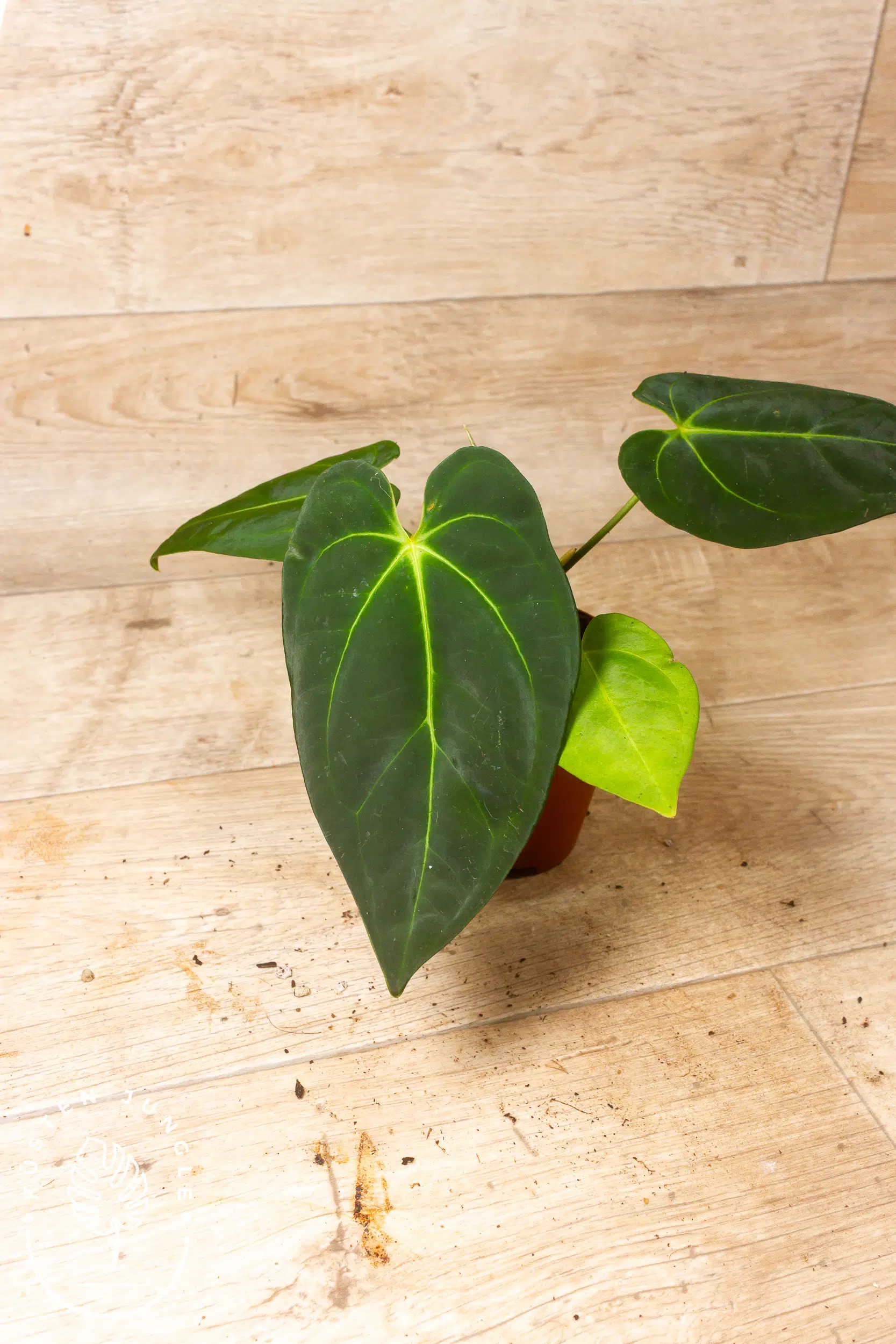
As a self-supporting rosette plant, this Anthurium grows upright and remains compact, reaching a maximum height and width of about 60 cm; it does not need a support. New leaves often unfurl in warm shades of bronze, burgundy, or reddish-brown before darkening to their final, velvety, almost black green with light veins. When kept solely by a window in the fall and winter, it takes a brief break from growth; under bright plant lights year-round, however, its growth remains more consistent.
Good to know
The parent species Anthurium papillilaminum originates from the tropical lowland rainforests of Panama and belongs to the Cardiolonchium group, which also includes A. warocqueanum, A. regale, and A. forgetii. Regarding the exact parentage of ‚Dark Phoenix‘ itself, there are varying accounts in the trade: some vendors list it as a cross with Anthurium dressleri, while others doubt this connection and lean towards it being a pure papillilaminum cultivar – an officially registered, botanically confirmed lineage does not currently exist.
Like all aroids, this Anthurium also contains calcium oxalate crystals and is irritating to pets and children if ingested – best to place out of reach.