
Anthurium ‚Silver Blush Mint‘ - Care
Location & Light
A bright spot with plenty of indirect light best highlights the silvery veining of this variety. Direct sun quickly burns the velvety leaf surface. While it can tolerate weaker light for a while, growth will become noticeably more hesitant. As a guideline for velvety-leaved anthuriums, approximately 20 to 100 µmol/m²/s PAR (PPFD) is considered ideal, which corresponds to a DLI of about 1 to 4 mol/m²/day.
Pour
Water when the top 2 to 3 cm of the substrate have dried out, which is usually about once a week. This Anthurium does not tolerate waterlogging well, so excess water should be consistently removed from the saucer to prevent root rot.
Fertilize
During the growth phase, a well-diluted liquid fertilizer every 4 to 6 weeks is sufficient. The pH range of approximately 5.5 to 6.5 and an electrical conductivity of the irrigation water of roughly 1.0 to 1.5 mS/cm are considered guidelines for the genus. If the plant is only placed by the window in autumn and winter, fertilizing is done less frequently or not at all due to the weaker light; however, with year-round bright plant lamp lighting, fertilization can continue at the usual rhythm.
We consciously alternate between different fertilizers for our own plants – currently including COMPO COMPLETE, Foliage Focus, Liquid Gold Leaf, and Hesi TNT-Complex, supplemented with Hesi Root Complex, Hesi PowerZyme, and CalMag as needed.
Substrate
Since this anthurium grows epiphytically by nature, a coarse, very loose substrate similar to that used for orchids is beneficial – a mix of orchid bark, perlite, and some sphagnum moss works well. A pot with good drainage is important; repotting is usually done in spring, as soon as the pot becomes noticeably too small.
Humidity & Temperature
Experience has shown that this Anthurium is one of the varieties that thrives in normal indoor air conditions—so a humidifier isn’t a must. While slightly higher humidity levels—starting at around 60 %—do make the colors appear even richer, they are not a deal-breaker for normal indoor care. Instead of misting—the effect is short-lived and standing moisture can actually encourage fungal growth—a humidifier is a much more reliable solution when in doubt. As for temperature, it handles fluctuations well; it thrives between 18 and 27 °C, though it can tolerate slightly cooler temperatures in winter.
Growth & Form
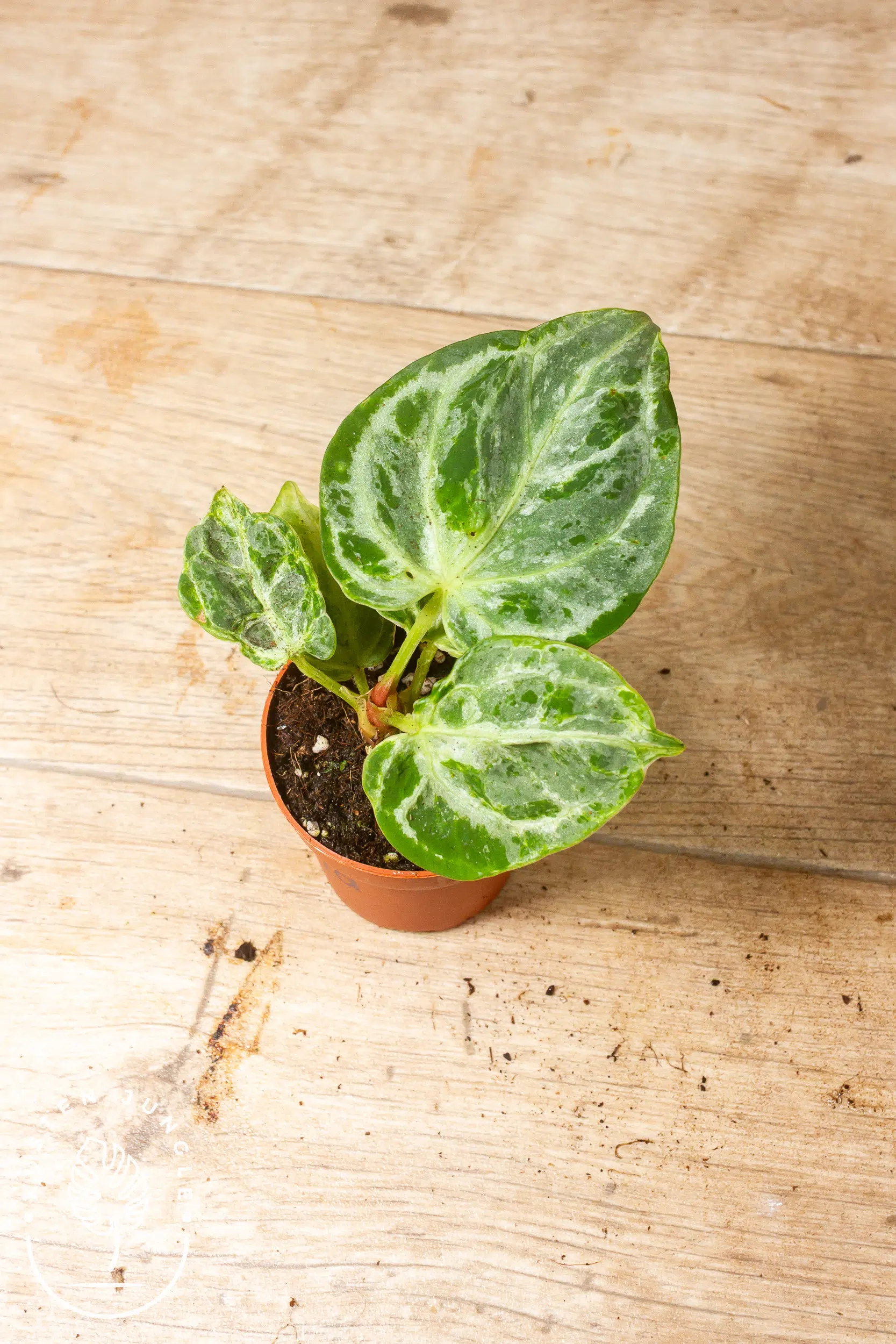
This Anthurium grows bushily from the center and forms long stems, each ending in a large, heart-shaped leaf – it doesn't need a climbing support. As it ages, it can bloom regardless of the season, but the flowers are rather inconspicuous compared to the decorative foliage. With window-only cultivation in autumn and winter, growth noticeably slows due to the weaker light; however, with year-round bright plant lamp illumination, growth remains largely uniform.
Good to know
‚Silver Blush Mint‘ is based on Anthurium crystallinum and has been specifically selected for more intense silvery veining, a delicate mint hue, and more compact growth compared to the pure species. Unlike Anthurium clarinervium, the silver content in the leaf pattern is particularly high.
Like all aroids, this Anthurium also contains calcium oxalate crystals and is irritating to pets and children if ingested – best to place out of reach.