
Ardisia gigantifolia – Care
Location & Light
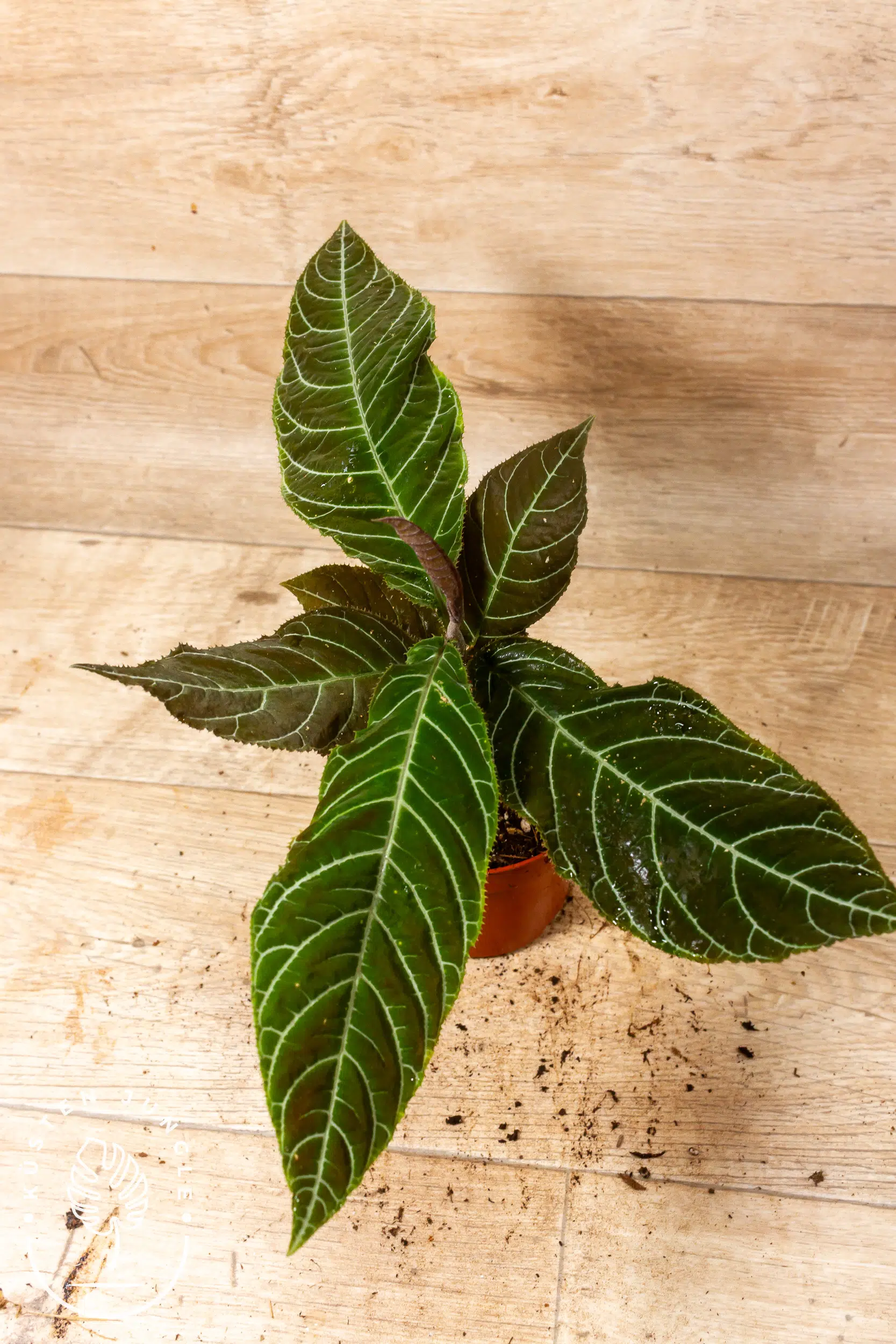
This Ardisia grows on the forest floor of Southern China and Vietnam, in the muted light of dense treetops. A spot with medium to bright, but always indirect light, suits it best. The dark, chocolate-brown leaf color with its vibrant green venation is particularly impressive when some light filters through the leaves without directly hitting them. Intense sun, especially at midday, quickly leads to unsightly light spots on the leaves. Despite targeted searching, there is no reliable source for a specific PAR or DLI value for this variety, which is why no numerical data is provided here.
Pour
The substrate should be kept uniformly moist, but not waterlogged – it's best to water as soon as the top layer of soil feels slightly dry. This Ardisia is sensitive to waterlogging and reacts with root rot, but it also doesn't tolerate complete drying out and will then let its leaves droop. Room-temperature, low-lime water is tolerated much better than hard tap water.
Fertilize
Since this Ardisia only grows slowly, a highly diluted, balanced liquid fertilizer every 4 to 6 weeks during the growing season is completely sufficient – it is not a heavy feeder. General guidelines for the Ardisia genus are a slightly acidic to neutral pH range of approximately 5.5 to 6.5 and an electrical conductivity of the irrigation water of roughly 1.0 to 1.4 mS/cm; follow the manufacturer's instructions for precise dosage. If the plant is only placed by the window in autumn and winter, fertilizing is done less frequently or not at all due to the reduced light; however, if it continues to grow year-round under sufficiently bright plant lights, you can continue fertilizing at the usual rhythm.
We consciously alternate between different fertilizers for our own plants – currently including COMPO COMPLETE, Foliage Focus, Liquid Gold Leaf, and Hesi TNT-Complex, supplemented with Hesi Root Complex, Hesi PowerZyme, and CalMag as needed.
Substrate
A loose, slightly acidic mixture of peat-reduced potting soil, perlite, and some pine bark provides plenty of support and drainage for the roots, allowing excess water to drain away quickly. A normal pot with drainage holes is sufficient for the compact root ball, but should be repotted as the plant grows larger.
Humidity & Temperature
Normal indoor air humidity in the range of 40 to 50 % is tolerable, but this Ardisia feels much more comfortable at levels of 60 % or higher, which is why it is often grown in terrariums or greenhouse cabinets. A humidifier or a tray of pebbles can help maintain optimal conditions in a room with normal humidity. The ideal temperature range is between 18 and 26 °C; temperatures below 10 °C and cold drafts should be avoided at all costs.
Growth & Form
As the name suggests, this Ardisia can grow to quite impressive sizes over time, developing into a small, bushy shrub. If you want to keep it more compact, you can prune the shoot tip, which reliably stimulates new growth from the lower leaf axils – this way, it can also be kept permanently small and suitable for terrariums. The growth is generally rather slow, but the striking leaf pattern of dark chocolate brown and vibrant green remains a real eye-catcher for years.
Good to know
Unlike most other plants on our care tips pages, Ardisia gigantifolia does not belong to the Araceae family, but to the Primulaceae family (formerly classified as its own family, Myrsinaceae). In its native region, the plant is traditionally used in folk medicine.
There is no scientifically substantiated toxicity classification for humans or pets for this species. However, a mild irritant effect upon ingestion is assumed for related Ardisia species as a precaution - it is best to place it out of reach of children and pets. Regular inspection of the undersides of the leaves is also worthwhile, as scale insects are among the more common problems with this genus.