
Begonia chlorosticta - Care
Location & Light
Bright, indirect light allows Begonia chlorosticta to grow most vigorously and best showcases the characteristic speckling on its leaves. A spot near an east or north-facing window is ideal. Avoid direct sunlight, especially at midday, as the sensitive leaves can quickly burn. If light is insufficient, growth will noticeably slow down, and the plant may become leggy and stretched.
Pour
Water once the top 2 to 3 cm of the soil have dried out – the root ball should then be consistently moist, but never waterlogged. Begonia chlorosticta tolerates neither completely dry soil nor permanent waterlogging well; both quickly lead to yellow or wilting leaves. Room-temperature, low-lime water is best tolerated; always pour off excess water from saucers or cachepots. In autumn and winter, when growth slows down, water noticeably less.
Fertilize
During the growth phase, Begonia chlorosticta only needs to be fertilized every 3 to 4 weeks with a highly diluted liquid fertilizer (a quarter to a maximum of half the recommended amount), as begonias are generally sensitive to high salt concentrations in the substrate. A rough approximation for begonias is a pH value of about 5.2 to 6.0 and rather low values of 0.5 to 1.3 mS/cm. For precise dosage, follow the manufacturer's instructions on the respective packaging. If the plant is only placed by the window in autumn and winter, the light becomes weaker and fertilization is correspondingly reduced or paused; however, if it grows year-round under sufficiently bright plant lights, the usual rhythm can be maintained without further reduction.
We consciously alternate between different fertilizers for our own plants – currently including COMPO COMPLETE, Foliage Focus, Liquid Gold Leaf, and Hesi TNT-Complex, supplemented with Hesi Root Complex, Hesi PowerZyme, and CalMag as needed.
Substrate
A slightly acidic, well-draining substrate is best for Begonia chlorosticta – a peat-poor, humus-rich potting soil with perlite in a ratio of about two to one works well. Since the roots are quite sensitive, repotting should be done carefully, moving up to a slightly larger pot size gradually rather than jumping into a pot that is too large.
Humidity & Temperature
Normal indoor air is not sufficient for Begonia chlorosticta in the long term—several independent sources agree that it needs consistently high humidity of at least 60 % to stay healthy. At lower levels, the leaves quickly dry out at the edges and become more susceptible to pests. A closed or partially closed terrarium, display case, or greenhouse cabinet is the most reliable solution here; a simple room humidifier is generally not sufficient for long-term care in most living spaces. As for temperature, the ideal range is between 18 and 25 °C; it does not tolerate sudden temperature fluctuations or cold drafts well.
Growth & Form
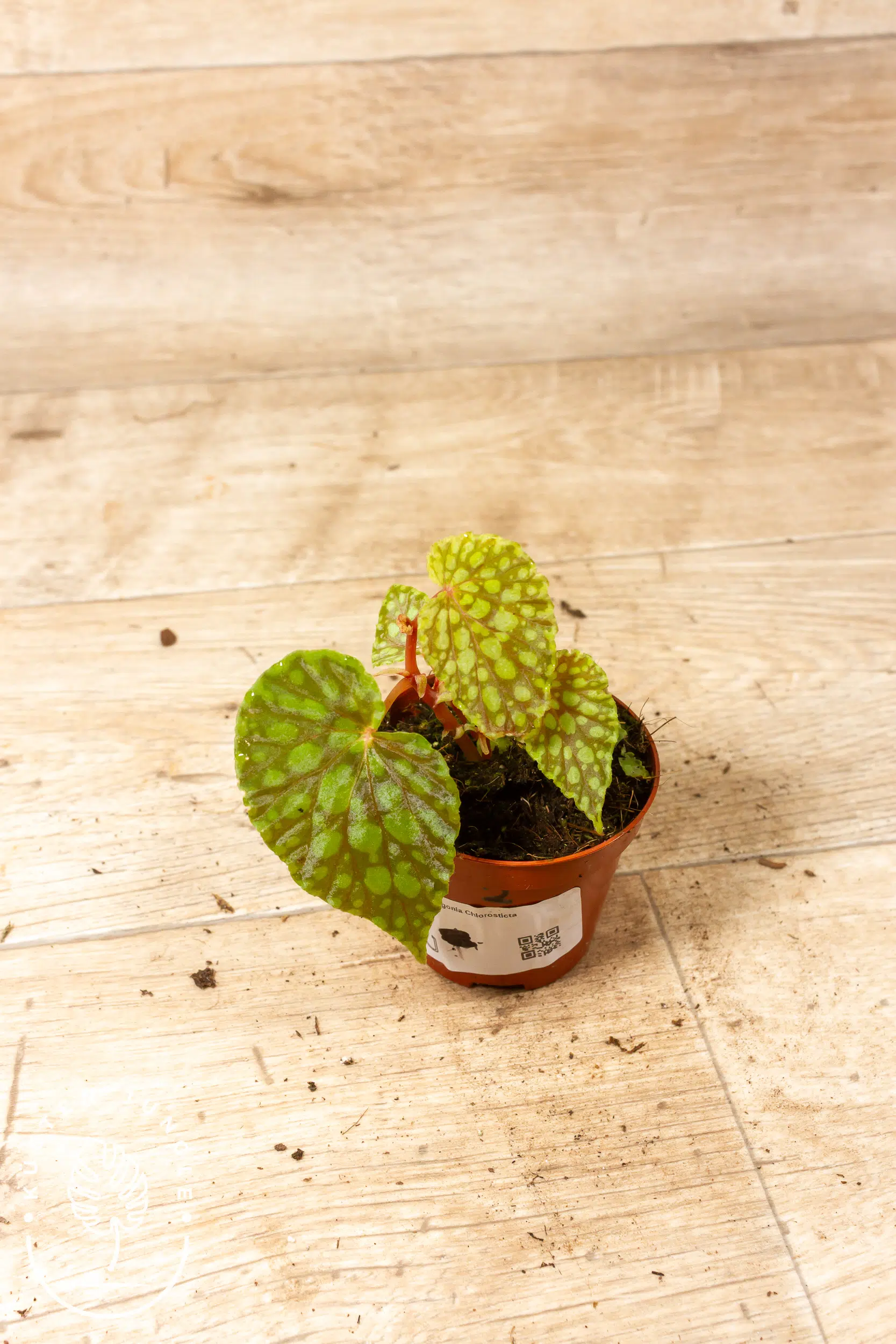
Begonia chlorosticta grows shrub-like and branched, usually reaching a height of up to about 30 cm. The light green leaves only develop their characteristic yellow-green speckles as they age – the pattern is usually barely visible on young leaves. Occasional pruning of the shoot tips keeps the plant compact and bushy, rather than allowing it to grow lanky and one-sided. A distinct dormancy period is not documented, but it grows noticeably slower in winter.
Good to know
Like many begonias, *calocephala* also contains calcium oxalate crystals and can cause irritation if ingested – it's best to keep it out of reach of children and pets.
Begonia chlorosticta originates from central Sarawak on Borneo, where it grows on moist rock slopes and shady cliffs. Its name is derived from the Greek words for „green“ (chloros) and „spotted“ (stiktos), describing its typical leaf pattern. Before its official botanical description, it circulated in the collector trade under the preliminary collection number U038. In addition to the green form described here, there is also a red and a dark („black“) form with different leaf coloration available in trade.
Regularly checking the undersides of leaves is worthwhile, as spider mites and powdery mildew can occur, especially in air that is too dry or stale.