Begonia darthvaderiana - Care
Location & Light
This begonia originates from the floor of dense Dipterocarp forests in Borneo, where only dim, filtered light reaches the forest floor. Accordingly, it is also very adaptable as a houseplant with rather weak, indirect light. Too much brightness tends to fade the deep, almost black leaf color rather than intensify it, which is why a shadier spot is actually advantageous here. Direct sun, however, quickly leads to burns. As a guideline for the genus, tropical shade begonias like this one are considered to be around 40 to 80 µmol/m²/s PAR (PPFD), which corresponds to a DLI of approximately 1.5 to 3.5 mol/m²/day with 10 to 12 hours of lighting.
Pour
The substrate should be kept consistently moist without water standing on the leaves – it's best to water directly at the base rather than over the top of the plant. Stagnant moisture on the leaves particularly favors rot spots in this species. Soft, low-lime water is tolerated much better than hard tap water, and complete drying out of the root ball should be strictly avoided.
Fertilize
When fertilizing, this begonia requires particular restraint: Even small overdoses can noticeably harm it, which is why experienced keepers proceed even more cautiously than is usual for other collector begonias – a highly diluted application every 6 to 8 weeks during the growth phase is the safer choice. General guideline values for the genus Begonia are a pH range of approximately 5.2 to 6.2 and a conductivity of the irrigation water of roughly 0.5 to 1.3 mS/cm; follow the manufacturer's instructions for precise dosage. If the plant is only on a windowsill in autumn and winter, fertilization is completely omitted due to the declining light; however, if it continues to grow year-round under sufficiently bright plant light, fertilization can continue at the already restrained rhythm.
We consciously alternate between different fertilizers for our own plants – currently including COMPO COMPLETE, Foliage Focus, Liquid Gold Leaf, and Hesi TNT-Complex, supplemented with Hesi Root Complex, Hesi PowerZyme, and CalMag as needed.
Substrate
A humus-rich, slightly acidic mixture of sphagnum moss, peat moss, or coco coir with a proportion of mineral components such as perlite or pumice mimics the nutrient-rich but well-aerated forest soil on which this begonia grows in the wild. A good balance between moisture retention and drainage is important so that the roots neither dry out nor remain permanently wet.
Humidity & Temperature
This species is one of the begonias that actually require consistently high humidity—normal indoor air conditions are not sufficient for it in the long run; it only becomes stable at humidity levels of about 70 to 80 %, which is why growing it in a terrarium or greenhouse cabinet is highly recommended. Consistency in temperature is equally important: it thrives best between 21 and 24 °C; it does not tolerate temperatures above about 27 °C or sudden fluctuations well.
Growth & Form
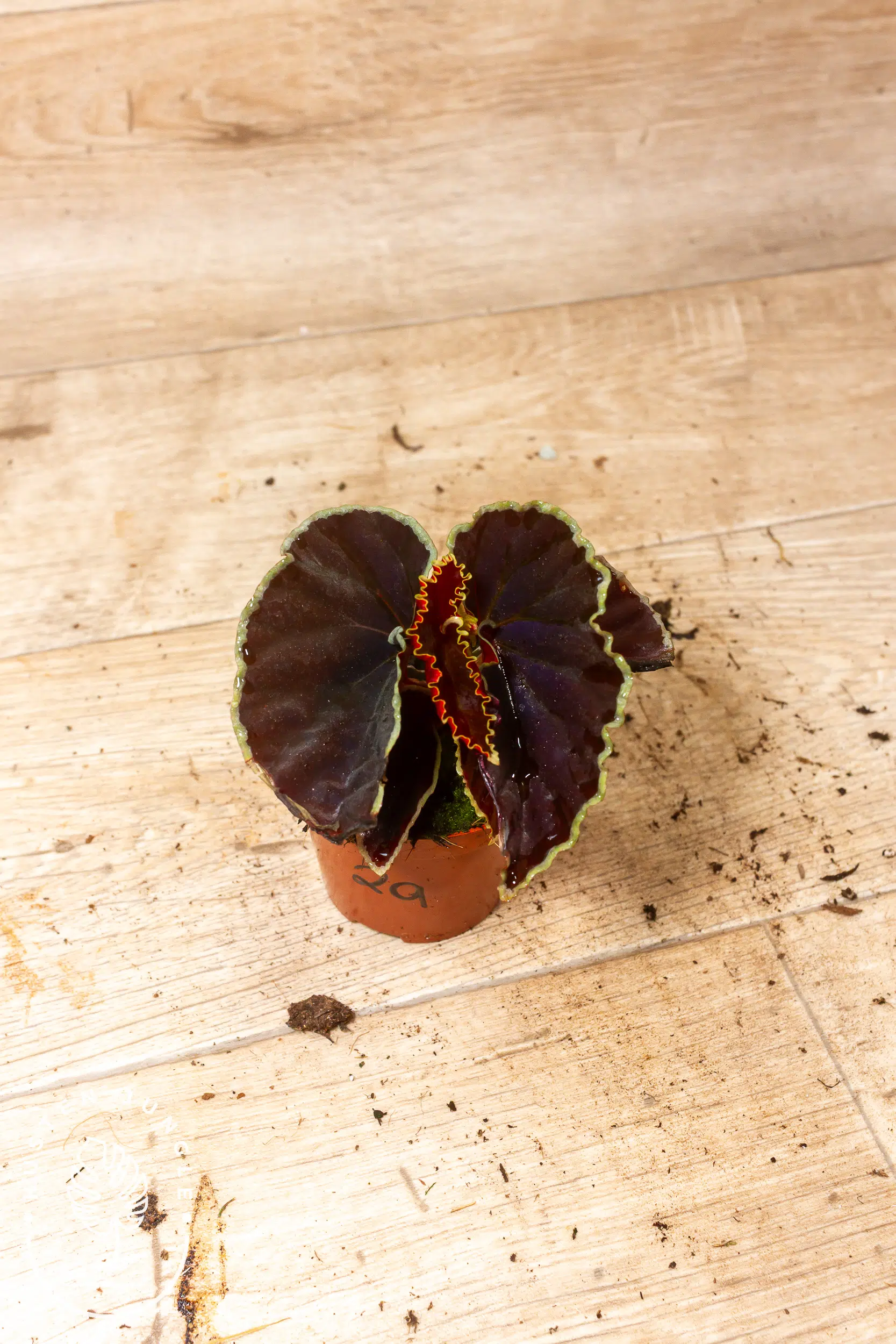
The dark olive to almost black leaves are finely textured and edged with a narrow, silvery shimmering stripe. With good care, delicate pink flowers appear. Over time, the plant can reach a height of around 50 to 60 cm, but usually remains quite slender. A distinct resting phase is not documented; if growth noticeably slows, it's more worthwhile to check light and humidity than to wait for a supposed winter break.
Good to know
Among collectors, Begonia darthvaderiana is considered one of the more challenging Borneo begonias. It tends to „melt,“ for lack of a better term, when environmental conditions change suddenly, usually starting at the leaf tips and spreading without any apparent cause. Those who have experience with more sensitive terrarium begonias, such as Begonia chlorosticta, will find it easier to manage the similarly finicky growth habit of this species. Beginners should be aware of the higher demands.
The dark leaf color, reminiscent of Darth Vader, is what gives it its name. A closely related species, Begonia daunhitam, described in 2020 from West Kalimantan, looks very similar at first glance, but can be distinguished by the absence of the silvery marginal stripe and a more textured leaf surface.
Begonias contain oxalates and are considered irritating to pets and children if ingested – best to place them out of reach.