
Begonia ‚Ginny Galaxy‘ Variegata – Care
Location & Light
The brighter the location, the more clearly the lime green, yellow, and pink leaf sections of this variety will stand out – a spot with plenty of indirect light is particularly worthwhile here. Direct sun should still be avoided, as the light-colored, variegated leaf areas in particular have little chlorophyll for protection and can burn quickly. As a rough guide, the suitable range is around 100 to 200 µmol/m²/s PAR (PPFD), which corresponds to a DLI of approximately 4 to 8 mol/m²/day. If there is too little light, the characteristic patterning will remain paler and less contrasting.
Pour
Water when the top one to two centimeters of the substrate feel dry – regularly, but without the root ball standing in water permanently. Excess water in the saucer should always be drained after watering, as the roots are sensitive to waterlogging. A complete drying out will cause the plant to droop and hang its leaves, but it will usually recover quickly afterward.
Fertilize
Because the variegated leaf parts photosynthesize less effectively than the green parts, ‚Ginny Galaxy‘ Variegata grows more slowly overall than the unvariegated original variety – a highly diluted liquid fertilizer every 4 to 5 weeks during the growing season is therefore sufficient. General guidelines for these cane begonias are a pH range of approximately 5.5 to 6.5 and an electrical conductivity of the irrigation water of roughly 1.0 to 1.4 mS/cm; follow the manufacturer's instructions for precise dosage. If the plant is only placed by the window in autumn and winter, fertilization is reduced or omitted due to the decreasing light; however, if it continues to grow year-round under sufficiently bright plant light, fertilization can continue at the usual rhythm.
We consciously alternate between different fertilizers for our own plants – currently including COMPO COMPLETE, Foliage Focus, Liquid Gold Leaf, and Hesi TNT-Complex, supplemented with Hesi Root Complex, Hesi PowerZyme, and CalMag as needed.
Substrate
A loose, well-draining potting mix with perlite and a little pine bark is perfectly adequate for this begonia. More important than a specific recipe is that water can drain away quickly. A stable pot with sufficient weight at the bottom will keep the bushy plant upright, even with several strong shoots.
Humidity & Temperature
This variety is one of the less demanding begonias in the collection when it comes to humidity: It tolerates normal indoor humidity levels of 40 to 50 % well, but in a greenhouse cabinet or at higher humidity levels around 70 %, it grows even more vigorously and displays more intense colors. The ideal temperature range is between 18 and 24 °C; cold drafts and temperatures below 13 °C should be avoided.
Growth & Form
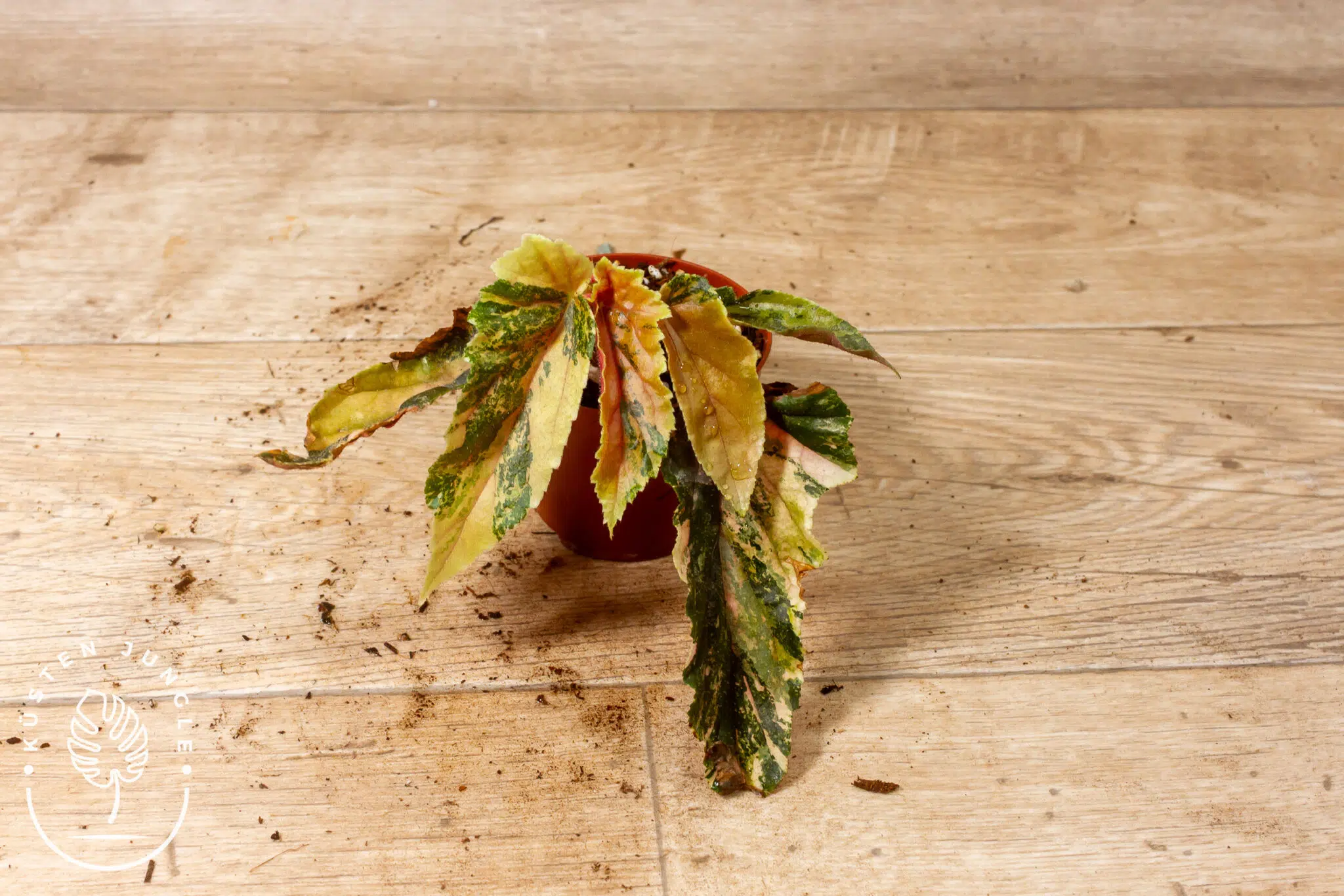
As a shrub-like begonia, ‚Ginny Galaxy‘ Variegata forms multiple upright, bushy, branched shoots over time with lanceolate leaves, the underside of which shimmers a striking reddish color. The color gradient is particularly charming: new leaves start in a delicate lime green, move through a rich yellow, and finally end in a strong rose to pink – no two leaves are exactly alike. With good care, loose panicles of flowers with pink buds additionally appear, from which white, slightly serrated flowers open.
Good to know
‚Ginny Galaxy‘ Variegata is a naturally occurring, variegated sport mutation of the all-green Begonia ‚Ginny‘. Unlike many other variegated plants, its pattern is considered relatively stable; however, occasionally, individual shoots can revert to the unvariegated original form („revert“). Such completely green shoots usually grow more vigorously and should be pruned to prevent them from outcompeting the variegated shoots.
Begonias contain oxalates and are considered irritating to pets and children if consumed – it's best to place them out of reach. Regularly checking the undersides of leaves is also worthwhile, as mealybugs and spider mites are among the more common problems with this genus.