
Begonia ‚Lucifer‘ - Care
Location & Light
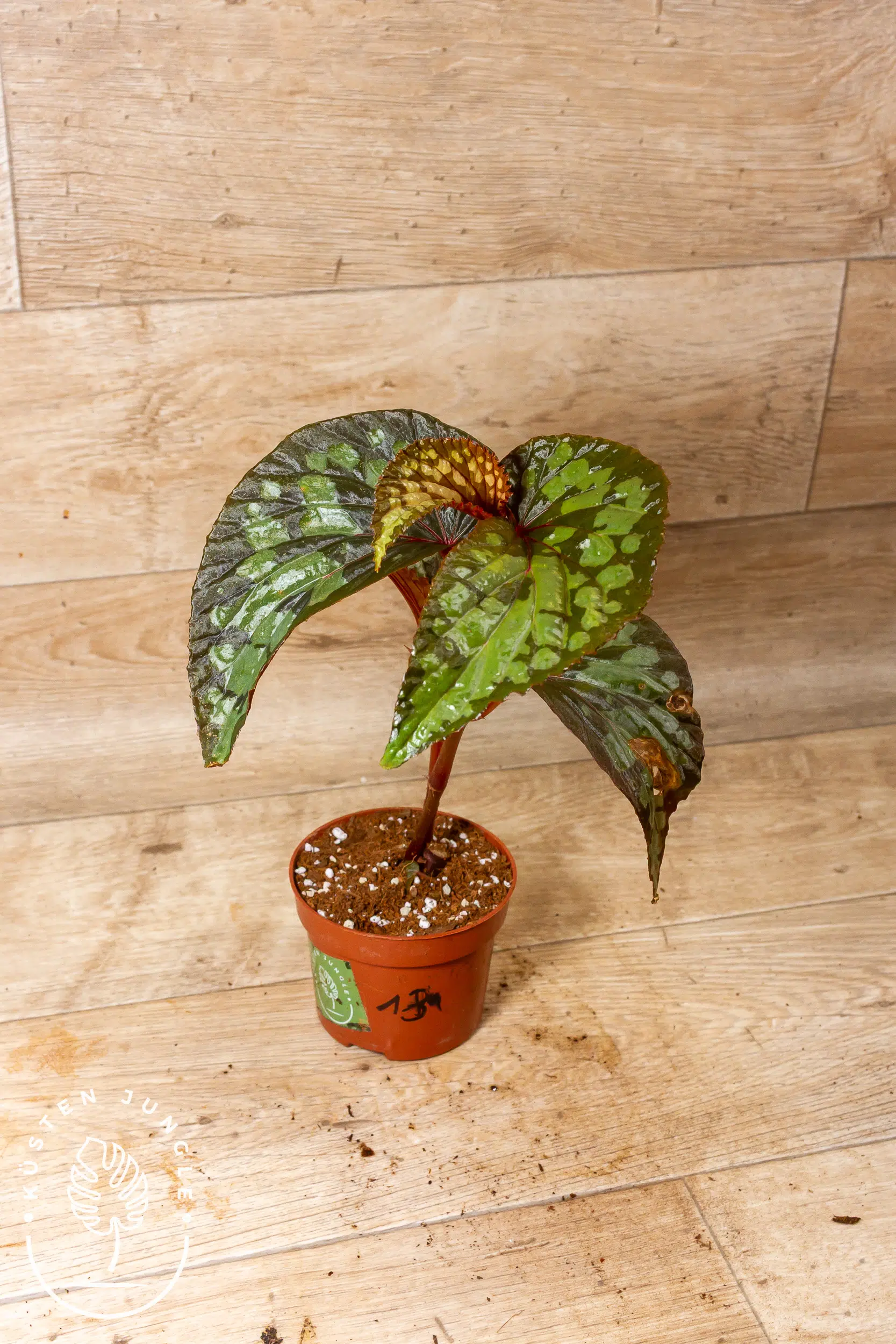
Direct sun hardly forgives ‚Lucifer‘ - its dark, almost black foliage with metallic shimmering spots absorbs sunlight so effectively that it quickly shows sunburn in the strong midday sun. A bright spot with filtered or indirect light, such as in an east or north window, best highlights growth and color contrast. If it stands too dark, growth slows down noticeably and the typical pattern becomes less distinct.
Pour
Water again only when the top 2 to 3 cm of the substrate feel dry – consistently damp or even wet soil can quickly lead to rhizome rot in this Rex Begonia. Water directly onto the substrate, without wetting the leaves, as standing moisture on the leaf surface promotes fungal infections. Soft water at room temperature is much better tolerated than hard tap water, which can otherwise appear as unsightly spots on the rhizome.
Fertilize
During the growth phase, ‚Lucifer‘ manages well with a highly diluted fertilizer application every 4 to 6 weeks; fertilized too concentrated or too often, it reacts with scorched leaf margins rather than more vigorous growth. General guidelines for Rex begonias are a pH range of approximately 5.7 to 6.5 and an electrical conductivity of the irrigation water of roughly 1.0 to 1.5 mS/cm – follow the manufacturer's instructions for the exact amount. If it only grows by the window in autumn and winter, fertilizing is done less frequently or not at all due to the decreasing light; however, under plant lights that are sufficiently bright year-round, fertilizing can continue at the usual pace.
We consciously alternate between different fertilizers for our own plants – currently including COMPO COMPLETE, Foliage Focus, Liquid Gold Leaf, and Hesi TNT-Complex, supplemented with Hesi Root Complex, Hesi PowerZyme, and CalMag as needed.
Substrate
A light, peat-reduced mixture of potting soil, coarse perlite, and some orchid bark keeps the root ball airy without drying out too quickly. A shallow, wide pot is better suited to its creeping rhizome than a deep one – the rhizome should always sit slightly above the substrate surface, as it tends to rot with constant contact with soil.
Humidity & Temperature
In normal indoor air at 40 to 50 %, "Lucifer" holds up well for a while, but its leaf pattern doesn't really come into its own until 60 % or higher —a greenhouse cabinet, a spot in the bathroom, or a humidifier can make a noticeable difference here. Direct spraying of the leaves should be avoided, as moisture left on the leaf surface promotes powdery mildew. In terms of temperature, it thrives best between 18 and 24 °C; below 15 °C or in drafts, it quickly reacts by dropping its leaves.
Growth & Form
As is typical for Rex begonias, ‚Lucifer‘ forms a creeping rhizome, from which the asymmetrical, heart-shaped leaves grow directly. New leaves initially unroll with a red-orange coloration and gradually open up to their characteristic dark, almost black surface with metallic green shimmering spots. The plant remains compact overall and grows wider rather than taller, so that older rhizome sections can also be divided over time to obtain new plants.
Good to know
Under the name ‚Lucifer,‘ a completely different plant circulates in trade alongside this dark-leaved collector's Rex begonia: a sun-loving bedding begonia with shiny bronze leaves and scarlet flowers. This page is exclusively about the Rex variety shown here with its dark, metallic-spotted leaf pattern – the care of the two plants differs fundamentally.
Begonias contain soluble oxalates and are considered irritating to mildly poisonous for pets and children if ingested – it's best to place them out of reach. Regular checks of the undersides of the leaves and the rhizome are also worthwhile, as mealybugs and fungus gnats are among the most common problems if the substrate remains too moist.