
Begonia pavonina – Care
Location & Light
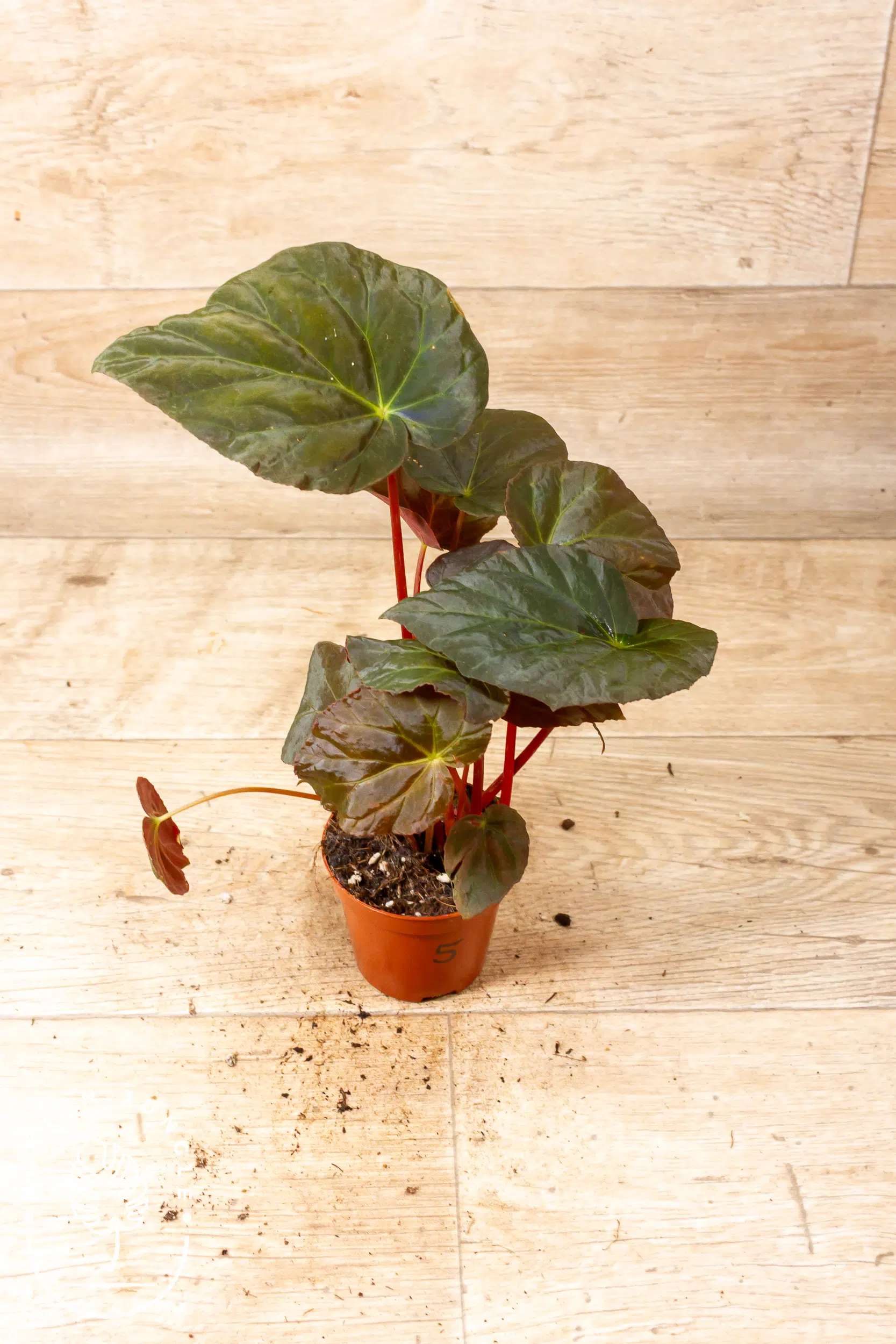
Unlike most houseplants, Begonia pavonina intentionally prefers shady to partly shaded locations – a spot near a north-facing window or further into the room, away from the brightest window area, works well. Its famous blue iridescence is an optical effect from special cell structures in the leaf, which actually fades with too much light: the leaves then appear greenish or bronzy instead of shimmering blue. It cannot tolerate direct sunlight at all; the leaves will quickly burn. Additional plant light, if needed at all, should only be used very sparingly.
Pour
The substrate should remain consistently slightly moist, without ever becoming waterlogged – water again as soon as the top layer of the substrate feels a bit dry. During the active growth phase, the plant requires small amounts of water quite regularly instead of a single large watering. Water should ideally only reach the substrate and not the flowers or leaves, as standing moisture on foliage can quickly lead to rot. In autumn and winter, when growth slows down, watering is reduced noticeably, but the root ball should not be allowed to dry out completely.
Fertilize
The roots of Begonia pavonina are sensitive to fast-acting, undiluted fertilizers, which is why a dose every 4 to 6 weeks with a highly diluted liquid fertilizer (a quarter to a maximum of half the recommended amount) is completely sufficient during the growth phase. As a rough guide, begonias generally require a pH of about 5.2 to 6.0 and a rather low EC of 0.5 to 1.3 mS/cm. For precise dosage, follow the manufacturer's instructions on the respective packaging. If the plant is only placed by a window in autumn and winter, the light becomes weaker and fertilization is reduced accordingly or paused; if, on the other hand, it grows year-round under stable, diffused light conditions in a terrarium, the already restrained rhythm can be maintained without further reduction.
We consciously alternate between different fertilizers for our own plants – currently including COMPO COMPLETE, Foliage Focus, Liquid Gold Leaf, and Hesi TNT-Complex, supplemented with Hesi Root Complex, Hesi PowerZyme, and CalMag as needed.
Substrate
A mixture of sphagnum moss and perlite is most suitable for Begonia pavonina – it retains sufficient moisture while remaining loose and airy enough for excess water to drain quickly. You should avoid heavy, compacting soil, as the fine rhizome roots are sensitive to waterlogging. Repotting is best done in spring at the beginning of the growth phase, and a pot that is significantly too large should be avoided.
Humidity & Temperature
This begonia is native to the humid mountain forests of Malaysia and, as a result, thrives best in high humidity—at levels of about 60 to 65 %, it already appears healthy and vigorous, even without strict terrarium conditions, it can thrive in a normal living room as long as the air isn’t consistently very dry. A humidifier or a spot with consistently higher humidity is often sufficient for this; a closed terrarium is helpful but not absolutely necessary. The ideal temperature range is 20 to 27 °C; some sources describe a significant drop in temperature at night as beneficial, but in practice this is not an absolute requirement for healthy growth—the plant thrives even at fairly consistent room temperatures. Temperatures consistently below 12 °C and prolonged heat above 32 °C should nevertheless be avoided.
Growth & Form
Unlike many compact terrarium begonias, Begonia pavonina does not remain tiny: it grows as an upright, mostly single-stemmed plant and can reach a height of about 40 cm. Since it hardly branches on its own, it can be encouraged to grow bushier by occasionally pruning the tip of the shoot. The iridescent blue shimmer of the leaves is caused by a special cell structure that refracts light, and is not a pigment but a purely physical effect – therefore, the blue hue changes depending on the viewing angle and incidence of light. A distinct resting phase is not documented, but the plant grows noticeably slower in winter.
Good to know
Like many begonias, *Begonia pavonina* contains calcium oxalate crystals and can cause irritation if ingested – it is best placed out of reach of children and pets.
The Begonia pavonina gets its name and the nickname „Peacock Begonia“ from its iridescent blue leaf surface, which is reminiscent of a peacock's plumage; the underside of the leaf, on the other hand, is a vibrant red. The blue effect is created by a special, tower-like arrangement of chloroplast structures in the leaf cells, which bundle light and make photosynthesis more efficient in the shady mountain forests of its native habitat. The species originally comes from the undergrowth of the mountain rainforests on the Malay Peninsula.
Regularly checking the undersides of leaves is worthwhile, as spider mites and powdery mildew can occur, especially in air that is too dry or stale.