
Begonia sp. „Temuyuk Silver“ - Care
Location & Light
Partial to shade, but never direct sun – this is how the Temuyuk Silver feels most comfortable, just like on the shady riverbanks of its natural habitat in the Borneo rainforest. A spot with filtered light, a bit away from the window or under a plant lamp in a terrarium, suits it well. It cannot tolerate direct sunlight, and the sensitive, thin leaves quickly scorch. If there is insufficient light, growth becomes noticeably slower, and the silvery pattern on the leaves becomes less prominent.
Pour
Water as soon as the top 2 to 3 cm of the substrate have dried out – the root ball should then be uniformly moist, but never waterlogged. The Temuyuk Silver is sensitive to both excessive dryness and permanently wet substrate, reacting with root and stem rot; a balanced rhythm is more important here than with more robust houseplants. Room temperature, low-calcium water is best tolerated. Water directly onto the substrate instead of over the leaves to avoid standing moisture on the foliage. In autumn and winter, when growth slows down, water significantly less.
Fertilize
As a dwarf terrarium begonia, the Temuyuk Silver is not a heavy feeder. During the growing phase, a feeding every 4 to 6 weeks with a highly diluted liquid fertilizer (a quarter to a maximum of half the recommended amount) is usually sufficient, as begonias are generally sensitive to high salt concentrations in the substrate. As a rough guide, a pH value of about 5.2 to 6.0 and rather low 0.5 to 1.3 mS/cm are generally considered suitable for begonias. For precise dosage, follow the manufacturer's instructions on the respective packaging. If the Temuyuk Silver is only placed by the window in autumn and winter, the light will be weaker and fertilization should be reduced accordingly or paused. If, on the other hand, it grows year-round under a gently adjusted plant lamp in the terrarium, the usual, already cautious rhythm can be maintained without further reduction.
We consciously alternate between different fertilizers for our own plants – currently including COMPO COMPLETE, Foliage Focus, Liquid Gold Leaf, and Hesi TNT-Complex, supplemented with Hesi Root Complex, Hesi PowerZyme, and CalMag as needed.
Substrate
A slightly acidic, loose, and well-draining substrate is best for Temuyuk Silver – a mixture of sphagnum moss, perlite, and peat-based potting soil works well while still retaining enough moisture. Avoid heavy, compacted soil, as the fine roots are sensitive to waterlogging. A relatively small pot, not much larger than the root ball, also helps ensure the substrate dries out reliably.
Humidity & Temperature
Unlike many hardier houseplants, the Temuyuk Silver cannot tolerate normal indoor air conditions over the long term—it requires consistently high humidity of at least 70 %, preferably 80 to 90 %, to stay healthy. Without these levels, the delicate leaf margins dry out quickly and growth stagnates. A closed or at least partially closed terrarium, a greenhouse cabinet, or a glass dome are the most reliable solutions here; a simple room humidifier is not sufficient in most living spaces to maintain such high humidity levels over the long term. As for temperature, the ideal range is between 20 and 25 °C; cold drafts and temperatures below 15 °C quickly lead to stunted growth.
Growth & Form
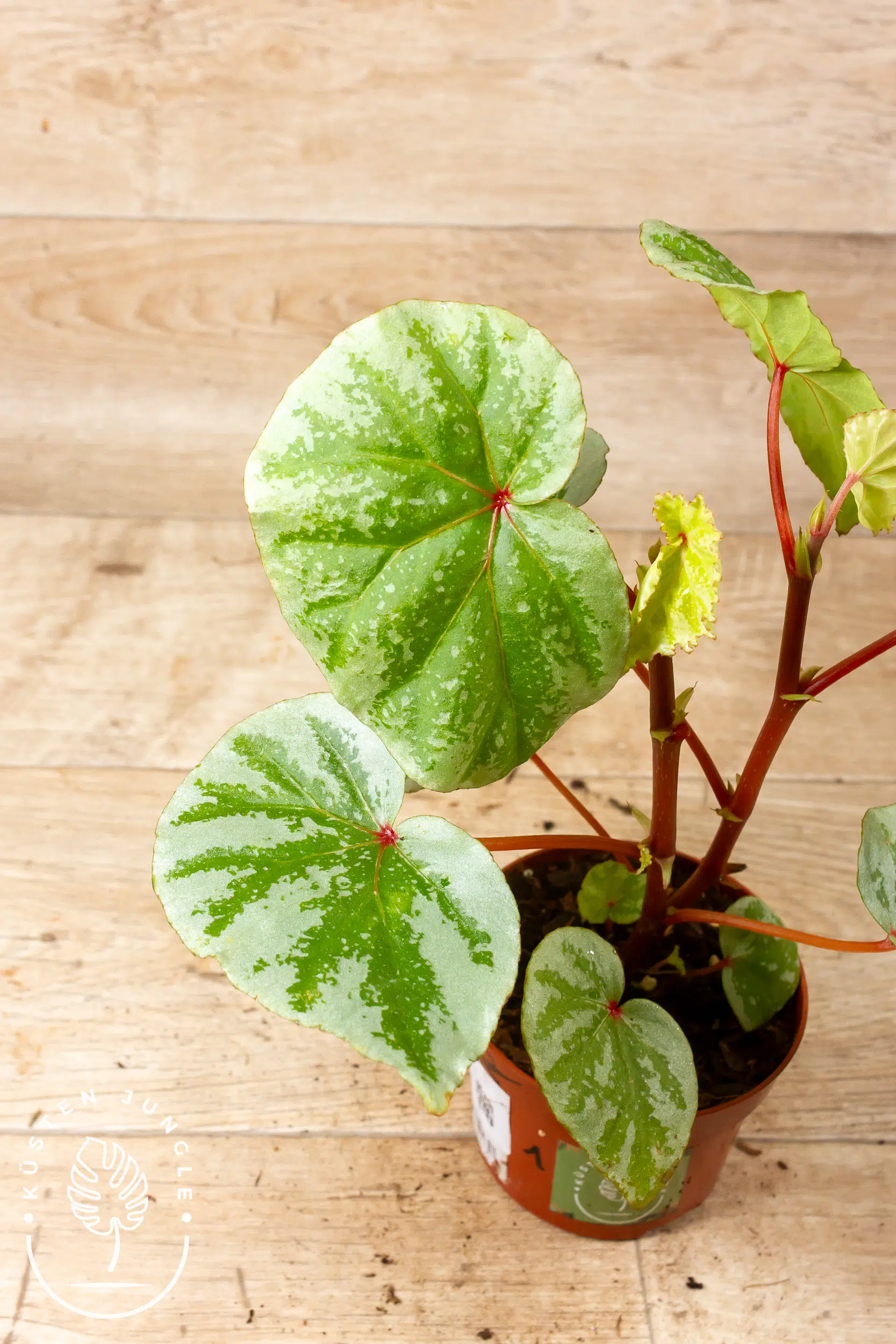
Temuyuk Silver remains very compact at a height of mostly under 20 cm and forms an upright, branched growth with thin, tubular stems (botanically referred to as „cane-type“). Its asymmetrical, slightly crooked leaves show a silvery shimmering surface with light green veins, which shimmer differently depending on the incidence of light – this is a natural characteristic of many begonias from Southeast Asia and not a sign of deficiency. A pronounced resting phase is not documented for this species; if growth noticeably slows down, it is usually due to insufficient light, low humidity, or temperature fluctuations rather than a seasonal break.
Good to know
Like many begonias, Temuyuk Silver also contains calcium oxalate crystals and can cause irritation if consumed – it's best to keep it out of reach of children and pets.
Botanically, Temuyuk Silver belongs to the species *Begonia kapuashuluensis*, named after its region of origin, Kapuas Hulu in Borneo. There, it grows in its natural habitat along riverbanks in humid, shaded forests at altitudes of approximately 100 to 300 meters. „Temuyuk“ refers to the precise discovery region and has become established as a common trade name alongside the official botanical designation; „Silver“ refers to the particularly silvery leaf coloration of this selection.
Regularly checking the undersides of leaves is worthwhile, as spider mites and powdery mildew can occur, especially in air that is too dry or stale.